


Introduction
A lingering chlorine taste in a glass of refrigerator water can make an otherwise convenient dispenser less appealing. A refrigerator filter can improve some aspects of water quality, but its effectiveness depends on the specific cartridge, the contaminants it is certified to reduce, and whether it matches the refrigerator. That is the practical answer to how well do refrigerator water filters work: they can help with listed contaminants and taste concerns, but they are not universal water treatment systems.
The options below include original-brand EveryDrop cartridges and a Waterdrop replacement cartridge, with different certification listings and compatibility details. Those details matter more than a broad claim that a filter makes water clean. Check the refrigerator model and existing cartridge before ordering, then compare the precise contaminant-reduction claims and the replacement schedule. For a broader look at household purifier choices, see our non-RO home water purifier guide; if you are maintaining another replaceable filter, our pitcher filter removal guide covers a different cartridge format.
Product Shortcode

Pros
- Certified NSF 42 performance significantly improves water and ice taste for camp cooking and hydration
- Accurate factory-style fit eliminates worries about loose seals and water leakage inside RV galleys
- Economical 3-pack provides up to 18 months of total filtration for budget-conscious adventurers
- Retains natural minerals that help keep active hikers and campers feeling refreshed on the trail
Cons
- Requires an initial flush of approximately 2.5 gallons to clear loose carbon dust and trapped air
- Targeted for chlorine, taste, and odor reduction rather than removing heavy metals or microbial cysts
- Specific to Filter 3 and Kenmore 9083 housings rather than universal inline water systems
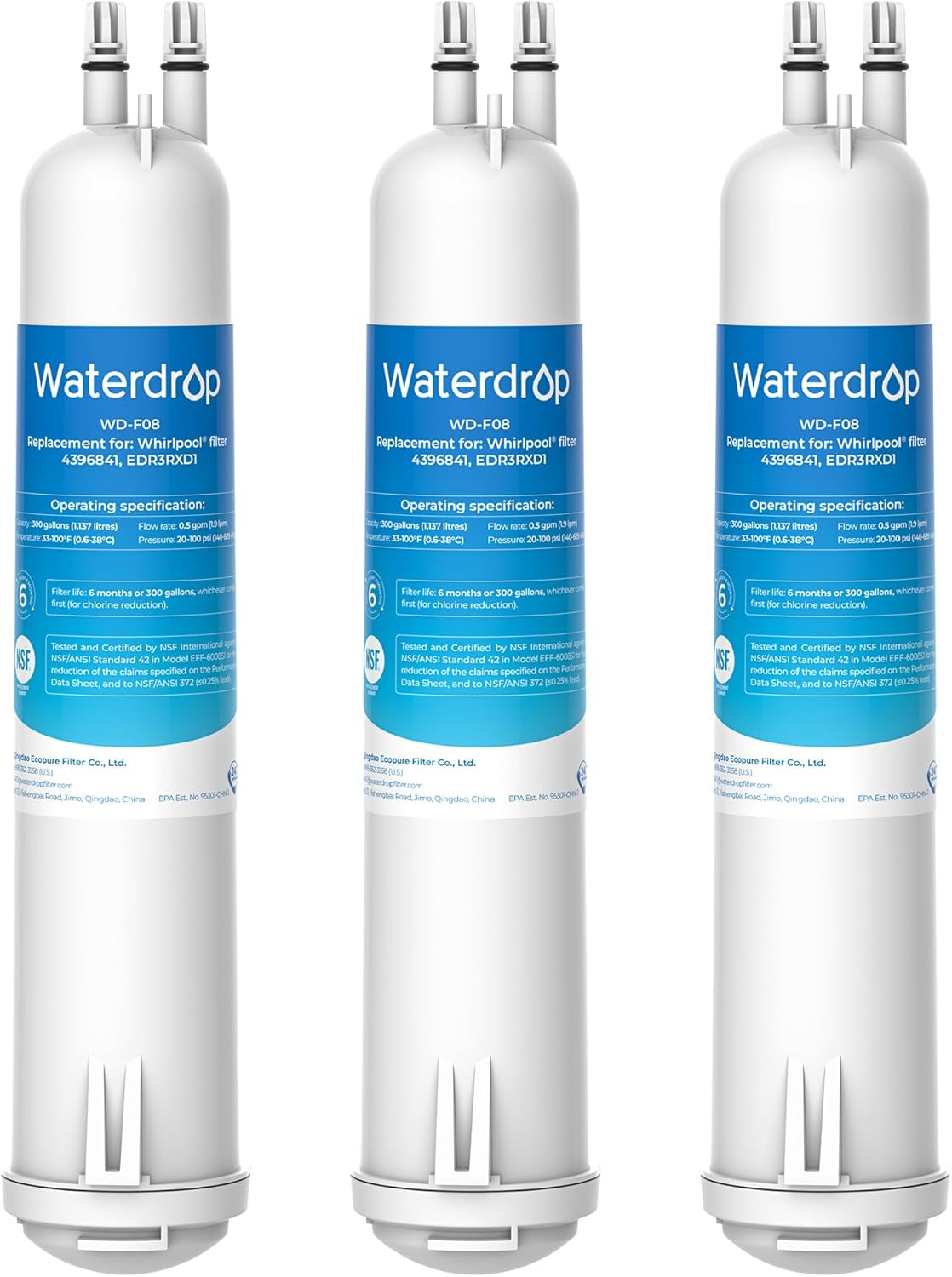
The Waterdrop WD-F08 replacement filter 3-pack is a practical water filtration solution designed to keep drinking water clean, crisp, and refreshing. While portable gravity filters and squeeze systems dominate backcountry trails, maintaining clean water in an RV galley, fifth-wheel trailer, remote hunting cabin, or home basecamp is just as essential. This replacement set is tailored for RV campers with residential-style refrigerators, off-grid cabin owners, weekend warriors, and outdoor families who need reliable drinking water on tap to fill hydration bladders, insulated bottles, and camp coolers before heading into the wild.
Filtration performance relies on a high-density Sri Lankan coconut shell carbon block engineered with expanded surface area and microscopic pores. This design effectively reduces chlorine, bad tastes, and chemical odors while retaining beneficial minerals that help keep hikers and outdoorsmen energized on active days. Certified under NSF 42 and NSF 372 standards for material safety and aesthetic impurity reduction, it provides peace of mind when brewing morning camp coffee or staging clean ice for backcountry coolers.
Build quality and fit precision are critical factors, especially for mobile RV galleys where road vibration can challenge loose water fittings. The filter housing utilizes precision measurement design to mirror original equipment specifications, replacing Everydrop Filter 3, Whirlpool 4396841, and Kenmore 46-9083 models without leaking. Installation requires no tools, twisting cleanly into place so RV travelers and campers can handle quick maintenance stops without hassle.
Day-to-day operation is straightforward, though proper initial priming is required. Following the manufacturer guidelines, running the water dispenser for about five minutes (roughly 2.5 gallons) clears out trapped air and loose carbon fines, preventing water sputtering. Each cartridge delivers a solid service lifespan of 300 gallons or six months of regular use, and the included calendar reminder stickers make it simple to monitor replacement intervals between extended road trips or seasonal camping outings.
As a realistic limitation, this model focuses on chlorine, taste, and odor reduction under NSF 42 rather than removing heavy metals like lead or microbial cysts. For untreated wilderness water or backcountry streams, a specialized outdoor purifier remains necessary. However, for RV campers, basecamp kitchens, and outdoor enthusiasts seeking dependable hydration maintenance at an accessible cost, this 3-pack provides reliable utility and long-lasting value.
Hydration logistics often start long before reaching the trailhead, making clean basecamp water essential for successful expeditions. RV travelers and overland trailer owners who utilize residential refrigeration setups need reliable filtration that withstands the bumps of the road without leaking. Having clean, filtered water on tap simplifies filling multi-gallon jugs, camp hydration reservoirs, and insulated growlers before setting out on day hikes or fishing excursions.
Maintaining optimal water flow and freshness requires minimal effort during the camping season. Always flush approximately 2.5 gallons of water through the system after installing a new cartridge to eliminate carbon particles and purge air bubbles. Affixing the included monthly reminder sticker directly to the filter housing helps you stay on track, ensuring timely replacements every 300 gallons or six months of outdoor travel.

How Refrigerator Filters Work, and What Their Claims Mean
Refrigerator water filters are point-of-use cartridges: water passes through a filter installed in or connected to the appliance before reaching the dispenser or ice maker. The product information here describes activated-carbon filtration, including coconut-shell carbon in the EveryDrop cartridges and a coconut-shell carbon block in the Waterdrop replacement. Such media can affect the water characteristics named in the cartridge’s documentation, but the filter’s actual scope depends on its specific design and verified performance claims.
That means the short answer is conditional. A cartridge may reduce certain contaminants and improve taste or odor if those effects are included in its substantiated claims and it is installed in a compatible refrigerator. It does not follow that every refrigerator filter treats every contaminant, or that a filtered glass is equivalent to water treated by reverse osmosis or a whole-house system. Read the precise claim for the cartridge you are considering rather than relying on the general word “filtered.”
What NSF listings tell you
The supplied product details list the EveryDrop Filter A and Filter 2 as independently certified to NSF standards 42, 53, and 401. In broad terms, these standards address different performance areas, so seeing several standards listed is more informative than seeing a generic certification phrase without the standard numbers. The product description also states that Filter A is certified to reduce 75 potentially harmful contaminants and Filter 2 is certified to reduce 70, including categories such as microplastics, heavy metals, and volatile organic compounds.
Those figures are product-description claims, not a promise that every contaminant is reduced equally or that every installation will produce the same result. Look for the certification and contaminant claims associated with the exact filter model, and check the applicable documentation if you need reduction of a specific substance. A standard number by itself does not tell you that a cartridge addresses every health concern. If a particular contaminant is the reason for buying, verify that it is named for that cartridge.
The Waterdrop replacement listing identifies NSF 42 and NSF 372 certifications. Its supplied information does not list the same NSF 53 and 401 certifications as the EveryDrop cartridges, so do not assume the products have identical certified claims. NSF 42 relates broadly to aesthetic effects, while NSF 372 addresses lead content in materials; a listing for NSF 372 should not be read as proof of lead reduction from the water. For a contaminant-specific decision, distinguish material compliance from a certified reduction claim.
Taste improvement is not the same as treating every water problem
Activated carbon is commonly used to address taste and odor concerns, and the supplied descriptions emphasize crisp-tasting water. But taste is not a reliable way to identify a contaminant or judge whether a cartridge has reduced it. Water can taste acceptable while still containing a substance that matters to a household, and an unpleasant taste does not identify which treatment is needed.
Do not assume a refrigerator cartridge is designed to remove fluoride, dissolved minerals, arsenic, or every PFAS compound unless the exact model’s verified documentation says so. The product information provided here does not establish universal reduction of those substances. If you are concerned about a specific contaminant, consult your local water quality information or appropriate test results, then match the treatment claim to the finding. A refrigerator cartridge is a focused appliance filter, not a substitute for diagnosing an unknown water-quality issue.
Municipal water and private well water can raise different questions. A municipal utility report may help identify substances monitored in the public supply, while private well owners generally need appropriate testing to understand their source water. Neither a filter’s color nor a change in taste establishes that the water is safe. Where a health concern or unusual water condition is involved, use reliable water-quality information and seek qualified advice rather than relying on a basic appliance filter alone.
Matching a cartridge to the refrigerator
Compatibility is a prerequisite, not a minor convenience. The EveryDrop listings identify Filter A for compatible Whirlpool, Maytag, KitchenAid, Amana, and JennAir refrigerators, while the Waterdrop listing describes a replacement for specified Filter 3 and related cartridge references. Those brand and part references do not mean the cartridge fits every refrigerator made by those brands. Refrigerator families can use different filter positions and cartridge designs.
Before buying, check the refrigerator’s manual, model information, and the number or letter printed on the existing cartridge. The EveryDrop description advises matching the package number or letter and color to the installed filter. The Waterdrop description lists specific replacement references, including EDR3RXD1 and Filter 3. Treat that list as a compatibility starting point, then confirm your own appliance’s documentation rather than relying on a similar-looking cartridge.
A cartridge that does not match the appliance can be difficult to install or may not seat as intended. Follow the filter maker’s installation instructions and inspect the connection after replacement for signs of leakage. Do not force a cartridge into a housing or assume that a shared brand name is enough to establish compatibility. If the filter will not engage normally, check the model and instructions before using the dispenser.
What the three listed options distinguish
The EveryDrop Filter A is described as a genuine Whirlpool-family cartridge with three-stage filtration and certifications to NSF 42, 53, and 401. Its product information states that it reduces 75 contaminants and identifies microplastics, heavy metals, and VOCs among the categories. It also specifies replacement every six months or 200 gallons. That schedule is the manufacturer’s stated guidance for this cartridge, not a universal interval for every refrigerator filter.
The Waterdrop EDR3RXD1 replacement is intended for the specified Filter 3 references and is listed with NSF 42 and NSF 372 certifications. Its description gives a service-life guideline of 300 gallons or six months, depending on water conditions, and includes installation stickers to help track the change date. These details may appeal to a buyer looking for a replacement cartridge for a listed compatible appliance, but the certification set and stated claims differ from the EveryDrop options. Check the precise model match and the treatment claim you need.
The EveryDrop Filter 2 is a separate cartridge, identified by its orange color and EDR2RXD1 reference. Its listing names 70 potentially harmful contaminants and NSF 42, 53, and 401 certifications, along with replacement guidance of six months or 200 gallons. It is not interchangeable with Filter A merely because both are EveryDrop products. Confirm the cartridge number and appliance model before choosing between them.
All three options are described as using coconut-shell-derived carbon media, but that shared material does not make their fit, certifications, capacity guidance, or contaminant claims interchangeable. The EveryDrop descriptions also identify a twist-in installation design, while the Waterdrop listing describes tool-free installation. Use the actual instructions for the selected cartridge and refrigerator. Product names and family resemblance are not substitutes for checking the model reference.
Replacement timing affects the result
Filter life is limited by time, water volume, and the conditions of the incoming water. The supplied EveryDrop guidance says to replace its listed filters every six months or 200 gallons, while Waterdrop lists 300 gallons or six months depending on water conditions. These are product-specific schedules. Follow the instructions for your selected cartridge and refrigerator, including any appliance indicator guidance.
A change indicator can be useful, but it should be understood as a maintenance prompt rather than a direct measurement of every contaminant in the water. If the dispenser flow changes or the water’s taste shifts, those observations may justify checking the cartridge and appliance instructions, but they do not identify the cause on their own. A cartridge can also be due for replacement even when the water still tastes normal. Keep a record of the installation date so elapsed time is not left to memory.
Skipping a replacement can undermine the performance the manufacturer specifies for a fresh cartridge. Replacing too often can add unnecessary expense, while using a cartridge beyond its stated service guidance may leave the household uncertain about its remaining capacity. The supplied schedules give both time and gallon limits, so use the limit that applies first according to the product instructions. Water conditions matter, especially where the incoming supply differs from typical municipal water.
After installing a new filter, follow the manufacturer’s flushing instructions before drinking the water or using ice. The exact flush procedure is not provided in the product data here, so use the instructions packaged with the cartridge rather than guessing at a volume or duration. Check that the cartridge is seated as directed and that no leak is visible. If the appliance continues to show a filter alert or the dispenser behaves unexpectedly, consult its manual.
Interpreting flow, taste, and ice changes
A slower dispenser after a cartridge change does not automatically prove the filter is defective. Possible explanations include an incorrect cartridge, incomplete installation, air in the line, or a filter that needs the manufacturer-directed flushing process. The available product data does not provide flow-rate measurements for these cartridges, so it would be misleading to assign a normal gallons-per-minute target or diagnose a specific pressure loss from the product names alone.
Start by checking the filter reference against the refrigerator manual and confirming that the cartridge was installed as directed. Then follow the appliance’s instructions for flushing and dispensing water. If flow remains poor, consult the refrigerator manual or manufacturer support, since the cause may involve the appliance or water supply rather than the cartridge. Avoid altering plumbing or bypassing safety components based on a guess.
Changes in taste or odor also deserve careful interpretation. A cartridge’s listed purpose can include improving taste, but a new or persistent odor may originate upstream, from the refrigerator, or from a water-quality issue outside the filter’s stated scope. Compare the water at another tap only if doing so is practical and safe, and use local water-quality information when the concern involves a possible contaminant. A refrigerator filter cannot diagnose the source of a problem by itself.
Ice can also reflect water that has been sitting in the appliance or a maintenance issue unrelated to the cartridge’s certified claims. Follow the refrigerator’s cleaning and ice-discard guidance after filter service. If an unusual odor or taste continues, do not keep replacing cartridges without checking the appliance instructions and source-water information. Persistent or health-related concerns call for appropriate water testing or qualified help.
How to decide whether a refrigerator filter is enough
A refrigerator filter may be a sensible point-of-use choice when the goal matches a cartridge’s documented performance and the appliance is compatible. It is convenient for dispenser water and ice, and the listed replacement cycles provide a manageable maintenance reference. Buyers should compare the specific standard and contaminant claims, not just brand reputation or the number of claims in a product description. Verify the model against the refrigerator before considering other features.
It is not enough when the water concern falls outside the cartridge’s verified scope, when treatment is needed at multiple taps, or when the supply has an unresolved safety issue. A refrigerator cartridge treats only water routed through that appliance. It does not protect other fixtures, and it should not be treated as disinfection for microbiologically unsafe water. A broader treatment approach may require a different technology selected for the identified water condition.
Buyers who need a specific reduction claim should read the product documentation closely and look for the exact cartridge model in the supporting certification information. The supplied details give different standards and stated capacities for the EveryDrop and Waterdrop products, so comparing them requires attention to those distinctions. Do not infer that a cartridge certified to one standard has the same claims as a cartridge carrying additional standards. If the documentation does not establish the reduction you need, choose a system with clear support for that claim or seek qualified guidance.
A useful comparison with refrigerator cartridges is how other point-of-use formats fit into household routines. Our inline water filter installation guide covers a different application, while its broader lesson is to confirm the intended filter type and follow the specific equipment instructions. That is especially relevant when a household is considering filtration beyond the refrigerator dispenser. A filter designed for one location should not be assumed suitable for another.
A practical way to judge performance
Judge a refrigerator filter by whether it matches the appliance, has credible documentation for the concern at hand, and is maintained within its stated service guidance. Taste improvement can be useful, but it is only one part of performance and cannot confirm removal of a health-related contaminant. The exact standards, named reduction claims, and capacity instructions matter more than broad promises. Keep those details tied to the specific cartridge rather than generalizing across a product brand.
For the options listed here, the two EveryDrop cartridges have broader stated certification listings than the Waterdrop replacement, while Waterdrop lists different NSF certifications and a different gallon guidance. That is a distinction in the supplied product data, not proof that one is universally better. The best match depends on refrigerator compatibility and the contaminant or taste concern you are trying to address. If either remains uncertain, verify the model and claims before ordering.
In short, refrigerator water filters can work well for the specific purposes their documentation supports, especially when the correct cartridge is installed and replaced on schedule. They cannot be assumed to solve every water-quality problem or replace testing when a contaminant concern is specific. Match the filter to the refrigerator, verify the exact certification and reduction claim, and follow the appliance’s maintenance instructions. That gives a more dependable basis for deciding whether a refrigerator cartridge is enough.


Write Your Review
No reviews yet. Be the first to share your experience!