


A faucet-mounted filter can be a practical way to get filtered water at the sink, but installation depends on the faucet outlet. If the filter does not match the aerator connection, forcing it can damage threads or leave a poor seal. This guide explains how to attach pur water filter to faucet models, what to check before installation, and how to tell whether a faucet is compatible.
The supplied PUR models are described as tool-free installations for most standard faucets with visible external aerators. They are not listed as compatible with pull-out faucets or faucets with internal aerators. For a broader look at home treatment options, see this non-RO home water purifier guide. If your setup involves a recreational vehicle, this inline RV filter installation guide covers a different type of connection.


Pros
- Quick, tool-free installation fits standard threaded RV and cabin faucets
- Convenient dual-mode switch preserves filter life during camp cleanup
- Lightweight and compact design stores easily in camp kitchen containers
- Built-in electronic sensor clearly indicates when it is time for a filter swap
Cons
- Incompatible with pull-out faucets and fixtures featuring internal aerators
- Plastic adapter threads require careful alignment to prevent accidental cross-threading
- Designed only for treated tap water sources, not for wilderness stream purification
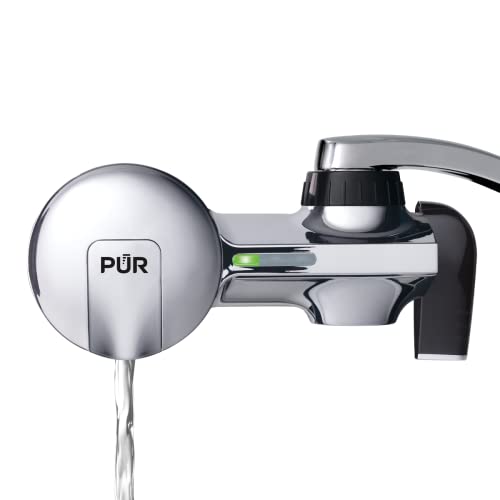
The PUR Plus Horizontal Faucet Mount Water Filtration System is a compact point-of-use tap filter engineered for standard threaded faucets, making it a practical water upgrade for RV campers, travel trailer owners, cabin visitors, and campers staying at serviced campgrounds. While backcountry backpackers rely on hollow-fiber squeeze filters and gravity bags for remote streams, road trippers and family campers frequently connect to campground spigots with questionable taste or older park piping. This faucet system attaches directly to an existing spout to provide certified reduction of lead, chlorine, and dozens of physical substances right at your galley sink.
Campground performance centers on day-to-day usability and steady water flow. The integrated switch lever lets you effortlessly toggle between unfiltered flow for scrubbing cast-iron skillets and filtered water for filling hydration bladders, brewing morning campfire coffee, or prepping camp meals. With support for source water up to 1000 PPM TDS, it reliably tackles typical municipal or park campground connections. The internal filter cartridge is certified for up to 100 gallons or about three months of regular use, which easily covers a full season of weekend camping trips or an extended cross-country road trip before needing replacement.
Weighing under three-quarters of a pound and measuring roughly 6.75 inches long, the housing adds virtually zero penalty to your vehicle cargo weight and slips neatly into a camp kitchen bin or campervan utility drawer. The system includes three common adapter fittings to match typical externally threaded spouts. The metallic grey housing looks tidy in small camper galleys, while the natural mineral and ion-exchange core improves overall taste. An integrated electronic indicator light tracks filter lifespan, flashing when it is time to install a fresh cartridge so you never drink through an expired core.
Despite its convenience around organized campgrounds and cabins, this faucet unit has practical limitations. It requires a pressurized faucet with an external aerator thread, meaning it will not mount to flexible pull-out spray faucets, commercial spray wands, or non-threaded outdoor hose bibs without third-party adapters. Campers should also exercise care when threading the plastic collar onto metal RV spouts to avoid cross-threading. Most importantly, this unit is engineered for microbiologically safe, municipally treated water and is not designed to eliminate wild bacteria or protozoan cysts from wilderness lakes.
For family campers, overlanders, RV travelers, and cabin dwellers who want great-tasting tap water without loading down the vehicle with single-use plastic water bottles, the PUR Plus faucet filter delivers excellent utility and certified filtration. It keeps your galley sink uncluttered, clears out unpleasant chemical odors from park water systems, and keeps fresh hydration flowing all season long.
Installation requires no tools or plumbing experience, making it convenient for quick setups at rental cabins or seasonal RV sites. You simply unscrew the existing aerator from your faucet spout, select the matching adapter ring from the included set, and thread the filter housing firmly into place by hand.
Before purchasing for a campervan or travel trailer, verify that your galley faucet uses a standard visible external thread. Sinks featuring hidden internal aerators or pull-down spray heads are not compatible with this mount style.
Maintaining the system on the road is straightforward. Wipe down the exterior housing with a damp microfiber cloth to remove mineral spots or grease from camp cooking. Never run hot water through the filter side of the switch, as excessive heat can degrade the internal filtration media.
If storing your camper or gear tote for the winter, remove the filter cartridge, allow the housing to drain completely, and let the components dry thoroughly to prevent freezing damage or mildew buildup during the off-season.

Pros
- Tool-free snap-on installation fits standard faucets quickly with included adapter rings
- NSF and WQA certified to reduce lead, heavy metals, and off-tasting well or campground water
- Convenient bypass lever preserves filter capacity during dish washing and cookware cleaning
- Visual LED filter life indicator eliminates guesswork on replacement timing
Cons
- Filtered water stream has a noticeably slower flow rate compared to standard tap pressure
- Incompatible with pull-out spray wands, handheld faucets, and non-standard designer spouts
- Plastic housing requires careful draining before winter camping to avoid freeze damage
The PUR Plus Vertical Faucet-Mount Water Filtration System offers a compact, on-tap solution for improving water quality in stationary camp kitchens, basecamp cabins, and recreational vehicles. RV campers, camper van dwellers, overland travelers, and budget-conscious road trippers often face unpredictable water quality at public campgrounds and rural dump stations. This system delivers certified filtration right at the spout, making it a practical upgrade for family campers and travelers who want clean drinking water without stockpiling single-use plastic jugs.
According to product specifications and user feedback, this system uses a genuine PUR Plus 3-in-1 filter certified by NSF and WQA to reduce lead, microplastics, and up to 70 chemical and physical impurities. For campers hooking up to questionable well water or highly chlorinated municipal RV park supplies, the activated carbon and ion exchange media noticeably improve odor and crispness. The filtration rate is naturally slower than raw faucet pressure, which is standard for lead-reducing media, but users report it fills camp kettles and hydration bladders within a reasonable timeframe.
Constructed from lightweight grey molded plastic with a vertical profile, the filter unit measures roughly 6.4 by 2.8 by 5.4 inches and weighs only 1.2 pounds, preserving valuable sink clearance in compact camper galleys. The package includes multiple threaded adapters designed to secure onto standard exterior-threaded or interior-threaded faucets without tools. A lateral on/off toggle lets you bypass the filter during dishwashing to maximize the 100-gallon cartridge life, while a built-in LED indicator blinks green or red to signal cartridge health.
Setting up the filter takes mere minutes at the campsite: unscrew your standard aerator, select the matching adapter ring, and click the housing onto the spout until it snaps into place. Maintenance simply involves a quick cartridge flush prior to first use and replacing the filter core after roughly three months of steady use. However, RVers and seasonal campers should note that this unit is not compatible with pull-out sprayer wands or custom non-standard faucets. Additionally, freezing temperatures can crack plastic housings holding residual water, so the unit should always be unclipped and drained before cold-weather transit or winter storage.
For weekend warriors, full-time RV families, and emergency preparedness kits, the PUR Plus faucet system provides dependable, cost-effective water security. While ultralight backpackers will need portable squeeze filters or gravity bags, travelers operating out of camper vans, travel trailers, or off-grid cabins with pressurized plumbing will appreciate having clean, great-tasting water on demand.
Installing the PUR Plus system requires no tools, which is particularly helpful when outfitting a travel trailer or basecamp sink. The filter body connects via a push-click mechanism after attaching one of the included adapter rings onto standard threaded spouts.
Campers should verify their faucet type before purchasing. The system fits standard vertical faucets with either external or internal threading, but it will not seat properly on pull-out spray faucets, handheld pull-down faucets, or faucets with built-in non-removable aerators common in some luxury motorhomes.
Routine maintenance involves swapping the filter cartridge approximately every 100 gallons or when the built-in LED indicator turns red. Flushing the new cartridge with cold water for five minutes before use clears loose carbon fines and primes the filtration media.
For outdoor adventurers and RV owners, freeze protection is critical. The plastic housing and internal water chamber must be detached and completely drained before temperatures dip below 34 degrees Fahrenheit, as freezing water inside the core can damage the seals or crack the housing during shoulder-season camping.
Attaching a Faucet-Mount Filter Without Forcing the Connection
Most faucet-mount filters attach at the faucet outlet, where the aerator normally sits. The key checks are whether the aerator is external and removable, whether the filter includes an adapter suited to the faucet threads, and whether the installed housing clears the sink. Product descriptions can establish broad compatibility, but the faucet itself still needs inspection before you begin.
Confirm the faucet has a removable external aerator
PUR lists its horizontal and vertical faucet-mount systems as compatible with most standard faucets that have visible external aerators. An external aerator is the fitting at the end of the spout, often with a textured edge or flat surface that can be unscrewed. Some faucets instead use recessed or internal aerators, while pull-out and handheld faucet heads have different outlet arrangements.
Look closely at the faucet tip before buying or fitting a filter. If there is no visible removable aerator, do not assume an adapter will solve the mismatch. The supplied PUR descriptions specifically exclude internal-aerator and pull-out faucet types, so those designs are a reason to stop and check the manufacturer’s compatibility information rather than apply force.
Faucet appearance alone does not confirm thread size or adapter fit. If the aerator will not turn by hand, use caution and avoid gripping the faucet finish with tools that could scratch it. A faucet manual or the faucet maker’s support information may identify the aerator type, and the filter’s included adapter instructions should identify which connection is intended.
Remove the aerator and prepare the outlet
Once compatibility appears likely, remove the faucet aerator according to the faucet and filter instructions. Keep any washers or small pieces together so they are not lost, and note how the original aerator was seated. The filter connection needs a clean, unobstructed outlet; grit or a crooked washer can interfere with a secure connection.
Do not use excessive force to loosen a stuck fitting. Faucet finishes and aerator threads can be damaged by inappropriate tools or strong twisting. If the fitting will not release with reasonable hand pressure, consult the faucet manufacturer or a qualified plumber instead of risking a damaged spout.
Check the filter package for the adapter and washer options provided for the specific model. The supplied product descriptions do not identify exact thread dimensions or list every included adapter, so it would be unsafe to assume one adapter arrangement works for all faucets. Follow the model’s instructions and use only the parts intended for that connection.
Seat the adapter and attach the filter housing
Choose the adapter indicated by the product instructions for the faucet outlet. Start the connection gently and keep the adapter square to the threads. If it catches, binds, or begins to cross-thread, stop and realign it rather than tightening harder. A fitting that starts crooked may leak or damage the faucet connection.
After the adapter is seated as instructed, attach the filter assembly to it. The PUR product listings describe quick, tool-free installation, so a wrench should not be needed for routine attachment unless the specific instructions say otherwise. Tightening beyond the manufacturer’s guidance can stress plastic components or threads without improving the seal.
Anglepingping’s three-pack faucet filter listing describes installation on faucets in a stated diameter range and says setup is intended to be simple. That description does not establish that the product shares PUR’s adapter design or compatibility limits. Check its supplied instructions and package contents separately, and do not transfer PUR installation assumptions to another brand.
Orient the mounted unit so it does not obstruct ordinary sink use or place leverage on the faucet. The PUR horizontal and vertical models differ in housing orientation, while the product listing for the horizontal version describes an on/off lever for selecting filtered water. Make sure any control can move freely and that the housing does not collide with the sink basin or nearby dishes.
Flush, Inspect, and Use the Filter as Intended
Follow the model’s startup and flushing instructions
After attachment, follow the exact startup directions included with the filter. Faucet-mounted cartridges commonly have preparation steps, but the supplied information here does not specify a flush volume or duration for each model. Do not invent a flushing schedule; use the product manual, including any direction about which control position to select during startup.
Watch the first water flow and inspect the adapter and housing connection for drips. If water appears around the faucet threads, turn off the flow and recheck whether the adapter and washer are positioned as instructed. A persistent leak is not a reason to keep tightening indefinitely. Disassemble and correct the connection, or contact the manufacturer if the cause is unclear.
Check that the unit remains secure when the faucet is operated normally. A filter that shifts or hangs at an angle may have an unsuitable connection, a missing or misplaced adapter, or interference from the faucet design. Stop using it if it cannot be mounted securely, since a strained connection can worsen over time.
Use the filter’s bypass or selection control as described in its instructions. PUR’s listed horizontal system includes an on/off lever for on-demand filtered water; the precise operating positions should be confirmed in the manual for the model in hand. Do not assume every faucet filter routes water in the same way or that every water outlet is filtered.
Filtered faucet systems are point-of-use devices, not whole-home treatment systems. They do not automatically address every water concern, and a product’s broad marketing language is not a substitute for checking the specific contaminant claims and supporting certifications. If a particular contaminant is the reason for purchase, verify that the exact model is certified or otherwise documented for reduction of that contaminant.
Know the listed capacity and replacement signal
The PUR faucet-mount listings state that the included filter is rated for up to 100 gallons or three months of regular use, and they describe a filter-change light. Those are manufacturer-listed limits, not a guarantee that every household will reach the same service duration. Follow the earlier limit reached and the instructions supplied with the replacement cartridge and system.
Replacement timing matters because a faucet filter is a consumable system. A change light can serve as a useful reminder, but it does not identify every possible water-quality issue or replace the cartridge’s rated capacity guidance. Keep track of installation timing and use so the cartridge is not treated as permanent equipment.
Check replacement cartridge compatibility by matching the cartridge to the specific filter housing and model. Similar product names do not prove that cartridges are interchangeable. The product information provided identifies genuine PUR filters for the PUR systems, so check the product documentation before purchasing a replacement or substituting another cartridge.
Some buyers may prefer the PUR model because its listing describes a change light and a stated capacity. Others may be comparing simple faucet attachments, such as the Anglepingping three-pack listing, which describes multiple media but does not provide the same stated capacity information in the supplied details. Compare documentation, replacement availability, and supported claims rather than assuming all faucet-mounted products have equivalent service intervals.
What the Product Listings Say About Filtration
Separate listed claims from verified needs
The PUR PLUS product descriptions state that the system uses a three-in-one filter and describe reduction of lead and other chemical and physical substances. One listing also attributes certifications to WQA and NSF and mentions microplastics. These are manufacturer-supplied product claims; shoppers should verify the exact model and contaminant claims in current certification records or product documentation before relying on them.
The Anglepingping listing describes media including activated carbon, zeolite, non-woven fabric, calcium sulfite, and maifan stones, and claims reduction of sediment, rust, chlorine, discoloration, and odors. The supplied information does not provide named third-party certification details or contaminant reduction percentages for that product. Treat the listed media and claims as product-description information, not proof that the filter addresses every health-related contaminant.
Activated carbon filtration is often selected to address taste and odor concerns, but a generic mention of carbon does not establish reduction of lead, fluoride, arsenic, or every other dissolved contaminant. The filter’s exact tested and certified claims matter. If a water report identifies a specific concern, choose a device with documentation that expressly covers it rather than inferring performance from the word “purifier.”
Municipal water customers can consult the local water provider’s Consumer Confidence Report for system-level information, while private well owners generally need appropriate laboratory testing to understand their water. A faucet filter should be matched to the identified issue and maintained according to its capacity. If testing indicates a health concern that the filter is not documented to reduce, seek guidance from local public health authorities or a qualified water treatment professional.
Basic faucet-mounted filtration should not be treated as disinfection. It does not make microbiologically unsafe water safe to drink unless the specific product is explicitly designed and documented for that use. Follow boil-water advisories and public health instructions; do not rely on a standard faucet filter to override them.
Troubleshooting a Faucet Filter That Will Not Attach
Resolve leaks, loose fittings, and poor alignment
A drip at the faucet connection usually calls for checking the adapter, washer, and alignment before assuming the cartridge is defective. Turn off the water, then inspect the connection in accordance with the product instructions. A washer that is absent, pinched, or seated incorrectly can prevent a proper seal, while cross-threading can create a leak even when the fitting feels tight.
If the adapter repeatedly loosens, confirm that the faucet type is supported and that the correct supplied adapter was selected. Do not add improvised tape, sealant, or extra washers unless the manufacturer specifically directs it. Unapproved materials may interfere with the connection or contaminate the water path.
A leak from the filter housing rather than the faucet adapter points to a different connection. Review the model’s assembly instructions and inspect the housing for visible damage, misassembly, or a poorly seated component. Stop using the unit if the housing is cracked or the leak persists after correct assembly, and contact the manufacturer for next steps.
Reduced water flow can result from an installation issue, a control setting, or a cartridge that has reached its replacement point, but the supplied product data does not specify diagnostic flow thresholds. Check that the control is in the intended position and consult the change indicator and capacity instructions. Avoid assuming that reduced flow proves a particular contaminant has been removed or that the filter is functioning correctly.
Recognize when the faucet is the limitation
Some faucets simply are not suitable for a faucet-mounted housing. Pull-out sprayers, handheld heads, and internal aerators are specifically outside the listed PUR compatibility. An adapter cannot necessarily overcome a faucet whose outlet moves, lacks accessible threads, or has a connection design the filter maker does not support.
In that case, consider a different treatment format only after checking the actual installation requirements. An under-sink unit or pitcher may avoid the faucet-tip compatibility problem, but each has its own space, cartridge, and maintenance needs. A guide to removing a pitcher filter cartridge explains one routine maintenance task for that alternative format.
Do not modify plumbing or faucet components just to force a filter onto an unsupported connection. If an installation requires changes to supply lines, shutoff valves, or fixed plumbing, follow local requirements and consult a licensed plumber when appropriate. Faucet-mounted products are intended to connect at the outlet, so substantial plumbing alterations are outside the simple attachment described by these listings.
Keep the Installation Reliable
Periodically check the attachment for movement or visible drips, particularly after removing and reinstalling the filter. Follow the product’s cleaning and cartridge replacement directions, and avoid disassembling parts that the manual does not identify as user-serviceable. A small leak should be addressed promptly rather than ignored beneath a frequently used sink.
When the filter is removed, reinstall the original aerator if it remains in good condition and the faucet instructions permit it. Store adapters and washers together so they are available if the filter is mounted again. If a fitting or washer is damaged, use the manufacturer’s specified replacement rather than an improvised substitute.
The simplest reliable installation is the one that matches the faucet type, uses the correct included adapter, and follows the model’s startup and replacement directions. For PUR, that means starting with a visible external aerator and avoiding pull-out or internal-aerator faucets. If the connection will not seat securely or the product’s contaminant documentation does not match your water concern, pause and choose a suitable alternative instead of forcing the setup.





Write Your Review
No reviews yet. Be the first to share your experience!