

Pitching a shelter on solid rock, wooden platforms, or frozen terrain often leaves campers wondering how to secure their gear when standard pegs cannot penetrate the ground. While ground pegs remain the standard method for anchoring outdoor shelters, campers frequently encounter hard surfaces or forgotten gear bags that force an urgent question: can you set up a tent without stakes? The short answer is yes, provided your shelter features a freestanding frame capable of holding its shape independently. Many campers who rely on easy setup camping tents appreciate that self-supporting pole systems stay upright on almost any level surface without initial staking.
Even though a self-supporting canopy can hold its structure on concrete, sand, or packed dirt, an unsecured shelter remains vulnerable to sudden wind gusts and heavy rain. Setting up without stakes requires alternative anchoring methods, such as utilizing heavy rocks, logs, gear sacks, or guyline tension against nearby trees. Understanding the difference between freestanding designs and non-freestanding trekking-pole shelters helps you plan your campsite safely. Learning how to balance natural ballast with structural tension ensures your sleeping quarters stay protected throughout the night.

Pros
- Pre-attached frame allows lightning-fast setup and takedown by a single person
- Generous 73-inch peak height provides true stand-up comfort for taller campers
- Solid all-around waterproofing with 2000mm fly and 3500mm rugged floor fabric
- Excellent airflow through four mesh windows and a breezy stargazing mesh roof
- Integrated E-port makes running power cords to lanterns or fans clean and simple
Cons
- Packed length of over 43 inches can be bulky for compact car trunks
- Included standard stakes may struggle in loose sand or rocky soil without upgrades
- Best suited for car camping and short walks, not suitable for backpacking due to frame weight
The HINSTANT 6-Person Instant Camping Tent is an instant-pitch cabin shelter designed to eliminate the usual hassles of assembling loose tent poles at the campsite. Featuring a pre-attached framework that pops into place in about a minute, this shelter is tailored specifically for family campers, car campers, weekend warriors, and first-time adventurers. It easily accommodates up to a king-size air mattress or several sleeping pads, making it an appealing pick for parents with kids, couples seeking a comfortable glamping setup, or festival goers who want shelter ready before sunset.
Living space is a primary highlight of this cabin design. With floor dimensions spanning 10 feet by 9 feet and a peak height stretching up to 73 inches, most adult campers can comfortably stand straight, stretch out, and change clothes without crouching. The pre-assembled frame utilizes galvanized metal poles treated to resist rust and corrosion, paired with heavy-duty internal spring buttons engineered to endure repeated collapsing and extending. Packing down is streamlined by the included expandable storage bag, reducing the usual struggle of wrestling rolled fabric back into an undersized sack.
When unexpected weather blows into camp, the shelter relies on a 190T polyester taffeta rainfly treated with a 2000mm polyurethane waterproof coating. Fully taped seams along the fly prevent moisture from sneaking through needle holes during heavy downpours. Down below, the rugged floor is constructed from 120-gram PE fabric rated to 3500mm of water resistance, creating an effective barrier against wet ground and morning dew. To handle brisk gusts, the package includes eight sturdy ground stakes and four adjustable guyline ropes to keep the cabin structure anchored securely.
Summer comfort depends heavily on airflow, and this tent addresses condensation and heat buildup with four oversized mesh windows and a wide mesh ceiling. The breathable B3 micro-mesh screens out no-see-ums and mosquitoes while facilitating cross-ventilation to keep internal temperatures manageable. Leaving the rainfly off provides an unobstructed view for stargazing right from your sleeping bag. Thoughtful touches such as smooth waterproof zippers, interior storage organizing pockets, and a zippered electrical access port allow campers to route extension cords for camp fans or devices without compromising bug defense.
While this instant cabin performs admirably for established campgrounds and roadside adventures, its 43-inch packed length and steel frame make it strictly a vehicle-dependent shelter rather than a backpacking option. Campers heading into extremely rocky campgrounds may also want to swap the standard ground stakes for heavy-duty forged steel pegs for better penetration. Overall, the HINSTANT 6-Person Instant Tent offers an exceptional blend of rapid setup, generous vertical space, and dependable three-season weather protection, making it a reliable shelter investment for family weekend getaways and car camping trips.
Setting up this shelter takes roughly 60 seconds thanks to the pre-attached pole system. Unfold the tent fabric flat on your groundsheet, extend the telescoping galvanized metal legs until the spring-loaded locking buttons click firmly into place, and secure the rainfly over the top.
Takedown is equally straightforward: release the push-button latches, fold the poles inward, roll the fabric toward the center to expel trapped air, and stow everything neatly inside the oversized expandable zippered carry bag.
Designed to handle unpredictable three-season elements, the rainfly is crafted from 190T polyester taffeta with a 2000mm PU waterproof rating and factory seam taping. The fabric effectively deflects steady rain while keeping internal walls dry.
The heavy-duty 120g PE floor features an elevated 3500mm waterproof coating to resist soaking from water pooling beneath the tent. For windy open terrain, using all four included guylines along with the eight stakes ensures the tall cabin walls stay rigid against gusty weather.


Pros
- Instant pop-up mechanism eliminates manual pole assembly and dramatically speeds up campsite arrival.
- Four-circle folding system creates a 28-inch packed diameter that is more compact than traditional three-circle pop-up designs.
- Dual-door and dual-window layout provides flexible airflow options across warm-weather outings.
- Low total weight of 6.6 pounds with built-in backpack straps allows hands-free transport from vehicle to campsite.
Cons
- Circular 28-inch packed disc shape is awkward for tight spaces and unsuitable for backpacking or trail carrying.
- The 48-inch center height requires adult campers to sit or crouch inside the shelter.
- Trekking poles or upright sticks needed to pitch the front door porch are not included in the package.
The Night Cat Pop-up Camping Tent is an instant-pitch shelter designed primarily for casual car campers, couples, weekend festivalgoers, and small families seeking straightforward campsite logistics. Rather than relying on traditional multi-piece shock-corded poles, this shelter utilizes an integrated, pre-strung flexible frame that automatically springs into full shape when released. This category of tent appeals strongly to first-time buyers and casual outdoor enthusiasts who prioritize minimal setup friction over technical mountaineering features.
In terms of practical space, the interior floor plan measures 9.5 by 6.6 feet (114 by 79 inches) with a peak center height of 48 inches (4 feet). While the listing mentions a stated capacity of 2 to 4 persons and references up to 6 in certain marketing lines, real-world usability tells a more measured story. The footprint can accommodate a standard queen or king mattress, but doing so leaves very little remaining floor space for gear, bags, or foot traffic. For optimal comfort, this floor plan best serves two adults with weekend gear, or two adults accompanied by one or two small children.
Pitching this tent requires minimal effort: you simply unstrap the packed disc, throw the body toward the ground, and allow the 6-mm flexible frame to snap open. Takedown requires learning a specific folding technique that twists the frame like a figure-eight twice into four concentric rings. The manufacturer recommends watching the instructional video and practicing the folding steps before heading outdoors, as collapsible spring-steel frames can feel unintuitive on the first few attempts.
Weather protection centers on a 190T polyester taffeta fabric treated with a listed PU 3000mm waterproof coating, supported by factory-taped seams to resist water penetration through stitching lines. The package includes ground pegs and guylines to anchor the 6-mm stretched frame against light to moderate breezes. For warm days, two large doors and two wide windows allow cross-breezes. The manufacturer specifically highlights that because the shell fabric is tightly sealed for rain protection, keeping door or window vents slightly cracked is essential to prevent natural condensation from collecting along interior walls.
Transportability is shaped entirely by the pop-up design. Weighing 6.6 pounds (3 kg), the tent is relatively light, but it collapses into a wide, flat disc measuring 28 by 28 by 2.8 inches. Night Cat engineered this model to fold into four circles rather than the standard three, trimming roughly 40 percent off traditional pop-up pack diameters. Even with that improvement, the broad circular footprint requires flat trunk space in a vehicle and cannot be packed into a standard hiking backpack, making it strictly a frontcountry or car-camping option.
Ultimately, the Night Cat Pop-up Tent provides a practical, budget-conscious solution for campers who dread traditional pole assembly and stick to moderate three-season weather. Buyers should plan to supply their own trekking poles if they wish to prop open the front door as a shaded porch, and they should confirm that the 48-inch seated ceiling height and circular pack dimensions align with their campsite comfort expectations.
The core appeal of the Night Cat Pop-up Tent is its rapid spring-loaded pitch. After removing the tent from its circular carry case and releasing the retention strap, tossing the shelter onto a clear patch of ground allows the integrated 6-mm poles to fully expand in seconds. Once open, campers simply need to drive the included pegs into the ground and tension the guylines to secure the shelter against wind movement.
Folding the shelter back into its bag requires a specific figure-eight twist repeated twice. Because the frame flexes into four concentric circles to achieve its 28-inch packed profile, the tension can feel stiff on initial attempts. Practicing the folding sequence at home before traveling prevents frustration at the campsite, and referring to the manufacturer-provided video guide helps clarify the necessary hand placements.
With interior floor dimensions of 9.5 by 6.6 feet (114 by 79 inches), the tent provides roughly 62.7 square feet of ground space. The manufacturer notes that this area fits a standard queen- or king-size air mattress, making it an attractive setup for couples looking for a quick glamping or weekend layout. When a large mattress is installed, personal gear must generally be placed near the edges or at the foot of the bed.
While product descriptions reference capacities ranging from 2 to 4 adults and up to small family groups, comfortable usable space depends heavily on individual gear volume. Two adults with duffel bags will find generous room, whereas four adults will sleep side-by-side with minimal spare floor area. The 48-inch center height allows comfortable sitting or kneeling, but occupants will need to crouch when changing clothes.
The tent body is built from 190T polyester taffeta with a manufacturer-specified PU 3000mm waterproof rating, complemented by taped seams across the fabric joints. Included ground pegs and guylines anchor the flexible 6-mm frame to improve stability when the wind picks up, though pop-up hoop structures naturally have more flex in high winds than rigid geodesic aluminum frames.
Because the single-wall construction is heavily coated against rain, internal condensation can form when warm, humid breath meets the cooler tent walls. To mitigate moisture buildup, the tent features two large doors and two wide windows. Campers should leave these openings partially unzipped whenever conditions permit to maintain continuous airflow throughout the night.
Pros
- Rapid instant frame mechanism allows fast pitching without threading individual poles.
- Generous 78-inch center height provides excellent vertical clearance and livable cabin volume.
- Adjustable ground vents pair with a full mesh ceiling for effective multi-level airflow.
- Included steel stakes, guylines, and factory-taped rainfly deliver essential pitching components out of the box.
Cons
- Weighing roughly 27.6 pounds, the tent is heavy and strictly suitable for drive-up car camping.
- Sleeping nine occupants requires leaving personal gear outside or in a vehicle.
- Specific packed dimensions and storage bag measurements are not documented in the listing.
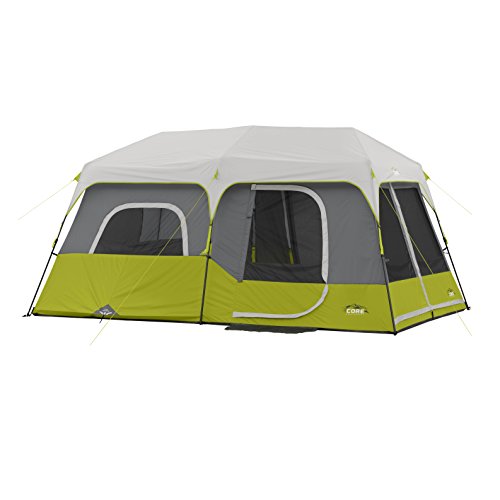
The CORE 9 Person Instant Cabin Tent is an instant-pitch family camping shelter built primarily for drive-up campsites and group car camping. With its pre-attached frame structure and cabin-style vertical walls, this tent caters to families and small groups who prioritize interior headroom and a fast pitch over backcountry portability. Its size and weight clearly mark it as a shelter meant to travel inside a vehicle trunk rather than on a hiking trail.
The tent floor measures 14 by 9 feet (168 by 108 inches) with an interior center height reaching 78 inches. This peak height allows most adults to stand upright comfortably, while the cabin profile maintains usable volume near the perimeter walls. The manufacturer lists the sleeping capacity at up to nine people without gear, or four campers when personal luggage and gear are brought inside. The floor plan is also sized to hold two standard queen-size air beds with room to maneuver around them.
Pitching relies on an instant pop-up mechanism with pre-attached structural poles that extend and lock into place, with setup listed at two minutes or less. The tent incorporates a fully taped rainfly, fully zippered window panels, and integrated interior pockets that keep smaller items off the floor. Structural anchoring is handled by included steel stakes and guylines, which should be properly tensioned to stabilize the shelter against campsite breezes.
For weather management, the tent uses CORE H20 Block Technology, which features 1200mm water-resistant fabric alongside sealed seams. Air circulation is supported by low-profile ground vents that pull cool air from ground level, paired with an expansive mesh ceiling that lets rising warm air escape. While these design choices help combat interior stuffiness, actual weather resistance will depend on proper staking, taut guylines, and prevailing wind conditions.
Weighing approximately 27.6 pounds, this is a substantial piece of gear that requires dedicated vehicle space. Packed dimensions are not detailed in the manufacturer specifications, leaving some uncertainty about exact trunk fit. As with any family tent, ensuring the fabric is completely dry before long-term storage is necessary to prevent fabric damage. Campers should also recognize that sleeping nine people eliminates nearly all interior gear storage.
For car campers seeking a straightforward setup process and generous standing room, this CORE instant cabin tent offers practical dimensions for a family of four with gear or larger groups using separate gear storage. Buyers comparing alternatives should weigh the convenience of the two-minute pre-attached frame against its roughly 27.6-pound pack weight and the need for adequate trunk space.
The tent features pre-attached poles that telescope and click into place, allowing setup in two minutes or less according to manufacturer specifications. Because the frame remains attached to the fabric body, there is no need to thread poles through sleeves or match color-coded sections.
To secure the structure, steel ground stakes and tie-down guylines are included in the package. Taking the tent down involves releasing the frame joints and folding the fabric back down around the collapsed poles for vehicle transport.
With footprint dimensions of 14 by 9 feet, the tent yields a broad interior that can accommodate two queen-size air beds side by side. The upright cabin design and 78-inch peak height ensure adults can walk upright throughout the central area of the tent.
The manufacturer rates total capacity at nine individuals without gear, while stating it comfortably accommodates four people when bags, coolers, and personal gear are stored inside. Built-in wall pockets provide raised organization for flashlights, phones, and small items.
Weather protection is centered around H20 Block Technology, utilizing 1200mm water-resistant fabric, sealed seams, and a fully taped rainfly. Windows feature full zipper closures to prevent rain penetration during storms.
Ventilation is handled via lower intake vents near the ground that pull in cooler air, while an open mesh ceiling facilitates upward heat exhaust to help manage interior humidity and condensation.
Pros
- Freestanding dome framework allows the pitched tent to be shifted without complete take-down.
- Documented PU 2000 coating and taped seams assist with managing rain and surface moisture.
- Double-layer door and roof mesh panels aid in airflow to help limit condensation buildup.
- Complete package includes all necessary poles, stakes, guylines, and a compact carry bag.
- Weighs 5.29 pounds, making it manageable for car camping, festivals, or short walk-in campsites.
Cons
- Interior width of 4 feet 11 inches leaves very little floor area for bulky gear when occupied by two adults.
- The specific material of the tent poles is not detailed in the product specifications.
- Manufacturer notes all-season use, but lightweight PU 2000 dome shelters are typically better aligned with mild to moderate three-season outings.
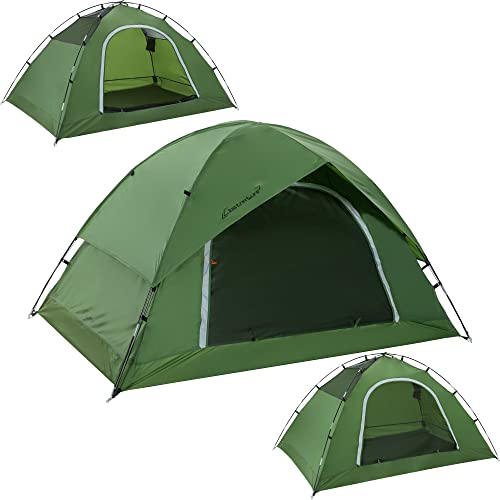
The Clostnature 2-Person Camping Tent is a classic freestanding dome shelter designed for casual campers, weekend festival attendees, and beginners looking for an uncomplicated setup. Built with standard crossing poles and a fitted rainfly, it aims to deliver simple weather protection and convenient portability without unnecessary bulk. While marketed for two people, understanding its specific dimensions and design features is essential for evaluating whether it matches your camping style and campsite expectations.
Regarding interior capacity, the floor measures 7 feet 3 inches in length by 4 feet 11 inches in width, accompanied by a peak height of 3 feet 10 inches (approximately 86.6 by 59.1 by 45.3 inches). For two adults using standard sleeping pads, this width creates close sleeping arrangements with minimal floor space remaining for large packs. Solo campers, however, will enjoy generous interior room to keep clothing, backpacks, and personal items protected indoors. The peak height permits comfortable sitting up for changing or reading, but does not support standing upright.
The structural layout relies on an X-pole dome configuration that makes pitching relatively quick, often completed in under five minutes by one or two people. Because the main tent body is freestanding, you can reposition the shelter around the campsite to avoid rocks or roots before staking it down. Ventilation is addressed through top-side mesh netting and an N-shaped double-layer door that combines solid fabric with breathable mesh, allowing campers to adjust airflow depending on temperature and breeze.
In terms of weather-related design, the tent utilizes polyester with a PU 2000 coating, supported by factory-sealed seams and dual-layer fabric reinforcement at the corners. The included rainfly uses an additional dedicated pole to extend coverage. Transport is straightforward thanks to an included storage sack measuring 16.5 by 6 by 6 inches, with the complete package weighing 5.29 pounds. Routine maintenance requires standard tent care: setting up on cleared ground, securing all eight stakes and four guylines, and ensuring the fabric is completely dry before long-term storage to prevent odor or mildew.
Buyers should account for certain practical trade-offs and missing details. The product data does not list the specific pole material, such as fiberglass or aluminum, which affects long-term resilience. While the manufacturer states all-season and all-weather capability, a compact PU 2000 dome tent is realistic for mild to moderate three-season conditions rather than heavy snow loads or high-wind exposure. Additionally, vestibule square footage is not specified, meaning gear organization mostly depends on available interior space.
For couples embarking on casual weekend car camping trips or solo campers seeking an inexpensive, portable shelter with plenty of elbow room, the Clostnature 2-Person Tent provides solid basic functionality. It balances a light 5.29-pound packed weight with documented seam sealing and dual-layer entry. Those planning extended wilderness trips in unpredictable mountain climates or groups requiring expansive interior living space should evaluate larger multi-person or heavy-duty specialized shelters instead.
The Clostnature tent incorporates a freestanding X-pole dome design, utilizing two main crossing poles to suspend the inner tent body. A third smaller pole is provided to support the rainfly configuration. Because the structure does not rely solely on stake tension to maintain its shape, it can be lifted and moved to adjust orientation before driving stakes into the ground.
The complete package comes with eight stakes and four guylines to anchor the tent against moderate wind. The manufacturer notes that setup can be completed in less than five minutes by one to two people, providing a straightforward pitching process that avoids complex mechanical hubs or automatic spring mechanisms.
Weather-related specifications center on polyester fabric treated with a PU 2000 coating, paired with factory-sealed seams to mitigate water entry along needle holes. The tent base features dual-layer fabric reinforcement at the corners for added durability at high-stress points.
Ventilation is supported by mesh panels located along the upper sides of the tent body, alongside an N-shaped double-layer door. This configuration allows campers to zip open the outer fabric panel while leaving the mesh layer closed, encouraging airflow to help manage condensation during warm or humid evenings.
The interior living area offers floor measurements of 7 feet 3 inches by 4 feet 11 inches, with a center height of 3 feet 10 inches. In metric measurements, this translates to roughly 220 centimeters long, 150 centimeters wide, and 115 centimeters high, providing a functional footprint for up to two sleeping pads.
For packing and transport, the tent compresses into an included storage sack measuring 16.5 by 6 by 6 inches. With an overall listed weight of 5.29 pounds, the shelter is simple to stow in a vehicle trunk or transport on shorter walk-in approaches to a campsite.
The Complete Guide to Pitching and Securing Camping Tents Without Ground Pegs
Pitching an outdoor shelter without driving stakes into the dirt is entirely achievable when using the right shelter design. While traditional setups rely on metal ground pegs to pull fabric taut and resist wind, many camping situations demand alternative tactics. Rocky terrain, solid wooden tent pads, frozen winter soil, and indoor setups eliminate the option of standard peg driving. Understanding the physical principles of tent balance and alternative anchoring allows you to sleep securely regardless of ground conditions.
Freestanding Versus Non-Freestanding Tents: The Structural Difference
The possibility of setting up without stakes depends primarily on whether your shelter uses a freestanding or non-freestanding architecture. Freestanding tents feature an engineered pole skeleton that holds the entire canopy rigid and upright under its own mechanical tension. Classic crossing dome frames, such as the X-pole configuration found on the Clostnature Waterproof Camping Tent for 2 Person, support their own weight without requiring external anchor pull. Once the shock-corded poles snap into the corner grommets, the shelter maintains its complete shape on any flat surface.
In contrast, non-freestanding shelters rely strictly on structural tension created by guyline anchors driven into solid earth. Tunnel tents, minimalist tarps, and trekking-pole shelters collapse instantly into a pile of fabric if their corner stakes lose grip. These lightweight designs trade structural pole rigidity for reduced pack weight, making them entirely dependent on ground resistance. Attempting to pitch a non-freestanding model on solid rock or a wooden deck without extensive anchoring anchor points inevitably leads to structural failure.
Pop-up and instant cabin structures represent another category of self-supporting frames that erect effortlessly without initial stakes. Models like the Night Cat Pop-up Camping Tent use coiled sprung steel or fiberglass hoops that expand outwards immediately upon release. Similarly, larger family shelters with pre-attached metal poles, including the CORE 9 Person Instant Cabin Tent, lock rigid leg joints into place within minutes. Both styles stand firmly on their own, allowing campers to position and orient the shelter before deciding how to secure it against ambient weather.
Why Ground Anchoring Remains Essential for Freestanding Shelters
Setting up a freestanding frame without stakes solves the problem of structural shape, but it does not address environmental stability. A completely unanchored tent essentially acts as a lightweight nylon sail when wind speeds increase. Even a gentle thermal breeze can slide an empty dome tent across a campsite or flip it upside down into nearby brush. Ground contact friction alone provides insufficient resistance against aerodynamic lift created over curved tent roofs.
Anchoring also plays an essential role in preserving interior floor dimensions and sidewall tension. When corner webbing points remain unpulled, bathtub tent floors tend to bunch toward the center, reducing usable sleeping area. Proper perimeter tension prevents occupants from rolling against loose sidewalls and keeps corner seam tape under uniform mechanical stress. Without tension, fabric wrinkles collect moisture and place undue strain on zipper tracks during daily use.
Rainfly separation represents another major reason why securing tension points matters even on self-standing frames. Waterproof rainflies require outward tension to create an insulating air barrier away from breathable inner mesh walls. If wind pushes an unanchored rainfly directly against inner fabric, moisture transfers directly into the sleeping cabin through capillary action. Securing guyout points ensures the outer shell sheds precipitation effectively without compromising interior climate control.
Natural Ballast and Deadman Anchoring on Rocky Terrain
When camping on solid granite slabs or rocky riverbeds where driving stakes proves impossible, natural ballast serves as the primary securing mechanism. Heavy rocks found around the campsite can function as immovable anchor points for both corner webbing loops and external guylines. To secure a corner loop, wrap a guyline around a smooth, heavy rock weighing at least twenty to thirty pounds, then rest it directly against or just outside the corner. Placing a second rock on top of the anchoring cord creates a secure friction clamp that prevents slippage during gusty conditions.
Deadman anchoring offers an exceptionally durable method for tying off guyline tension cords without traditional metal pegs. The technique involves wrapping your guyline securely around a stout log, flat stone, or buried branch before laying it horizontally against natural rock barriers. Instead of relying on vertical holding power like a stake, a deadman anchor resists horizontal pulling forces through broad surface friction. Campers can also bury these weighted objects under piles of scree or gravel to prevent shifting during changing wind patterns.
Fabric protection requires careful attention whenever you incorporate natural stone into your campsite anchoring strategy. Sharp granite edges can abrade thin polyester guylines, slice through corner webbing, or puncture waterproof floor coatings. Always inspect stones for jagged contours before wrapping cordage around them, opting for river-rounded rocks whenever available. You can also place spare camp towels, wool socks, or foam pads between sharp stones and delicate tent fabrics to prevent mechanical wear.
Gear weighting inside the tent cabin provides an immediate defense against sudden updrafts while you construct exterior ballast. Placing heavy duffel bags, loaded backpacks, and sleeping pads into the corners immediately stabilizes the floor against movement. For solo or pair campers, resting water bladders or full hydration jugs against windward corner joints adds reliable downward mass. While interior ballast prevents the tent from blowing away, it should always be paired with external guylines to keep the upper frame from deforming.
Pitching on Wooden Platforms and Hardened Camp Pads
Designated wilderness campgrounds frequently feature elevated wooden tent platforms to protect delicate root systems and prevent soil erosion. Driving metal stakes into these wooden deck boards is strictly prohibited and often physically impossible. Campers facing wooden platforms can utilize specialized anchor hardware such as spring-loaded fishbone anchors or aluminum deck pegs that slip between board gaps. Turning these anchors ninety degrees beneath the planks locks them against the underside of the deck, providing firm upward resistance.
If dedicated platform anchors are unavailable, standard utility cords and guylines can easily secure the shelter to deck structural timbers. Campers can thread cordage through the gaps between wooden planks, looping around crossbeams or joists beneath the platform surface. Tying the cord back to the tent corner rings with adjustable taut-line hitches allows for precise tension adjustment. Platform perimeter rails, support posts, and side steps also serve as sturdy tie-off locations for windward guylines.
Hard-packed asphalt camp pads or indoor setups present identical anchoring limitations where driving pegs is prohibited. In these environments, campers can attach guylines to heavy picnic tables, concrete parking barriers, or weighted water jugs positioned around the perimeter. Smooth indoor floors benefit from placing non-slip rubber mats beneath tent corners to keep pole ends from sliding on polished tile or hardwood. Applying gentle tension against immovable external objects maintains canopy stability without damaging flooring surfaces.
Managing Rain Protection and Condensation Without Ground Stakes
Maintaining adequate tension on the rainfly fabric keeps the outer layer from touching the inner canopy during heavy downpours. In wet environments, setting up heavy duty water resistant shelters without stakes requires creative anchoring to preserve the manufacturer air barrier. When rainfly corners remain slack, pooling water can overwhelm polyurethane coatings and seep through factory-taped seams. Tying rainfly guyout cords to distant weighted rocks pulls the waterproof fly taut, allowing precipitation to run off smoothly.
Ventilation management becomes doubly important when a tent cannot be staked in its standard configuration. Unstaked ground vents often fold inward or collapse against the main canopy, choking off incoming low-level airflow. When warm human breath and ambient ground moisture meet cool tent walls, condensation forms quickly on inner surfaces. Maintaining cross-ventilation requires positioning the tent door into gentle breezes and using guyline tension to keep exterior vent covers propped wide open.
Proper vestibule management poses another distinct obstacle when pitching without traditional ground stakes. Most tent designs rely on staked vestibules to create dry storage porches for muddy boots and packs outside the sleeping quarters. Without stake tension, vestibule fabric sags loosely against the front door zipper, allowing rain to drip directly onto the inner threshold. Campers can overcome this challenge by extending vestibule guy lines to heavy deadman stones or tying them to sturdy trekking poles braced in a tripod layout.
Evaluating Specific Tent Styles for Stakeless Stability
Compact two-person backpacking shelters, such as the Clostnature Waterproof Camping Tent for 2 Person, excel at stakeless setup due to their minimal wind profile. The symmetrical X-pole frame flexes naturally to absorb wind pressure while keeping the rectangular floor completely expanded. Because the total interior volume is modest, placing two sleep pads and a pair of packs inside the cabin provides significant anchoring ballast. The low center of gravity makes small dome shelters far less prone to tipping than tall family cabins.
Pop-up shelters like the Night Cat Pop-up Camping Tent offer rapid convenience on hard ground because their integrated circular frames deploy within seconds. However, the flexible fiberglass coils that make pop-up designs so portable also make them more vulnerable to side gusts. Without stakes, strong breezes can push against the broad sidewalls and compress the flexible frame inward toward the occupants. Utilizing the four exterior guy lines tied to heavy logs or rocks restores necessary sidewall rigidity in exposed terrain.
Instant family cabin shelters provide towering headroom and sprawling floor plans, but their upright walls generate tremendous aerodynamic resistance. The HINSTANT 4/6/8/10 Person Instant Tent features robust thickened metal poles with galvanized coatings that maintain a solid free-standing cabin frame. Nevertheless, an upright cabin standing over six feet tall can act like a billboard in open wind if left unsecured. Campers using large instant frames must anchor all four perimeter corners and upper guyout points to heavy natural ballast before occupying the shelter.
Larger multi-room designs present substantial surface area that catches wind like a sail when unanchored. Campers utilizing spacious outdoor tents with tall center heights must place significant ballast along perimeter points to prevent frame shifting. Shelters like the CORE 9 Person Instant Cabin Tent measure fourteen by nine feet, requiring strategic weighting at multiple frame joints. Combining interior gear loads with external deadman anchors along each leg ensures expansive family shelters remain stable without peg penetration.
Step-by-Step Procedure for Securing a Stakeless Pitch
The first step in executing a secure stakeless pitch is surveying the terrain for natural wind barriers and suitable anchor materials. Look for campsite depressions, large boulders, or dense shrub rows that shield your shelter from prevailing evening gusts. Avoid setting up directly on ridgelines or wind corridors where unanchored fabric faces maximum aerodynamic drag. Gather your anchor rocks, logs, or platform ties before unpacking the tent body so you can secure the structure immediately upon expansion.
Assemble the freestanding pole skeleton and clip the tent body into position according to the manufacturer instructions. As soon as the frame stands upright, immediately drop your heaviest gear bags or filled water containers into the windward interior corners. Never walk away from an erect freestanding tent on hard ground before weighting the inside floor, as a sudden gust can roll the frame away in seconds. Position the tent with its lowest profile or narrowest wall facing directly into the wind to minimize resistance.
Next, rig your alternative corner anchors using heavy rocks, logs, or platform hardware. Tie short lengths of strong utility cord to the corner webbing loops where stakes would normally insert. Wrap the cords around twenty-to-thirty-pound stones positioned about a foot from each corner, using clove hitches or bowline knots to prevent slipping. Ensure the floor fabric pulls smoothly taut without overstressing corner seams, creating a flat and even sleeping foundation.
Finally, drape the rainfly over the frame and secure its interior velcro attachments to the underlying poles before tensioning external guylines. Extend guy cords outward from the tent sidewalls and tie them to heavy boulders or distant deadman anchors at a forty-five-degree angle. Adjust line tension sliders until the rainfly separates cleanly from the inner mesh walls across all panels. Inspect the entire perimeter to confirm the air gap remains unobstructed and the structure resists lateral movement when nudged.
Common Pitfalls When Camping Without Ground Stakes
Underestimating nighttime wind shifts represents one of the most frequent mistakes made when camping without ground stakes. A campsite that feels completely calm at sunset may experience brisk thermal downdrafts or incoming weather fronts in the early morning hours. Relying solely on interior body weight without rigging exterior ballast leaves campers vulnerable to sudden structural deformation. Taking the extra time to build robust exterior rock anchors before sleeping ensures you stay safe through unexpected atmospheric changes.
Another widespread error is selecting anchor rocks that are either too light or dangerously sharp. Stones weighing less than fifteen pounds can easily slide across smooth slickrock when pulled by a taught guyline during heavy gusts. Furthermore, jagged slate or sharp volcanic rock can sever nylon guylines under tension or slice through tent floor coatings underfoot. Always test the mass of your anchor stones and inspect contact points to avoid equipment damage during the night.
Neglecting rainfly perimeter ventilation while trying to secure the fly to ground anchors can cause severe moisture accumulation. When campers pull the fly tight against ground boulders without maintaining an exit path for air, interior humidity spikes rapidly. Stagnant air inside the shelter quickly produces heavy condensation on the waterproof ceiling fabric, which drips onto sleeping bags. Balancing tension with generous air gaps around the lower perimeter keeps the interior dry and breathable.
Practical Takeaways and Camp Verification Checklist
Setting up a camping shelter without ground stakes is a reliable technique when applied to freestanding frames and backed by proper weighting methods. Always verify that your tent architecture is genuinely self-supporting before embarking on trips over rock, sand, or wooden platforms. Use heavy natural ballast, deadman anchors, and interior gear loading in combination rather than relying on a single securing method. Regularly check knot integrity and line tension throughout your stay to accommodate cord stretch or changing wind directions.
Before settling in for the night, perform a comprehensive walk-around inspection of your entire stakeless setup. Confirm that every corner is held flat by substantial ballast, all guylines maintain firm tension against heavy anchors, and the rainfly does not touch the inner canopy. Ensuring that doors zip smoothly without excessive diagonal strain confirms that your alternative anchors provide balanced structural support. With careful preparation and methodical rigging, you can enjoy a safe, comfortable night outdoors on any terrain.




Write Your Review
No reviews yet. Be the first to share your experience!