


Foul tasting water from a remote cabin well or campground spigot quickly spoils morning coffee and leaves stubborn rust stains across cookware. Heavy sediment, lingering chlorine odor, and murky suspended particles also degrade plumbing lines over time. Understanding how to choose and compare water filtration systems lets you identify the right balance between flow rate and filtration precision for clean drinking water. While packing for remote trails calls for specialized portable tools like the best water filter for hunting, managing a basecamp cabin or home tap requires dedicated multi-stage filtration hardware.
System capacity and cartridge lifespan determine how consistently your setup delivers fresh water without sudden drops in line pressure. Multi-stage sediment and carbon blocks tackle coarse debris and chemical tastes, while advanced reverse osmosis purification strips dissolved solids and heavy metals. These systems make filling up gear like the best hydration pack for backpacking fast and reliable before any outing. Careful comparison of micron ratings and automated backwash valves ensures long-term performance across varied water supplies.

Pros
- Alkaline remineralization stage balances pH for refreshing, clean-tasting drinking water
- Operates without electricity using standard water line pressure
- Clear first-stage housing allows easy monitoring of sediment accumulation
- Top-mounted faucet installation eases setup in cramped camper and cabin cabinets
- High 75 GPD output easily supports group camp kitchens and multi-day hydration prep
Cons
- Requires a pressurized water supply, making it unsuitable for unpressurized backcountry streams
- Under-sink footprint and storage tank require dedicated storage space in compact rigs
- Produces standard reverse osmosis wastewater during the purification process
The iSpring RCC7AK is a comprehensive 6-stage under-sink reverse osmosis water filtration system engineered to produce purified drinking water with added alkaline minerals. Designed to operate entirely on water line pressure without electricity, this system provides a dependable water purification solution for fixed basecamps, hunting cabins, RV campers, and home emergency preparedness stations. By combining high-level filtration with a dedicated remineralization stage, it addresses common water quality concerns encountered when sourcing water from diverse campground hookups, rural wells, or municipal systems.
This filtration system is particularly suited for RV campers, overlanders with built-in plumbing, cabin owners, and emergency preparedness planners who need consistent water purification for groups and extended stays. Family campers and weekend warriors who frequently fill large water jugs, hydration bladders, and camp kitchen cookware before heading out to remote trailheads can also benefit from having a high-output purification hub at home or in their mobile setup.
Based on product specifications, the multi-stage setup includes sediment filtration, dual carbon block stages, a reverse osmosis membrane, and an alkaline remineralization stage. It removes contaminants including chlorine, lead, fluoride, PFAS, and heavy metals, while the transparent first-stage canister makes it easy to monitor sediment accumulation from gritty campground supplies. Because the system can produce up to 75 gallons per day and includes a pressurized storage tank, users get on-demand flow suitable for washing produce, boiling camp meals, and filling multiple hydration reservoirs without long waiting times.
In terms of hardware and build quality, the unit features standard quick-connect fittings, color-coded tubing, and a brushed nickel dedicated faucet. The patented top-mounted faucet design allows the faucet to be fastened securely from above the counter, which avoids difficult maneuvering inside tight RV or cabin cabinetry. The included housing wrench and clear manual facilitate DIY installation and regular filter replacements across seasonal outdoor cycles.
A realistic limitation is that reverse osmosis systems require a pressurized water line between 45 and 70 PSI to function efficiently, meaning it cannot filter unpressurized water directly from a backcountry creek without a separate pump. Additionally, the system and its storage tank occupy noticeable space under a sink, which requires thoughtful layout planning in compact camper van conversions or small travel trailers.
For RV travelers, basecamp managers, and emergency preppers seeking dependable water treatment without relying on electrical power, the iSpring RCC7AK offers high-capacity purification and mineral balancing. It serves as a practical, high-volume hydration solution for outdoor enthusiasts who prioritize clean drinking water across their road trips, cabin retreats, and wilderness preparations.
Installing this unit in an RV, overland rig, or off-grid cabin requires a secure under-sink mounting location and adequate water pressure from an onboard 12-volt pump or city water hookup. Quick-connect push fittings make routing the color-coded lines straightforward even in tighter spaces.
Because the top-mounted faucet secures from above the countertop, securing the hardware does not require awkward reaching beneath cramped camper sinks. The included pressurized holding tank ensures that purified drinking water is readily available on demand for filling camp thermoses, boiling trail meals, or quenching thirst after a day on the hiking trail.
Routine maintenance for this reverse osmosis unit involves replacing the pre-filters on a scheduled basis to protect the RO membrane. The transparent first-stage sediment filter lets you see sediment buildup at a glance, which is especially helpful when dealing with varying water quality at different campgrounds or well water sources.
Replacing the three lower pre-filter cartridges is typically recommended every 6 to 12 months depending on water usage and source clarity, while the reverse osmosis membrane and alkaline remineralization filter generally last 1 to 3 years. Winterizing the system by fully draining the storage tank and housing canisters is essential for RV campers and seasonal cabin owners to prevent freezing damage during cold months.

Pros
- Heavy-duty brass thread ports prevent leaks and resist pipe torque during rough plumbing setups
- Generous 15 GPM peak flow maintains steady water pressure across multiple cabin or camp fixtures
- Individual oil-filled pressure gauges and countdown timers make maintenance tracking completely straightforward
- Comes equipped with helpful servicing accessories including housing drain valves, a filter wrench, and a cleaning brush
Cons
- Dry weight of 44 pounds requires a sturdy mounting surface or solid support frame at your campsite or cabin
- System reduces sediment, chemicals, and heavy metals but does not soften hard water or remove dissolved limescale
Providing clean, safe running water for a remote outpost requires equipment that handles tough conditions without choking off flow. The HQUA WF3-01 is a heavy-duty three-stage whole-house filtration unit designed to treat high volumes of incoming water. Utilizing three oversized 20-inch by 4.5-inch Big Blue filter housings mounted on a rigid steel bracket, this setup serves as an exceptional centralized water station for off-grid cabins, hunting lodges, overlanding base stations, RV park hookups, and rural homesteaders preparing for grid disruptions.
Filtration performance is centered around progressive contaminant removal. The first stage deploys a high-density polypropylene sediment cartridge that catches suspended sand, silt, and coarse rust. The second stage uses a compound media blending Granular Activated Carbon with Kinetic Degradation Fluxion (KDF), targeted directly at neutralizing chloramines and capturing heavy metals like lead, mercury, copper, nickel, and chromium. The third stage utilizes a dense carbon block to polish the water, stripping out volatile organic compounds (VOCs), residual chlorine, and foul sulfur or swampy tastes. The result is crystal-clear, odorless water for camp cooking, dishwashing, and drinking.
Build quality stands out in critical plumbing areas where lesser filters fail. A primary failure point in remote water systems is cracked plastic female threads under line stress or high water hammer. HQUA integrates 1-inch FNPT brass thread inserts into the inlet and outlet ports, providing rugged connections that withstand pipe movement and wrench torque. The package also includes adapters to step down to 3/4-inch plumbing lines if needed. Built for operating pressures between 25 and 116 PSI and handling water flow up to 15 gallons per minute, the system easily keeps pace with multiple camp faucets running at once.
Field maintenance is streamlined through several thoughtful features. Individual oil-filled pressure gauges monitor each stage, making it simple to see which cartridge is loading up with debris before water flow slows to a trickle. Built-in bottom drain valves allow users to drain accumulated sediment and empty the heavy canisters before unscrewing them, preventing messy indoor floods or slippery cabin floors. Red pressure relief buttons on top bleed trapped air after servicing, while the included oversized housing wrench and dedicated scrub brush keep routine cartridge changes swift and painless.
While this system excels at clearing sediment, rust, chemicals, and heavy metals, outdoor enthusiasts should understand its practical boundaries. At roughly 44 pounds dry and requiring a space envelope of at least 22 inches wide by 30 inches tall, this is not portable gear for lightweight car trunk camping. It also does not soften hard water or strip out dissolved mineral scale. For those establishing an off-grid cabin retreat, seasonal hunting basecamp, or dependable rural emergency water reserve, the HQUA WF3-01 offers rugged hardware, high-volume capacity, and dependable multi-stage purification.
The core structural strength of this system comes from its heavy gauge mounting bracket, designed to support the significant weight of three fully flooded 20-inch filter housings. Brass connection ports resist cross-threading and cracking under vibration or seasonal pipe movement, making the system far more durable than all-plastic alternatives often used in temporary setups.
With an operating pressure tolerance ranging from 25 to 116 PSI and temperature ratings spanning 40 to 125 degrees Fahrenheit, the system is well-suited for varied outdoor climates. The housings are built from impact-resistant materials that can handle the rigors of off-grid utility rooms, sheltered outdoor pump houses, or dedicated utility trailers.
Regular upkeep is straightforward thanks to the visual pressure gauges and included 180-day countdown timers. When a pressure differential between the inlet and outlet gauges indicates restriction, the bottom drain ports allow you to purge suspended grit or drain the canister before using the supplied wrench to spin off the housing.
For seasonal cabin or basecamp use, winterizing the unit is essential to protect against freezing temperatures. Open the bottom drain valves completely and vent the top air buttons to evacuate all standing water before cold mountain weather sets in. The provided housing brush makes it quick to scrub out algae or fine silt deposits during cartridge changeouts.
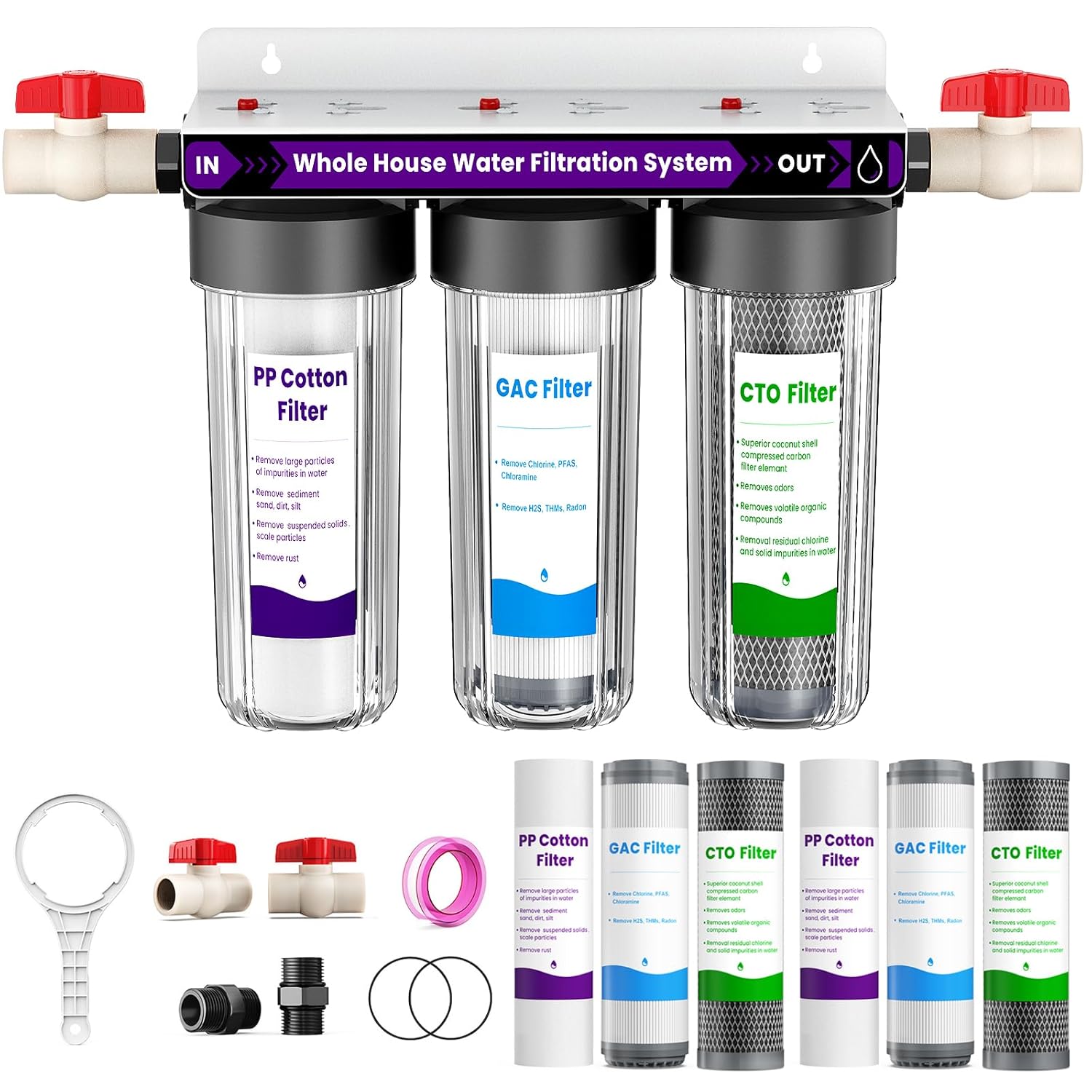
Pros
- Includes two extra replacement filter sets (nine cartridges total) for outstanding long-term value
- See-through filter canisters make it simple to monitor sediment buildup without disassembling the unit
- Strong 15 GPM flow rate prevents water pressure drop across multiple camp or cabin faucets
- Included shut-off valves and housing wrench simplify cartridge swaps in tight utility compartments
Cons
- Does not reduce total dissolved solids (TDS) as it preserves minerals rather than utilizing reverse osmosis
- Weighs over twelve pounds, making it suitable for stationary cabin, RV, or basecamp installations rather than trail packing
- Requires careful thread sealing with the included plumber tape to avoid minor connection leaks
The DYLSDFQ 3-Stage Water Filter System is a high-capacity inline filtration unit engineered to treat incoming water supplies for RV campers, off-grid cabin owners, overlanders with plumbed rigs, and emergency preparedness enthusiasts. Having clean, dependable water is essential whether you are hooked up to an unfamiliar campground spigot with heavy sulfur odors or pumping from a remote well at a family basecamp. This multi-stage setup treats water directly at the main supply line, delivering clean, odor-free water to every faucet, showerhead, and camp kitchen sink.
Real-world performance centers on high-volume flow and thorough sediment and odor reduction. Delivering a fast 15-gallon-per-minute flow rate, the system maintains steady pressure so you do not experience annoying drops while showering or washing cookware. The filtration process utilizes a three-tier sequence: an initial polypropylene sediment filter to catch rust, silt, and pipe scale, followed by a granular activated carbon (GAC) filter and a dense carbon block (CTO) cartridge rated down to 0.5 microns. Based on product specifications and user feedback, this system excels at knocking out strong sulfur smells and chemical chlorine tastes often found in rural well water and public campground connections.
Build quality is rugged and practical for stationary basecamps and mobile rigs alike. The unit features clear filter housings that let campers inspect dirt accumulation at a glance without opening the canisters. Double O-ring seals provide reliable leak resistance under standard line pressure, while the 3/4-inch ports connect readily to standard plumbing fittings or RV hose adapters. The package also supplies two isolation ball valves, a canister wrench, thread sealing tape, and mounting hardware, giving you the key components needed for a tidy utility setup.
Routine maintenance and seasonal handling are straightforward. The included dual shut-off valves allow you to isolate the water line and swap spent cartridges in just a few minutes without draining your entire RV or cabin plumbing system. According to user reviews, having two extra replacement filter sets included right in the box provides exceptional long-term value, covering regular filter changes for many months of outdoor living. For winter camping or off-season storage, draining the clear housings before temperatures drop below freezing is necessary to protect the polymer canisters against frost damage.
While this filtration system is a dependable solution for sediment, taste, and odor issues, outdoor enthusiasts should recognize its operational scope. Because it preserves natural minerals, it will not lower TDS meter readings, nor is it designed to replace a full water softener for severe mineral hardness. At over twelve pounds, it is intended for RV bays, cabins, and homestead basecamps rather than lightweight backcountry trekking. For campers and cabin owners seeking clean, fresh-tasting water from every tap, this three-stage system offers solid durability and excellent long-term convenience.
Campers who travel across different regions frequently encounter unpredictable water quality, from silty well water at remote campgrounds to heavily treated city supplies. Installing this three-stage system in an RV storage bay or off-grid cabin utility wall ensures that all water entering your holding tanks and indoor plumbing is thoroughly pre-filtered. This proactive protection helps keep dirt and grit out of RV water heaters, 12-volt pump diaphragms, and delicate faucet aerators.
Off-grid adventurers will appreciate that the filtration process operates entirely on line pressure without needing electrical power. It functions smoothly with gravity-fed holding tanks, off-grid water pumps, or standard municipal hookups. The integrated dual valves make it quick to shut off water during camp tear-down or when prepping your rig for highway travel.
Maintaining clean water and good pressure requires simple periodic upkeep. Checking the transparent canisters regularly lets you visually gauge when the sediment cartridge is loading up with rust and dirt. In most cabin or RV setups, replacing the cartridges every four to six months maintains optimal flow and taste, and the included housing wrench makes unscrewing the canisters hassle-free.
Winterization is critical for campers in cold climates. Before sub-freezing weather sets in, close the shut-off valves, depressurize the system, unscrew each housing, and drain all standing water completely. Storing the canisters empty and dry during the off-season keeps the O-ring seals pliable and prevents freeze expansion from cracking the housings.

Pros
- Compact tankless design fits neatly under cramped RV galley sinks and tiny basecamp kitchen counters.
- Dual dispensing delivers both remineralized alkaline drinking water and ultra-pure water for brewing camp coffee.
- Built-in UV purification provides peace of mind when hooking up to unverified campground or rural water sources.
- Low wastewater ratio saves water compared to traditional bulky tank-based reverse osmosis setups.
Cons
- Requires a 110V to 240V AC power outlet and pressurized water line, making it unsuitable for primitive backcountry backpacking.
- Initial installation requires running a dedicated faucet hole through your sink or countertop.
- Initial startup needs roughly 20 minutes of carbon flushing before the water runs clear and ready to drink.
The WINGSOL Tankless Reverse Osmosis Water Filter System is a high-performance undersink water purification solution engineered to provide continuous, pristine drinking water. While conventional water filtration for outdoor enthusiasts usually centers on portable squeeze filters or gravity bags, this robust tankless RO unit caters directly to RV campers, overlanders with plumbed rigs, off-grid cabin dwellers, and emergency preparedness planners. Anyone managing an outdoor basecamp or mobile rig knows that tap water from rustic campgrounds, RV parks, or rural wells can vary drastically in quality, taste, and mineral load. This unit eliminates guesswork by purifying pressurized feed water directly at your camp galley sink.
Out in remote basecamps or campground hookups, water quality can range from heavily chlorinated municipal supplies to silt-laden well water carrying potential biological and chemical contaminants. Operating at a brisk 400 gallons per day rating, this filtration system pushes out water fast enough to fill a standard camping canteen or a 12-cup percolator in roughly ten seconds. The multi-stage filtration structure pairs high-density sediment and carbon blocks with a reverse osmosis membrane and automated UV sterilization. Users frequently praise the dual-mode dispensing faucet, which lets you toggle between pure water near zero TDS for clean cooking or remineralized alkaline water infused with essential minerals like calcium and magnesium for balanced hydration after a long day hiking dusty trails.
Space is always at a premium inside a travel trailer, converted camper van, or compact hunting lodge. Traditional reverse osmosis units require cumbersome multi-gallon storage tanks that consume virtually all under-sink cabinet space and risk stagnant water buildup during travel downtime. By utilizing a tankless configuration measuring just 14 inches long by 6 inches wide and 18 inches high, this system reclaims roughly 75 percent of the cabinet footprint. The casing is rugged and clean, while the quick-twist filter housings let you replace filter elements without wrenches or messy spills. Furthermore, the 1.5 to 1 pure-to-drain efficiency ratio wastes substantially less water than typical RO units, helping keep gray water tank levels manageable during extended camping stays.
Setting up the system under a camp sink is straightforward thanks to color-coded quick-connect fittings and included hardware. Most handy campers report smooth installation using an existing accessory hole in the sink deck, such as a retired soap dispenser or side sprayer knockout. Keep in mind that a 20-minute initial flush cycle is necessary to clear out harmless carbon fines before your first glass. For RVers and cabin owners facing freezing mountain winters, winterization is an essential maintenance task. The internal water lines and filter canisters must be completely drained or moved indoors to prevent freeze damage when temperatures dip below freezing, as trapped water expansion can crack filter housings.
If your outdoor adventures involve remote backcountry backpacking where every ounce counts, a lightweight gravity bag or trail straw remains your top choice. However, for RV owners, overlanders with camper builds, hunters maintaining remote basecamps, and homesteaders seeking reliable water security, the WINGSOL Tankless RO system offers exceptional value. It reliably strips out harsh minerals, chlorine odor, and potential contaminants from inconsistent rural hookups, ensuring your camp kitchen serves up fresh, crisp water for cooking hearty campsite meals and brewing the perfect morning camp coffee.
Installing the system in an RV, camper van, or off-grid basecamp requires two primary conditions: a pressurized cold water supply and standard 110-volt household electricity, which can be powered by shore power, a portable generator, or an inverter hooked to a solar battery bank.
Because the unit does not use a bulky storage bladder, it slides neatly alongside galley plumbing without sacrificing precious storage for camp cookware and dry goods. The included dual-action faucet mounts securely through a standard countertop hole, providing a dedicated outlet specifically for drinking and cooking water.
The filtration process works through multiple defense lines, combining polypropylene sediment capture, carbon block absorption, reverse osmosis filtration, and active UV treatment to address over 99 percent of dissolved solids, chemicals, and unwanted tastes.
Unlike standard reverse osmosis systems that strip out all minerals and leave water tasting flat, the integrated remineralization stage adds beneficial elements back into the hydration line. This helps balance pH levels and provides a refreshing, crisp taste that outdoor enthusiasts appreciate when rehydrating after demanding trail treks.
Maintaining top performance across camping seasons is simple thanks to the modular twist-lock filter cartridges. Scheduled replacements can be performed in seconds without turning the under-sink area into a flood zone, making quick tune-ups between road trips completely hassle-free.
For owners operating in seasonal campgrounds or off-grid cabins, proper winterization is critical. Before leaving your rig in freezing mountain temperatures, shut off the feed line, depressurize the faucet, and remove the filter cartridges to store them in a climate-controlled space to prevent internal freezing.
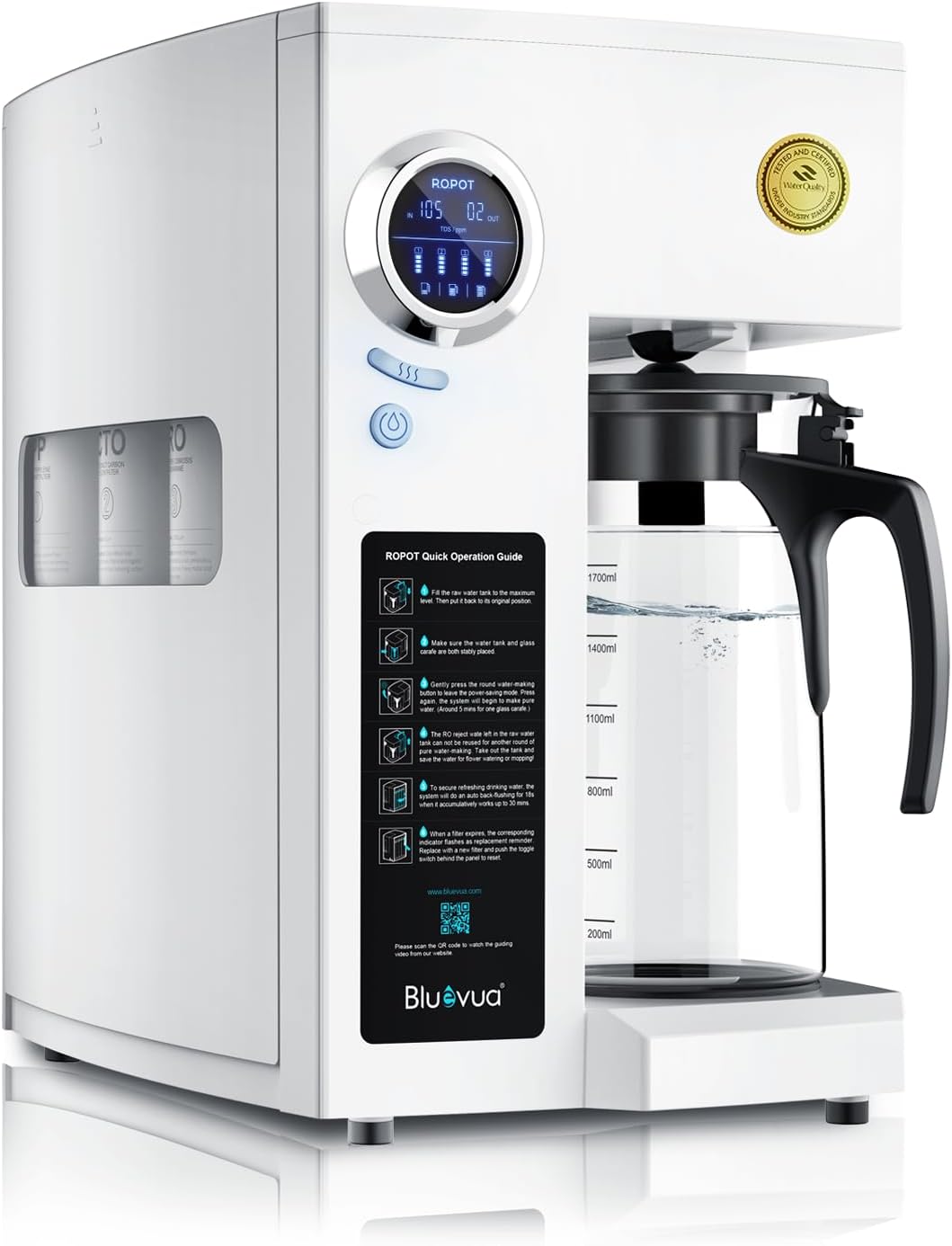
Pros
- Zero plumbing required for quick setup on RV counters, camp tables, or cabin galleys
- Borosilicate glass carafe eliminates plastic taste and protects purified water quality
- Remineralization stage improves water taste and balances essential minerals
- Digital TDS monitor offers instant visibility into filtration performance
- Efficient 2:1 filtration ratio helps preserve water reserves at dry campgrounds
Cons
- Requires a 120V AC electrical outlet or a capable portable power station with an inverter
- Substantial 23-pound weight makes it best suited for vehicle-based camping rather than trail packing
- Residual wastewater tank must be manually dumped after each filtration batch
The Bluevua RO100ROPOT is a standalone countertop reverse osmosis water filtration system designed to produce bottled-quality drinking water wherever you have access to electricity. While reverse osmosis is traditionally reserved for under-sink residential plumbing, this self-contained design bridges the gap for vehicle-supported outdoor travel. It functions as a complete multi-stage filtration station without needing a tap splice, drain saddle, or pressurized plumbing line. For outdoor enthusiasts who spend extended periods on the road or at stationary camps, it provides high-level water security without permanent vehicle modifications.
This system is well suited for RV campers, overland trailer travelers, hunt cabin owners, glamping setups, and emergency preparedness planners. Campers who frequent state parks or remote campgrounds often encounter tap water with unpleasant sulfur tastes, heavy chlorine, or high mineral hardness. When connected to campground shore power, an onboard generator, or a high-capacity portable power station, this system easily handles questionable municipal or well spigots. It also serves solo travelers and family campers who want to eliminate single-use plastic water bottles from their packing lists.
Filtration performance is centered around a multi-stage process that includes polypropylene sediment removal, carbon block treatment, a 0.0001-micron reverse osmosis membrane, and an integrated post-carbon remineralization stage. Based on user reviews and technical specifications, incoming total dissolved solids (TDS) levels exceeding 400 to 500 PPM are routinely reduced to well below 30 PPM. The remineralization cartridge restores trace magnesium and other beneficial minerals, which helps eliminate the flat or acidic profile typical of pure distilled water. The result is clean, refreshing hydration for camp morning coffee, hydration bladders, and trail cooking.
The physical build reflects durable materials, highlighted by a 1.7-liter borosilicate glass carafe rather than a typical plastic jug. Glass construction prevents chemical leaching, resists clouding, and keeps water tasting crisp even when sitting in a warm RV galley. The main housing features a compact footprint measuring roughly 11 by 15 inches, fitting neatly on most galley counters or camp kitchen tables. An intelligent LCD interface displays real-time inbound and outbound TDS readings alongside filter life indicators, eliminating guesswork about when to replace internal cartridges.
Day-to-day operation is straightforward. Fill the rear reservoir with tap water, place the carafe on the platform, and press the cycle button. The system operates with an efficient 2:1 pure-to-drain ratio, which is considerably more frugal than older under-sink systems that frequently discard four gallons for every single gallon produced. The leftover concentrated water in the rear tank should be discarded or repurposed for camp cleanup and dishwashing rather than re-filtered. Maintenance involves wiping the holding tank periodically, running occasional descaling flushes, and replacing the twist-and-pull filter stages every 12 to 24 months.
The primary limitations involve weight and power reliance. At over 23 pounds dry, this is strictly a vehicular or basecamp luxury rather than a portable backpacking filter. It requires a standard 120V AC wall plug, so off-grid users must ensure their solar power bank or inverter can handle the wattage during active filtration cycles. For travelers, overlanders, and cabin owners looking for clean, dependable hydration without the recurring expense and environmental toll of store-bought water jugs, the Bluevua RO100ROPOT stands out as a highly practical investment.
Integrating this system into an RV galley or overland trailer is simple because it requires zero plumbing lines. You only need a flat, stable countertop space and access to a standard electrical outlet. Because the unit pulls standard AC power, it runs smoothly when connected to campground shore power, an RV generator, or a modern lithium portable power station paired with an inverter.
To make the most of your camp resources, the 2:1 pure-to-drain ratio leaves behind a small amount of concentrate water in the rear tank after every batch. Instead of pouring this down the gray water tank, many campers collect it in a wash basin. It works well for rinsing muddy camp footwear, washing cookware before sanitizing, or extinguishing evening campfire coals.
Keeping the system clean during seasonal trips requires simple routine maintenance. The borosilicate glass carafe can be hand-washed with mild dish soap and air-dried just like ordinary camp cookware. Wiping down the rear raw-water tank every few days prevents biofilm formation, especially when operating in humid summer environments.
When storing the unit between camping seasons or during winter freezes, the internal filters and reservoir should be drained thoroughly to protect the RO membrane from freezing temperatures. Bluevua replacement cartridges feature a quick-turn mechanism that allows easy swapping without tools when the LCD monitor alerts you that a filter has reached the end of its life.

Pros
- Effectively neutralizes harmful microorganisms without adding chemicals or altering taste - great for campers concerned about waterborne illnesses.
- Automatic on/off operation means no manual switching; it works when you need it and stays off otherwise.
- Solid stainless steel construction with Philips UV lamp offers long-term reliability for repeated camping seasons.
Cons
- Requires a 110V power source, so it's not suitable for off-grid backpacking - best for RVs, cabins, or campsites with electricity.
- Flow rate of 1 GPM may be slower than some campers expect for filling large containers quickly.
- Installation requires existing water lines under a sink, which might not be feasible for all RV or cabin setups without minor plumbing changes.
The iSpring UVF11A is an ultraviolet water filter designed to be added as a final stage under a sink, making it an excellent choice for campers who base out of an RV, cabin, or even a well-supplied campsite with electricity. It uses a high-output 11W UV lamp housed in a stainless steel chamber to destroy bacteria, viruses, and other microorganisms in your drinking water. For families or groups who rely on well water or fill their tanks from unknown sources, this unit adds critical peace of mind.
Who is this best suited for? The UVF11A works well for RV campers, overlanders who stay at electric hookups, cabin owners, and anyone setting up a semi-permanent camp kitchen with a water supply. It’s not a portable backpacking filter, but rather a stationary system for treating larger volumes of water at a base camp. Weekend warriors who tow a camper or drive an RV will appreciate the ability to connect this to their existing faucet setup.
In terms of real-world performance, the UV light is highly effective against microbiological contaminants when the water is clear and pre-filtered (the kit is often paired with a sediment or reverse osmosis system). The smart flow sensor is a practical feature: it turns the UV lamp on automatically when water flows and off when it stops, saving electricity and extending lamp life. The unit operates silently and requires no maintenance beyond replacing the UV lamp annually (or after 8,000 hours of use). Water flow is steady at 1 gallon per minute, which is adequate for drinking water and cooking needs, though filling a large cooler might take a few extra minutes.
Build quality is solid. The stainless steel housing feels durable, and the included Philips UV lamp is a reputable component. Quick-connect fittings make installation straightforward for DIY-inclined campers, and the mounting brackets allow secure attachment under a sink or on a wall. The kit includes everything needed except the water source itself. One limitation: it requires a 110V AC outlet, so it’s not suitable for dry camping without a generator or inverter. Also, the unit is designed for a maximum water temperature of 100°F and a minimum of 40°F, so it must be protected from freezing in winter storage.
Care and maintenance are minimal. Periodically cleaning the quartz sleeve ensures optimal UV transmission, and replacing the lamp every 8,000 hours keeps performance high. iSpring provides solid customer support based on user feedback, with helpful representatives available for questions. The unit may not be the cheapest option, but its energy efficiency and long lamp life reduce ongoing costs.
Overall, the iSpring UVF11A is a practical add-on for campers who want to eliminate biological contaminants from their water supply without relying on chemicals or boiling. For RVers, cabin dwellers, or anyone setting up a home base in nature, it delivers reliable purification. Just remember it needs electricity and a sink connection, so it’s best for campgrounds with power or your own mobile power setup.
The UVF11A uses ultraviolet light at a wavelength of 254nm to damage the DNA of microorganisms, preventing reproduction and rendering them harmless. The 11W lamp provides higher intensity than many comparable units, making it effective against a broad spectrum of bacteria and viruses. According to the manufacturer, it can treat water with a TDS level up to 1000 ppm, which covers most well and municipal sources. For campers drawing from lakes or streams, a pre-filter (such as a sediment cartridge) is recommended to remove particles that could shield microbes from UV exposure. The flow sensor ensures the lamp only operates when water is flowing, which extends the lamp’s life and reduces energy consumption.
This unit is designed as an add-on to an existing under-sink filtration system, often as a final stage after a reverse osmosis membrane. The package includes quick-connect fittings, a stainless steel chamber, the UV lamp, a ballast with smart flow switch, and mounting brackets. Installation steps: plug the lamp into the ballast, insert it into the quartz sleeve, then connect the water lines to the inlet and outlet. The manufacturer recommends testing for leaks before regular use. Most RV or cabin owners with basic plumbing skills can complete the setup in under an hour. Keep in mind the unit requires a 110V power outlet nearby.
The housing is made of 304 stainless steel, which resists corrosion and handles the pressure of standard household plumbing. The UV lamp comes from Philips, a trusted brand in UV sterilization. The electronic ballast is designed for a 110V input and includes a smart flow sensor that also has a self-cleaning function: it activates for 5 minutes after 24 hours of idle time to prevent stagnant water in the chamber from deteriorating. The quartz sleeve protects the lamp from water contact and is replaceable. Overall, the construction feels robust enough for the vibrations and temperature changes common in RVs.
Pros:
- Effective against bacteria and viruses without chemicals
- Automatic on/off conserves power
- High build quality with stainless steel housing
- Easy DIY installation for most users
- Long 8,000-hour lamp life
Cons:
- Requires 110V power, not for off-grid use
- Flow rate of 1 GPM can be limiting for high-demand scenarios
- Must be protected from freezing
- Additional pre-filtration may be needed for cloudy water

Pros
- Automated digital backwash valve eliminates the recurring hassle and expense of replacing filter cartridges
- High flow rate maintains robust water pressure across basecamp fixtures, camp kitchens, and gear wash stations
- Durable fiberglass tank construction provides exceptional long-term reliability for remote cabins and homesteads
- Noticeably improves tap water taste, clarity, and safety by removing lead, chlorine, and common well water impurities
Cons
- Substantial 69-pound freestanding tank requires a dedicated utility space, drainage line, and standard electrical outlet
- Not designed to soften hard water or remove high iron levels without adding separate dedicated pre-treatment units
- Requires basic plumbing installation skills or professional plumbing assistance to integrate into existing water mains
The iSpring WF150K is a heavy-duty central water filtration system engineered to purify entire plumbing loops, making it an essential upgrade for hunting cabins, off-grid homesteads, RV basecamps, and emergency preparedness facilities. Unlike portable gravity filters or compact backpacking squeeze purifiers, this freestanding 69-pound unit mounts at the primary water point of entry to scrub chlorine, lead, heavy metals, particulates, and volatile organic compounds before water ever reaches a faucet. For outdoor enthusiasts who maintain a remote base of operations or want reliable water security during regional disruptions, this stationary system provides clean, great-tasting water on demand.
This high-capacity system is best suited for rural property owners, family campers with fixed lake houses, hunting camp managers, overlanding basecamp operators, and survivalists building resilient off-grid water infrastructures. When returning from a grueling day of backcountry trekking, mountain biking, or trail clearing, having clean water for drinking, cooking camp meals, running laundry, and showering is a massive upgrade. It eliminates the logistical headache of hauling dozens of single-use plastic gallon jugs or constantly unclogging small tabletop carbon blocks when dealing with sediment-heavy well lines.
In terms of filtration throughput and practical campsite infrastructure performance, the unit excels with a peak flow rate ranging between 15 and 26 gallons per minute. This high volume prevents noticeable water pressure drops even if someone is washing muddy camping gear outside while dinner is being prepped in the camp kitchen. The proprietary catalyst filtration media targets up to 99.9 percent of chlorine, 99.4 percent of lead, and a wide array of industrial contaminants. The digital smart valve controls automatic backwashing and rinsing cycles based on your scheduled intervals, constantly restoring media effectiveness without requiring you to disassemble the canister or handle messy wet filters.
The build quality reflects industrial-grade durability, featuring a tough fiberglass-wound composite cylinder, rugged plastic control head, and stainless steel hardware capable of operating between 35 and 100 psi of water pressure. The programmable digital interface is intuitive, allowing users to customize backwash cycles depending on local water turbidity and household size. Because the system utilizes an automated regeneration protocol, the media bed can last between five and ten years before requiring replacement. It also safeguards your valuable off-grid appliances, including compact tankless water heaters, camp dishwashers, and RV washdown pumps, from abrasive particulates and sediment accumulation.
Setup requires standard plumbing connections using 3/4-inch or 1-inch NPT fittings, along with access to a standard electrical outlet for the control head and a dedicated drain line for discharge during backwash cycles. Campers and cabin stewards should understand that while the system excels at eliminating chemical taste, odors, and heavy metals, it is not a water softener and cannot remediate heavy iron deposits or severe hydrogen sulfide without secondary dedicated filtration tanks. Additionally, because the unit weighs nearly 70 pounds and stands over five feet tall, it must be sheltered inside a well-ventilated well house, basement, or insulated gear shed protected from freezing temperatures and direct sun exposure.
For outdoor enthusiasts investing in dependable basecamp infrastructure, rural hunting lodge reliability, or whole-property emergency preparedness, the iSpring WF150K represents an exceptional set-and-forget solution. The extended lifespan, robust manufacturer support, and automatic maintenance cycles minimize chore time so you can spend more time exploring the outdoors. If your outdoor lifestyle includes managing a remote retreat, cabin compound, or serious off-grid refuge, this whole-system purifier provides exceptional peace of mind with every turn of the tap.
Routine maintenance on the iSpring WF150K is largely hands-free thanks to the smart automatic backwash valve. By scheduling the digital head to regenerate during low-demand hours, such as 2:00 AM, the media bed clears accumulated sediment and particulates into a drain line automatically without manual intervention.
Cabin owners and off-grid users should periodically inspect the power adapter, check the bypass valve for any seal wear, and ensure the drain line remains free of obstructions. In cold-weather regions, safeguarding the unit and connecting plumbing lines against freezing temperatures is critical, as severe frost can damage the composite tank and internal distributor tube.
Constructed with a heavy-duty fiberglass exterior and reinforced composite liner, the pressure tank is built to withstand operating pressures up to 100 psi. This sturdy build ensures long-term resistance to pressure spikes common in well pump systems and rural water networks.
The digital control valve features corrosion-resistant components and straightforward push-button programming. Combined with commercial-grade catalyst filtration media, the system is engineered to withstand up to a decade of continuous service in demanding residential, cabin, and basecamp environments.
Essential Questions When Comparing Water Filtration Options
How do whole house filtration systems differ from under-sink reverse osmosis units?
Whole house filters treat water at the main entry point, while under-sink reverse osmosis units deliver targeted purification right at the tap. High-flow systems like the DYLSDFQ 3-stage filter provide up to 15 GPM to safeguard appliances, showers, and plumbing from sediment and chlorine. Under-sink reverse osmosis systems focus on slow, ultra-fine filtration to eliminate total dissolved solids and heavy metals specifically for drinking.
Does a standard multi-stage carbon filter lower water TDS levels?
No, standard polypropylene and carbon block filters do not reduce total dissolved solids (TDS). These cartridges trap physical sediment, rust, and volatile organic chemicals while preserving naturally occurring minerals like calcium. If you need near-zero TDS for pristine drinking water, look toward tankless reverse osmosis setups like the WINGSOL dual outlet system instead.
When should you add an ultraviolet (UV) sterilizer to your system?
Ultraviolet light is necessary whenever your supply comes from untreated well water, mountain cisterns, or natural surface sources with potential biological activity. An add-on like the iSpring UVF11A uses an 11W lamp to neutralize bacteria and viruses without chemicals. The UV stage works automatically during water flow to provide safe hydration without slowing down your supply line.
How frequently do home and basecamp filter cartridges require replacement?
Most sediment and carbon cartridges require replacement every 6 to 12 months, depending on source water turbidity and total gallons treated. Models like the HQUA WF3-01 feature integrated pressure gauges and countdown timers to show cartridge status clearly. Routine maintenance keeps water lines flowing freely, just as knowing how to clean lifestraw water bottle filter parts protects field performance.
Why is an alkaline remineralization stage beneficial in reverse osmosis?
Remineralization restores essential minerals such as calcium and magnesium that standard reverse osmosis membranes strip away during purification. Systems like the Bluevua countertop unit balance pH levels and improve overall flavor. This creates crisp, revitalizing drinking water that is great for filling up a durable container like the best 64 oz insulated water bottle with straw 2026.


Write Your Review
No reviews yet. Be the first to share your experience!