


Unpleasant campsite tap water with heavy sulfur smells and gritty sediment can ruin morning coffee and damage RV plumbing lines. Hooking up to unknown campground water hookups often introduces silt, chlorine, and foul odors into fresh water tanks. Finding the right setup requires evaluating micron ratings, brass fitting durability, and overall flow rates. Many campers wonder what is the best water filtration system for rv travel when moving between municipal hookups and rustic well water. Just as off-grid adventurers select the best water filter for hunting to protect against stream contaminants, camper owners need dependable multi-stage protection right at the spigot.
Standard inline carbon cartridges work well for basic sediment reduction, but advanced multi-stage setups with 0.2-micron or 0.01-micron ultrafiltration capture microscopic particulates and bacteria. Solid brass connectors prevent roadside leaks, while high flow ratings keep shower pressure strong. Learning how to clean lifestraw water bottle filter without hassle shows how maintenance matters, and RV canisters also benefit from routine cartridge swaps. Based on manufacturer specifications, water pressure thresholds, and user feedback, choosing a reliable filter keeps your water fresh across every state park stop.
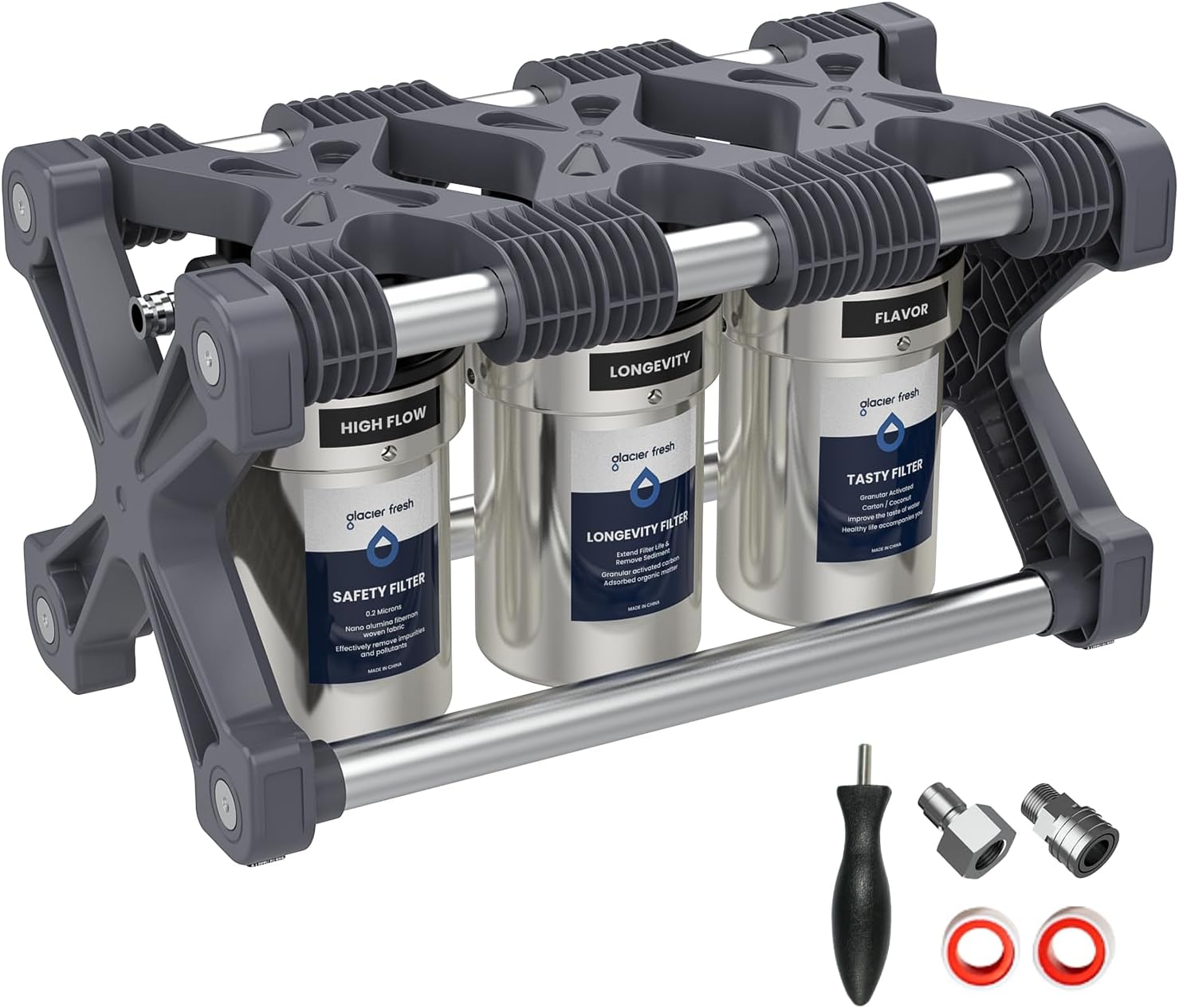
Pros
- Fine 0.2-micron filtration effectively captures submicron particles, rust, and heavy campground sediment.
- Noticeably improves the odor and flavor of municipal city water and mineral-heavy campground wells.
- Compact footprint and lightweight frame make it much easier to store than bulky 10-inch residential setups.
- Includes quick-connect fittings to streamline campsite setup and takedown.
Cons
- Tight 0.2-micron filtration can lower overall water flow and increase freshwater tank fill times.
- Inlet and outlet connection points may require additional plumber tape and careful hand-tightening to prevent dripping.
- Canisters must be fully drained and stored indoors before freezing temperatures hit.
The GLACIER FRESH 3-Stage RV Water Filtration System is an exterior inline water treatment unit built specifically to handle variable campground water supplies. Rather than relying on basic single-canister inline filters that only trap coarse debris, this multi-stage setup combines a sediment barrier, a coconut shell activated carbon block, and an ultra-fine 0.2-micron finishing filter. For RVers, camper van travelers, and overlanders, it serves as a frontline defense against murky well water, harsh chlorine odors, and gritty sand often encountered at private and state park hookups across North America.
This system is tailored for full-time RVers, seasonal travel trailer owners, overlanders, and camping families who want reliable drinking water straight from their rig taps. Anyone who regularly moves between remote public lands, private campgrounds, and municipal parks knows that water quality varies wildly. Rather than hauling cases of single-use plastic bottles or guessing whether a campground tap is clean enough for cooking and morning coffee, this compact unit offers dependable filtration for weekend warriors and long-term road nomads alike.
On the road, water quality can range from sulfur-smelling well supplies to rust-tinted water from aging park pipes. According to user feedback, the three-stage filtration makes a dramatic difference in clarity, odor, and taste. The coconut carbon stage helps reduce chlorine and chemical odors, while the 0.2-micron filter captures submicron particles. Because the filtration is so thorough, campers should anticipate a modest reduction in water flow rate. Filling an entire fresh water holding tank takes longer than running an unfiltered hose, but the reward is clear, odor-free water that protects internal plumbing, water heaters, and pump seals from abrasive grit.
Built around an ultra-lightweight polycarbonate carbon fiber frame, this unit is engineered to withstand routine campsite handling without adding excessive tongue weight or eating up precious cargo capacity. The 5-inch compact housings make the entire assembly significantly smaller than residential-style 10-inch canisters, allowing it to slide easily into an RV pass-through storage bay or underneath a camper. The system integrates standard garden hose quick-connect fittings, enabling fast setups directly at the campground spigot or camper water inlet.
While installation is straightforward, practical attention to the connections is essential. Based on user experiences, the brass-to-fitting junctions require careful handling during initial setup. Applying a generous wrap of quality plumber thread tape and tightening fittings to a snug, finger-tight position prevents distortion of the internal rubber seals. Overtightening can pinch the gaskets and cause spray under high water pressure. Pairing the system with an RV water pressure regulator is always recommended to safeguard both the filter housing and your rig interior from pressure spikes.
For outdoor travelers seeking dependable water quality without the bulk or expense of complex plumbed systems, this GLACIER FRESH 3-stage filter strikes an effective balance. It turns variable spigot water into clean drinking water, safeguards appliances from grit, and packs down small enough for travel trailers and camper vans. It is a smart addition to any camp setup, provided you carry spare filter cartridges for high-sediment state parks and take a few minutes to seal hose connections properly.
Setting up the filter at camp is fast thanks to the included garden hose quick connects. Place the filter on a level patch of ground or secure it in an exterior storage compartment near your freshwater connection. Always use a dedicated drinking-water-safe RV hose on both the inlet and outlet sides to avoid introducing plastic chemical tastes.
To avoid minor leaks reported by some campers, apply plumber tape evenly across the threads of all hose adapters. Snug the connections firmly by hand rather than wrenching down hard, which keeps internal O-rings and flat washers from warping out of position. Running water through the unit for a minute prior to connecting it to your RV will flush out loose carbon fines and clear air pockets.
Routine maintenance involves swapping filter cartridges every three to four months, or sooner when camping at locations with high iron or sediment. When winterizing your rig, always remove the filter cartridges, drain all water from the housings, and store the assembly in a climate-controlled space to prevent freezing and housing cracks.

Pros
- GAC and KDF media work together to reduce chlorine and keep stored filters fresher between camping trips
- Includes a flexible hose protector that prevents awkward hose kinks at crowded campground pedestals
- Maintains high water flow rate for speedy tank fills and consistent camp sink pressure
- Independently tested and certified lead-free to strict NSF standards for peace of mind
- Made in the USA with sturdy, UV-resistant exterior plastic housing
Cons
- Not rated for untreated backcountry wilderness water sources containing giardia, cryptosporidium, or raw organic matter
- Requires periodic replacement each camping season to maintain optimal flow and filtration efficiency
- Adds physical length to the campground spigot setup, which may require careful positioning on low-clearance hookups
The Camco Tastepure RV Inline Water Filter (40043) is an external inline filtration system engineered to purify potable water before it reaches an RV holding tank, camp kitchen, or drinking water container. Featuring an integrated 20-micron sediment barrier, Granular Activated Carbon (GAC), and Kinetic Degradation Fluxion (KDF) filtration media, this inline cartridge targets the most common water quality issues found at public campgrounds, state parks, and RV resorts. It is tailored for RV campers, travel trailer owners, overlanders, family campers, and tailgaters who need reliable access to clean, palatable water wherever a standard hose bib is available.
Campground water supplies often carry noticeable chlorine tastes, sulfur smells, sediment, or mineral cloudiness that can spoil your morning coffee and leave residue in camp cookware. Based on product specifications, the Camco Tastepure utilizes a 6-step Hex-Flow filtration process that efficiently reduces foul tastes, odors, and chlorine. The internal 20-micron sediment filter stops rust flakes, sand, and fine silt from entering RV plumbing lines or clogging camp sink aerators. Meanwhile, the wide-body canister design keeps water moving smoothly, preventing frustrating pressure drops when filling large 30-gallon freshwater tanks or running outdoor showers.
Durability and safety are standout aspects of this filtration unit. Made in the USA, the housing is constructed from robust, lead-free plastic and is independently certified to NSF/ANSI 42, 53, and 372 standards. A practical feature included in the package is the reinforced flexible hose protector. Attaching this spring-wrapped extension to the campsite spigot prevents tight hose bends, stops kink-induced flow restrictions, and relieves mechanical strain on the faucet threads, ensuring reliable operation throughout windy weekends and extended stays.
Setting up and maintaining the filter is straightforward. Campers simply attach the flexible protector to the campground spigot, thread the Tastepure filter in the direction of the water flow arrow, and attach a drinking-water-safe hose to the output end. Flushing the unit for thirty seconds clears any loose carbon dust before connecting it to your vehicle or hydration jug. Between camping trips, the integrated KDF media helps inhibit bacteria and mold growth inside the damp cartridge, making storage in a camp tote or RV pass-through compartment worry-free.
While this inline filter excels at treating municipal and regulated campground water, it is not designed to filter raw, unchlorinated backcountry water from mountain streams, lakes, or stagnant puddles that may contain dangerous microbiological cysts or viruses. Backpackers and primitive wilderness campers will still require a dedicated microfilter or chemical purifier. For weekend warriors, seasonal RVers, road-trippers, and car campers hooking up to park utilities, the Camco Tastepure provides an affordable, highly effective way to guarantee fresh, odor-free drinking water at every campsite.
Installing the Camco Tastepure RV Inline Filter takes less than two minutes at any standard outdoor water hookup. Begin by screwing the flexible hose protector onto the campground faucet to prevent hose pinching and kinking. Attach the intake side of the filter cartridge to the protector, pointing the directional flow arrow toward your RV or water vessel. Before connecting your clean drinking hose to the outlet, run the water for approximately 30 to 60 seconds until the stream runs crystal clear, which purges excess loose carbon fines from the manufacturing process.
For optimal care between camping excursions, shake out excess standing water from the filter body and allow it to drain thoroughly. Replace the threaded end caps when storing the filter in an RV storage bay, gear tote, or garage to keep dirt, insects, and grit from entering the intake and outlet ports. Replace the filter at the start of every new camping season or whenever you notice a significant drop in flow rate or taste quality.

Pros
- Exceptional 20 GPM flow rate prevents water pressure drops inside RV plumbing fixtures
- Comprehensive package includes three filter cartridges, solid brass adapters, and maintenance tools
- Durable housing withstands high water pressures up to 125 psi for dependable leak prevention
- Detachable top handle makes it easy to transport and reposition between the campground hookup and RV bay
Cons
- Substantial 17 by 16 inch footprint occupies more storage space than slim inline cylinder filters
- Requires manual winterization and careful draining to prevent freezing damage in cold mountain weather
- Higher upfront investment compared to basic single-stage disposable carbon cartridges
Clean water is a top priority whether you are parked at a developed state park or boondocking with a travel trailer. The WLSINJL RV Water Filter System is a freestanding, multi-stage water purification setup built for travel trailers, motorhomes, overlanders, and extended family campers. Hooking up to campground spigots often introduces rust, heavy sediment, chemical odors, and high levels of chlorine. This system sits right between the park spigot and your camper freshwater inlet, giving RVers dependable potable water straight from the interior faucets.
Performance hinges on filtration capability and water volume, and this unit balances both effectively. The 5-stage setup pairs a high-performance sediment filter with an ultrafiltration membrane designed to capture fine particulates, eliminate foul tastes, and reduce heavy metals. Unlike narrow inline stick filters that frequently choke down flow, this system is rated for an impressive 20 GPM flow rate. That allows you to wash dishes at the galley sink while someone else showers without experiencing an annoying drop in cabin water pressure.
The structural construction reflects the demands of outdoor travel. Made from food-grade polypropylene, the heavy housing is pressure-tested up to 125 psi. This robust build handles the unexpected water surges and pressure spikes common at older RV parks. Brass adapters are included to bridge the 1-inch ports to standard 3/4-inch garden hose threads, preventing the plastic cross-threading issues seen with cheaper assemblies. A molded top handle makes it simple to pull the unit out of your gear pass-through and set it on the ground near the hookup post.
Routine operation and maintenance are straightforward. The package includes three filter cartridges, each rated for up to 3,000 gallons, which easily covers a typical outdoor camping season for weekend warriors or full-time road travelers. Swapping cartridges requires unscrewing the housing with the supplied wrench, taking off the protective plastic wrap from the new element, and securing the housing back over the leak-proof O-ring seal.
As with any substantial filtration station, there are a few practical considerations. Measuring 17 inches by 16 inches, the unit requires dedicated space in your camper basement or truck bed compared to tiny disposable inline filters. Campers venturing into sub-freezing mountain climates must also remember to drain the housing completely to prevent cracked canisters. For RVers, overlanders, and camping families looking to eliminate plastic water bottles and protect their camper plumbing from nasty municipal sediment, this high-flow system offers solid peace of mind on the road.
Setting up the WLSINJL filtration unit takes just a couple of minutes at the campsite. Simply connect your incoming drinking water hose to the brass 3/4-inch inlet adapter and run your secondary RV drinking hose from the outlet directly into your camper city water connection. Make sure to apply the included thread tape to all threaded brass connections to maintain a watertight seal under pressure.
When preparing camp for freezing shoulder-season trips, always shut off the supply, depressurize the lines, and unscrew the canister bowls using the provided wrench to drain standing water. Before installing any replacement cartridges, remember to completely peel away the protective outer plastic film to avoid blocking the water flow.
Campground water hookups frequently deliver inconsistent pressures that can rupture weaker filter setups. This unit features thick-walled polypropylene housings engineered to endure working pressures up to 125 psi, safeguarding against line spikes. Solid brass connector fittings resist the thread wear and corrosion often caused by repeated connections to metal campground hydrants.
The sturdy freestanding base keeps the filters upright and off the wet ground or gravel. Combined with an ergonomic detachable carry handle, the system transitions smoothly between campground hookups, trailer storage bins, and marina docks without putting strain on the plumbing fittings.
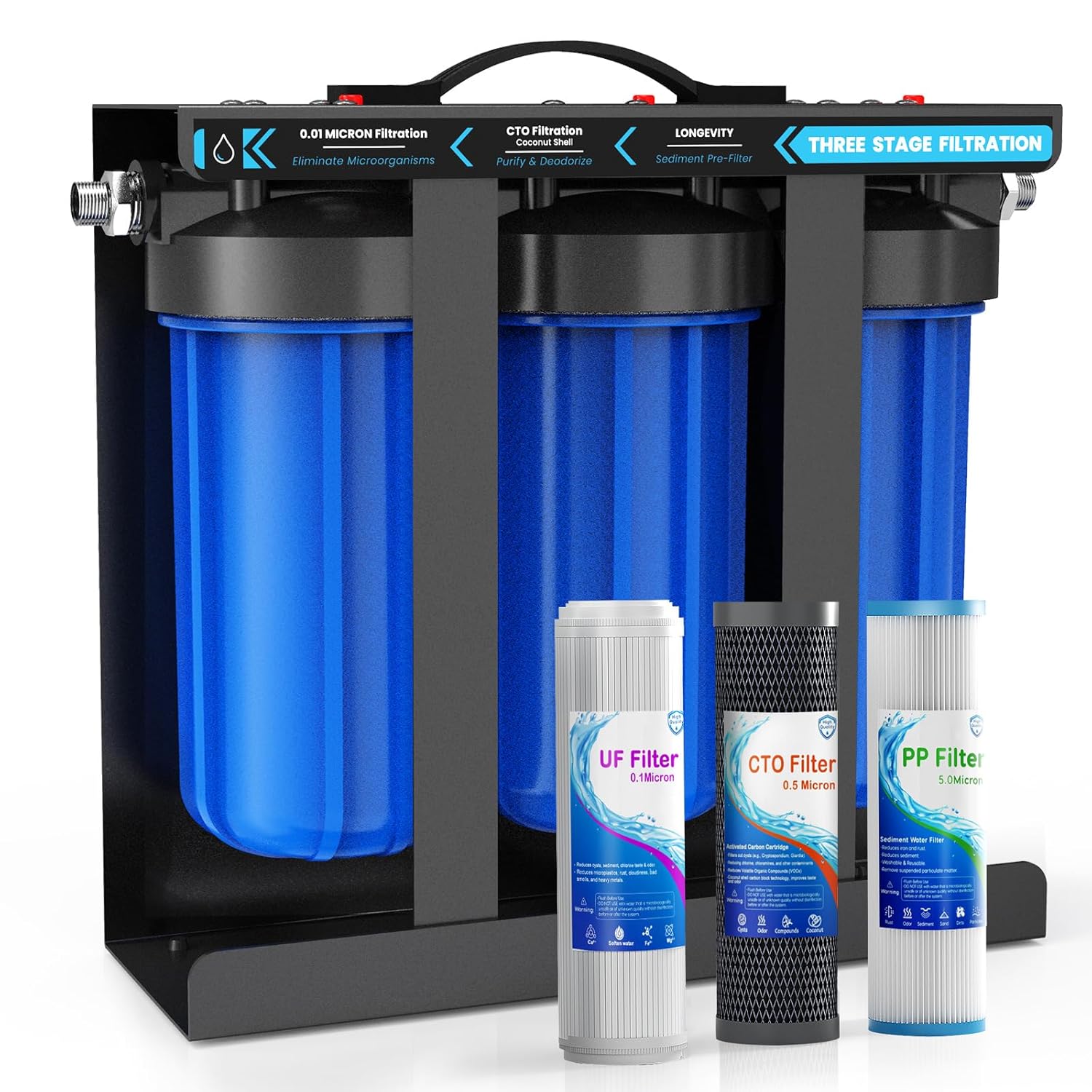
Pros
- Significantly better filtration performance than basic single-canister inline filters
- High flow capability keeps RV shower pressure strong and fills camp cook pots fast
- Durable metal mounting bracket and brass fittings provide a solid, leak-resistant connection
- Eliminates bad campground water smells and aftertastes for pure morning coffee and cooking
Cons
- Weighing nearly 19 pounds, it adds noticeable bulk compared to compact disposable filters
- Requires adequate clearance in your RV utility bay or a dedicated exterior stand
- Must be thoroughly drained before freezing temperatures hit to avoid housing damage
Campground water hookups can be notoriously unpredictable, ranging from heavily chlorinated municipal supplies to gritty, high-sulfur well water. The DYLSDFQ RV Water Filter System is a dedicated multi-stage water filtration unit engineered to treat water directly at the source before it enters your rig. Tailored for RV campers, travel trailer owners, overlanders, and long-term road warriors, this heavy-duty system acts as a reliable gatekeeper for your entire freshwater network.
Filtration capability is the standout highlight of this system. Rather than relying on a basic inline activated carbon tube that only traps coarse dirt, this setup combines a polypropylene sediment stage, a CTO carbon block, and an ultrafiltration membrane. Product specifications indicate it catches fine particulate matter down to microscopic levels, clearing out silt, rust flakes, chlorine, volatile organic compounds, and unpleasant odors. This means the water pouring from your camper galley faucet tastes crisp and clean, whether you are prepping morning coffee at sunrise or boiling pasta after a long day on the trails.
Water flow rate is another critical factor when evaluating an RV filtration setup. Many tight-pore filters drastically restrict water flow, turning an evening shower into an irritating trickle. According to product specifications, this system is engineered to sustain generous flow rates ranging up to 4.5 gallons per minute during typical operational demands, and up to 20 gallons per minute at maximum capacity. This high-throughput design ensures that filling your freshwater holding tank does not take all afternoon, and campsite shower pressure remains consistently strong.
From a hardware perspective, the assembly is built for practical outdoor handling. The canisters are supported by a durable metal bracket that can be mounted inside a dedicated utility compartment or positioned securely alongside your campsite water hookup. The package includes heavy-duty brass thread adapters that transition from 1-inch ports down to standard 3/4-inch garden hose fittings. A housing wrench, replacement O-rings, and thread seal tape are supplied right out of the box, making initial setup relatively straightforward without requiring trips to the local hardware store.
There are a few realistic limitations to keep in mind. At roughly 19 pounds and measuring 17 by 16 inches, this is not a compact accessory for ultralight minimalist campers or small vehicle trunks. It demands dedicated space in an exterior storage compartment or under an RV bay. Additionally, like any canister-based water system, it must be protected against freezing. If you enjoy cold-weather camping in mountain elevations, you will need to drain the canisters completely before frost sets in to prevent cracked housings.
For family campers spending weeks at state parks, full-time RVers traversing the country, and overlanders seeking dependable water quality at every stop, the DYLSDFQ filtration setup offers dependable performance. It strikes an effective balance between deep multi-stage purification and high-volume water flow, helping keep your camper plumbing clean and your drinking water genuinely enjoyable.
Installing the system is relatively simple thanks to the included 3/4-inch brass adapters that mate directly with standard drinking-water-safe garden hoses. Before initial installation, be sure to open each canister, inspect the internal O-rings, and peel off any protective shipping plastic covering the filter cartridges. Applying a wrap of the included thread seal tape on the brass fittings helps establish a tight, leak-free seal.
Routine maintenance involves swapping out cartridges at recommended service intervals or whenever you notice a dip in line pressure from heavy sediment buildup. Using the provided housing wrench makes unscrewing the filter bowls manageable even in tight RV utility bays. When packing up camp for seasonal storage or winter transit, loosen the housings, discard standing water, and store the unit in a heated compartment to prevent freeze damage.

Pros
- Dual 5-micron and 0.5-micron stage setup effectively removes heavy sediment, well-water rust, and chemical odors
- Solid lead-free brass fittings resist cross-threading, stripping, and high water pressure leaks
- Maintains impressive water flow rate without creating frustrating pressure drops inside the camper
- Flexible installation allows either permanent trailer mounting or portable standalone use in a storage tub
- Prompt customer support backed by a genuine lifetime manufacturer replacement warranty
Cons
- Food-grade silicone lubricant for the canister O-rings is not included in the package and must be sourced separately
- Requires proper thread sealing tape on the manifold brass connections during initial assembly to prevent minor drips
- Bulky dual-canister design requires dedicated storage space and careful winterizing to prevent freeze damage
The Beech Lane External RV Dual Water Filter System is a heavy-duty, two-stage outdoor filtration unit engineered specifically for travel trailers, motorhomes, fifth wheels, and overland rigs. Connecting directly between campground city water spigots and your fresh water drinking hose, this filtration station cleans water before it ever enters your camper plumbing or onboard holding tank. Unlike disposable inline plastic filters that clog quickly, this dual-canister system treats high volumes of municipal and well water throughout extended road trips.
This system is ideal for full-time RVers, weekend family campers, overlanders, and road-trippers who frequent state parks, private campgrounds, and rustic hookups across North America. Anyone who has hooked up to a rural campground spigot only to find cloudy water, heavy silt, or strong sulfur smells will appreciate the protection this dual-stage setup offers. It is equally valuable for budget-conscious RV owners wanting to protect their plumbing lines, water heater, and water pump from mineral buildup and grit.
In real-world camping scenarios, filtration effectiveness is where this system shines. The initial stage houses a 5-micron spun polypropylene sediment filter that captures coarse particles like sand, dirt, and pipe rust. The water then travels into the second stage, passing through a 0.5-micron extruded carbon block that absorbs chlorine, bad tastes, and chemical odors. Despite the fine 0.5-micron rating, user feedback indicates that water flow rate remains steady, providing ample pressure for washing dishes, taking hot showers, and filling camp kettles without frustrating dribbles.
Build quality reflects rugged outdoor practicalities. The housing utilizes thick-walled polymer canisters rated to withstand typical municipal pressure surges and outdoor exposure. Beech Lane equips this model with 3/4-inch lead-free brass fittings instead of standard plastic threads, preventing cross-threading when attaching heavy-duty drinking hoses. A sturdy powder-coated metal bracket ties the canisters together, offering mounting holes for securing the unit to a trailer tongue, bumper, or wood stand, though it can also sit securely upright on a campsite picnic table or ground pad.
Operating and maintaining the system is straightforward once properly assembled. During initial setup, applying several wraps of Teflon thread tape to the brass fittings ensures a watertight seal against the polymer manifold. Replacing filter cartridges between seasons is quick using the included custom canister wrench. Campers should keep a small container of food-grade silicone grease on hand to lubricate the rubber O-rings, ensuring smooth canister threading and preventing leaks during pressurized use.
For outdoor adventurers seeking reliable, clean drinking water at every stop, the Beech Lane Dual Water Filter System provides a massive upgrade over single-canister inline filters. While it does require dedicated storage space in an exterior camper pass-through and must be drained thoroughly before freezing nights, its rugged brass fittings, superior two-stage water clarity, and lifetime warranty support make it an essential investment for worry-free camping.
Routine care ensures your filtration canisters deliver clean, fresh water on every outdoor excursion. When setting up the system for the camping season, inspect the rubber O-rings located inside each canister head for cracks, dirt, or flattening. Applying a thin coat of food-grade silicone grease to these O-rings creates an airtight seal and prevents the rubber from sticking or bunching when tightening the housing with the included wrench.
Winterizing is essential for preventing structural damage to the plastic canisters. Water left inside the filter housing during sub-freezing campground nights will expand and crack the thick polymer walls. Before putting your rig in cold storage or towing through freezing mountain passes, unscrew the canisters, discard used filter cartridges, empty all standing water, and allow the housing to dry completely before stowing it away in a warm compartment.
Beech Lane backs this dual filtration system with a no-hassle lifetime manufacturer warranty, covering defects in materials and manufacturing. This warranty provides valuable assurance for long-distance overlanders and full-time travelers who subject their gear to constant road vibration, sun exposure, and variable campground water pressures.
Customer feedback consistently praises the brand for responsive support, with replacement components and entire filter units dispatched quickly if manifold threading or casting issues arise. Registering your purchase and keeping proof of purchase handy ensures rapid assistance should you ever need replacement parts or warranty verification while traveling on the road.

Pros
- Comprehensive three-stage protection includes virus defense beyond typical RV inline filters
- Extremely durable powder-coated frame and stainless fittings built for long-term outdoor campsite use
- High 4.5 GPM flow rate provides strong water pressure throughout the camper plumbing system
- Freestanding design sets up securely on the ground without requiring custom RV wall brackets
Cons
- Substantial weight at over thirty pounds makes it bulky to haul without a vehicle or camper storage bay
- Replacement multi-stage filter cartridges represent an ongoing maintenance expense
The Clearsource Ultra RV Water Filter System is a premium, high-capacity water purification setup built specifically for mobile outdoor living. While standard inline canister filters handle basic grit and foul tastes, this heavy-duty system is engineered for full-time RV campers, overlanders, fifth-wheel travelers, and extended road trippers who encounter unpredictable water sources at remote campgrounds, rural parks, and boondocking access points across North America.
Filtration capability is where this system stands out from conventional camping filters. It utilizes a sequential three-stage process to systematically scrub municipal or well water before it enters your camper plumbing. The first stage employs a 5-micron filter to catch sand, rust, and coarse sediment, preventing clogs downstream. The second stage features a 0.5-micron coconut shell carbon block that removes chlorine, volatile organic compounds, and sulfur odors, leaving fresh water ready for brewing morning camp coffee. The third stage uses Clearsource-exclusive VirusGuard technology, which uses an electro-positive charge coating to attract and trap microscopic contaminants, reducing bacteria like E. coli, cysts like Giardia, and microscopic viruses.
Campground performance depends heavily on water pressure, and the Ultra system handles this well with a rated flow rate of 4.5 gallons per minute. That provides ample volume to run an outdoor camp kitchen or an indoor RV shower without suffering a frustrating drop in flow. Connecting the unit between the campsite hose bib and your RV fresh water inlet is simple thanks to standard hose threads, and the included filter canister wrench makes swapping out cartridges straightforward when service is due.
Build quality matches the rigors of vehicle-based camping and outdoor travel. The three oversized filter housings sit securely within an industry-exclusive powder-coated metal chassis. This freestanding frame holds its ground on uneven gravel RV pads, grass, and mud, while heavy-duty stainless steel fittings handle continuous hose connections without cross-threading or leaking. Unlike plastic inline filters that can crack under sun exposure or accidental drops, this metal structure is built to survive seasons of outdoor living.
There are a few realistic trade-offs to consider before adding this unit to your camping kit. At over thirty pounds and standing roughly fifteen inches tall, this is not a lightweight option for backpackers or minimalist car campers packing small trunks. It requires dedicated storage space in an RV basement pass-through, camper shell, or truck bed. In freezing mountain conditions, campers must also be diligent about draining the heavy canisters to avoid freeze damage during cold shoulder-season trips.
For family campers, travel trailer owners, and overland adventurers who refuse to gamble on questionable campsite spigots, the Clearsource Ultra provides top-tier peace of mind. Its commercial-grade exterior, high flow rate, and comprehensive three-stage virus protection make it one of the most reliable water defense systems available for extended life on the road.
Outdoor equipment needs to withstand rough treatment, and the Clearsource Ultra is built like an industrial tool rather than a disposable accessory. The entire unit rests in a custom powder-coated metal chassis designed to resist moisture, rust, and abrasion from gravel campsites. The wide base keeps the center of gravity low, reducing the chance of tip-overs when hoses get tugged around the campsite.
Plumbing connections take substantial stress during camp setup and pack-down. Clearsource equips this system with rugged stainless steel inlet and outlet fittings rather than cheap plastic threads, ensuring long-term leak-free hookups season after season. The thick-walled filter canisters can comfortably handle high municipal water pressures often found at commercial campgrounds.
Setting up the Ultra system at a campground is quick and requires no permanent modifications to your rig. Simply place the freestanding unit near your camper water hookup, attach your incoming freshwater drinking hose from the campsite bib to the inlet, and connect a second drinking-safe hose from the outlet to your RV city water connection. The system starts filtering immediately as soon as you turn on the spigot.
Routine care involves swapping the cartridges periodically depending on water quality and campground usage. The system comes with an oversized filter wrench that gives you plenty of leverage to loosen the canisters during maintenance. For winter camping or off-season storage, make sure to vent pressure, unscrew the canisters, empty standing water, and let the components dry thoroughly to protect the housing from freeze-related cracking.

Pros
- Submicron 0.2-micron filtration captures micro-particulates far better than standard inline blue filters.
- Rugged carbon fiber polycarbonate housing keeps total weight under ten pounds for easy transport.
- Stainless steel quick connects simplify camp setup after dark without cross-threading brass fittings.
- Significantly improves freshwater taste, eliminating the need to haul heavy plastic water bottles.
Cons
- Requires proprietary 5-inch replacement cartridges rather than universal standard 10-inch filters.
- Must be safeguarded from freezing temperatures below 40 degrees Fahrenheit to prevent canister damage.
- Premium price point requires a bigger upfront gear investment compared to basic single-stage inline units.
The Blu Technology AR3 is a specialized three-stage mobile water filtration system engineered specifically for recreational vehicles, camper vans, travel trailers, and overland rigs. While many campers rely on basic inline disposable canisters that do little more than catch coarse sand, the AR3 steps up protection with a multi-stage approach. It combines an initial sediment filter to catch silt and rust, an activated coconut shell carbon block to strip away unpleasant chemical smells and sulfur tastes, and a 0.2-micron ultra-filtration barrier designed to target submicron particles commonly found in untamed campground well water.
This system caters directly to full-time RVers, extended-trip overlanders, van life travelers, and weekend warriors who refuse to gamble on campground water quality. Whether you are hooking up to an aging municipal line at a crowded family campground or tapping into a remote state park well spigot, water supplies can vary drastically from stop to stop. Campers report that this system brings peace of mind to daily camp tasks, from brewing morning coffee and washing dishes to filling onboard freshwater holding tanks, significantly reducing the necessity of lugging bulky plastic water jugs from the grocery store.
Where the AR3 truly distinguishes itself from traditional home-style filtration assemblies adapted for camper use is in its compact, rugged architecture. Built with an ultra-lightweight polycarbonate carbon fiber frame, the entire unit weighs under ten pounds and measures just 16.65 inches long by 8.5 inches high. Instead of awkward ten-inch commercial housings that monopolize precious under-bed or exterior pass-through storage bays, Blu Technology uses proprietary five-inch canisters. The housing is durable and corrosion-resistant, protecting the canisters from shifting gear inside a packed vehicle trunk or trailer compartment during transit.
Field setup is streamlined thanks to high-grade stainless steel garden hose quick-connect fittings. Instead of wrestling with stiff hoses and cross-threading plastic fittings at a muddy campground pedestal, campers can simply snap their lines into place for a secure, leak-free connection. User feedback frequently praises the high flow rate, noting that unlike dense residential filters that choke off plumbing flow, the AR3 manages to deliver deep filtration without causing a noticeable drop in shower or sink water pressure.
Every filtration setup comes with practical trade-offs that buyers should consider. The specialized five-inch canisters mean you must purchase replacement cartridges specifically sized for this unit rather than picking up generic ten-inch filters at a local hardware store. Additionally, because water remains inside the sealed canisters between stops, winter care is essential. The system has an operating range between 40 and 125 degrees Fahrenheit, meaning it must be drained and brought indoors during hard winter freezes to prevent expanding ice from cracking the housing components.
For outdoor enthusiasts who spend considerable time living on the road or frequently camp in regions with questionable water supplies, the Blu Technology AR3 represents a high-value upgrade to your mobile plumbing setup. Its compact footprint, sturdy carbon fiber frame, and multi-stage 0.2-micron filtration system make it a reliable companion for cross-country road trips, boondocking adventures, and family camping holidays where clean drinking water is non-negotiable.
Setting up water at a new campsite is often a chore, especially when arriving after dark or in wet conditions. The Blu Technology AR3 simplifies this routine by utilizing pre-installed stainless steel garden hose quick connects. Campers can leave the female adapter attached to their standard RV drinking water hose and simply click the line directly onto the system intake and discharge ports without reaching for thread tape or wrenches.
Takedown is equally straightforward when breaking camp. Users can quickly disconnect the hoses, tip the unit to empty excess water weight, and stow the compact frame inside a storage compartment or utility bay. The collar design around the five-inch canisters allows for quick, tool-free filter checks, using an included mini-tool to secure the housing without relying on oversized, easily misplaced filter wrenches.
Mobile outdoor gear takes a beating from rough highway travel, bumpy washboard dirt roads, and outdoor exposure. The AR3 is constructed with an ultra-lightweight polycarbonate carbon fiber chassis that provides structural rigidity without adding unnecessary weight to your camper tongue or cargo payload capacity.
The compact five-inch canister architecture keeps the center of gravity low, preventing the unit from tipping over when placed on uneven ground near the utility pedestal. High-grade stainless steel hardware protects against thread stripping and withstands repetitive connect and disconnect cycles across months of frequent travel.
Frequently Asked Questions About RV Water Filtration
How often should RV water filter cartridges be replaced?
Most RV filter cartridges should be replaced every 3 to 6 months or after filtering around 3,000 gallons of source water. Well water with high sediment levels can clog cartridges faster than treated city water hookups. Regularly inspecting flow rate drops helps you know when a fresh cartridge is needed.
What micron rating is ideal for an RV water filter system?
A 0.2-micron to 0.5-micron rating offers strong protection against fine sediment, cysts, and bacteria without drastically restricting water pressure. Standard inline filters usually provide 20-micron sediment screening, while advanced dual or triple canister systems combine a 5-micron pre-filter with sub-micron carbon blocks. Ultrafiltration membranes can reach 0.01 microns for maximum particulate removal.
Can an RV water filtration system handle high campground water pressure?
Yes, durable multi-canister systems and heavy-duty housings are typically tested to withstand pressures between 40 psi and 125 psi. Using a dedicated water pressure regulator at the campground spigot remains recommended to prevent unexpected pressure spikes from damaging fittings. Solid brass 3/4-inch connectors also offer superior leak resistance compared to plastic hose threads.
Will an inline RV filter remove water odors and bad tastes?
Granular activated carbon and solid carbon block filters effectively reduce chlorine, sulfur odors, and organic compounds that cause unpleasant water taste. Combining carbon blocks with KDF media helps prevent mold and bacteria growth inside the filter canister between trips. This dual-action approach delivers clean-tasting drinking water directly from your RV faucets.
Is a dual canister system better than a single inline filter for campers?
Dual canister systems provide superior filtration by separating sediment removal from chemical purification. The primary 5-micron stage traps dirt and rust before water enters the fine carbon or sub-micron stage, extending overall filter life. Hikers carrying the best hydration pack for backpacking prioritize lightweight gear, but RV owners benefit from the thorough protection of multi-stage external systems.
Do RV water filters protect against viruses and cysts?
Standard sediment and carbon filters do not remove viruses, but specialized systems with electro-positive coatings or ultrafiltration membranes can capture them. Look for systems featuring dedicated virus guard technology or 0.01-micron ratings if you frequently connect to untested well water or boondock in remote areas.




Write Your Review
No reviews yet. Be the first to share your experience!