


Packing Clean Electricity for Remote Campsites
Packed weight and packed dimensions often dictate whether an off-grid charging setup actually fits into your vehicle or pack. Setting up camp away from standard utility lines means planning your power generation around real sunlight conditions and battery capacities. Selecting the best foldable solar panels camping gear requires checking whether your setup needs direct USB connections for handheld devices or specialized DC and MC4 cables for a central power station. Folding units balance surface area against storage space, giving weekend campers and vehicle travelers a reliable way to sustain essential gear without noisy fuel generators.
Direct device charging introduces clear practical limitations because panels only generate usable wattage when unobstructed sunlight hits the cells. A compact twenty-eight watt folding charger easily replenishes phones and flashlights, while high-output two-hundred watt arrays recharge portable power stations that run electric coolers and campsite lighting. Pairing your energy needs with essentials like a reliable water storage container for emergencies ensures total self-reliance on multi-day journeys. Inspecting cable lengths, kickstand angles, and weather resistance ratings helps identify which folding setup provides consistent charging without cluttering your camp footprint.

Pros
- Folds down to an easily handled carry size weighing around 7 to 9 pounds, making solo transport and setup effortless.
- Included 9.8-foot cable allows power stations to stay shaded while panels capture full sun.
- Supplied PWM controller features a readable LCD screen and integrated USB output ports.
- Comes as an all-in-one kit complete with storage bag, cables, and multiple DC adapters.
Cons
- Fabric outer casing is water-resistant against splashes but should not be left outside in heavy downpours.
- Power station solar intake limits may cap real-world charging speed on smaller battery banks.
- Lacks integrated kickstands, requiring campers to lean the panel against camp furniture, tires, or gear bins.
The DOKIO 150W Portable Foldable Solar Panel Kit is an all-in-one off-grid solar charging system built around monocrystalline solar cells and a standalone charge controller. Designed for car campers, RV travelers, overlanders, and outdoor enthusiasts preparing for unexpected storm outages, this kit delivers a practical balance of wattage output and portable packing convenience. It folds into a compact suitcase profile measuring around 19.3 by 20.9 inches, making it easy to slip behind a vehicle seat or stow atop camping bins without consuming critical cargo room.
Out in the field, solar efficiency hinges on proper sun exposure and heat management. High temperatures can cause power stations and battery banks to throttle charging or degrade, which is where the included 9.8-foot cable makes a measurable difference. This extended cord lets campers set the panel out in full sunlight while keeping the power station, cooler, or 12V deep cycle battery tucked safely beneath vehicle awnings or tree shade. The monocrystalline cell construction helps convert sunlight reliably even during intermittent cloud cover or morning light at camp.
Regarding hardware build and weather resilience, the panel face features a durable, splash-resistant surface that tolerates typical campground dust, morning dew, and stray water droplets. However, the outer fabric casing is not designed for continuous heavy downpours, so campers should pack the unit away before severe thunderstorms hit. The separate PWM charge controller features a clear LCD display and provides essential electrical safeguards, including protection against reverse polarity, overcharging, short circuits, and overload conditions.
Setting up the solar array takes only a couple of minutes thanks to the pre-wired cabling and included adapter collection. DOKIO supplies four standard DC adapter tips, including 8.0mm and 5.5mm variations, allowing direct connection to an assortment of popular portable power stations alongside standard 12V lead-acid or lithium batteries. The controller also hosts onboard USB ports, offering a direct way to plug in headlamps, smartphones, or camping lanterns without needing an external inverter.
Before ordering, buyers should verify their specific power station input limitations. Many compact solar generators cap solar intake between 60W and 100W, meaning the 150W panel output will be limited to that specific device threshold. In addition, this panel does not feature integrated kickstands, so campers will want to lean it against camp furniture, an RV tire, or a vehicle windshield to capture optimal solar angles.
For weekend campers, overlanders, and outdoor enthusiasts seeking dependable off-grid recharging without bulky rigid panels, this foldable kit provides solid value and straightforward utility. It keeps essential campsite electronics running through extended dry camping trips and provides peace of mind as an emergency backup power generator during severe home weather events.
The DOKIO 150W kit stands out by providing an all-inclusive connection package right out of the box. Inside the package, campers receive the folding 150W solar array, a detachable LCD PWM solar charge controller, and a 9.8-foot primary extension cable that enables flexible camp positioning.
To ensure compatibility across various power setups, DOKIO includes a 3.3-foot cable, a JY60 short connector, and four DC adapter plugs (3.5x1.35mm, 5.5x2.1mm, 5.5x2.5mm, and 8.0mm). These connectors mate smoothly with many common portable power stations and solar generators used for car camping and mobile basecamps.
The bundle is completed by a protective fabric storage bag and an instruction manual. The storage bag helps keep the cables, adapters, and folded solar panel neatly organized in one place, preventing loose plugs from rattling around in a packed truck bed.
Deploying the solar kit is straightforward even for first-time campers. Unfold the panel, connect the primary cable, and attach the appropriate DC adapter for a portable power station, or wire the standalone PWM controller directly to a 12V camper battery following the manual connection order.
To maintain peak solar conversion efficiency, wipe the monocrystalline panel surfaces periodically with a soft microfiber cloth to remove campsite dust, pollen, and water spots. Never use abrasive cleaners or scratchy scouring pads that could compromise the cell coatings.
Always allow the fabric exterior to dry completely in the sun before packing the kit into its zippered storage bag. Storing damp outdoor equipment can lead to fabric deterioration, so keeping the panels clean and dry between camping trips ensures long-lasting service in the backcountry.
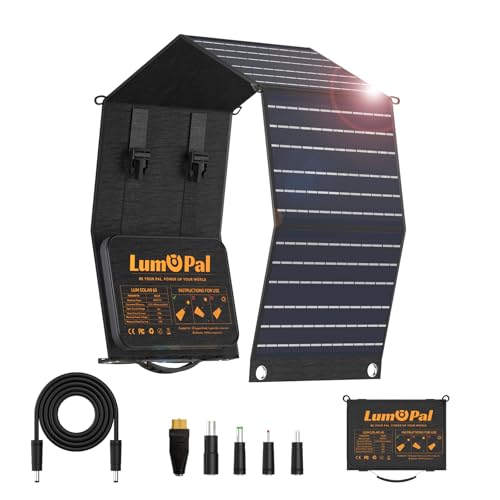
Pros
- Direct 60W USB-C Power Delivery allows fast charging for compatible laptops, phones, and tablets without requiring a separate power station.
- 18-20V DC output port (5.5 x 2.1mm) offers broad plug-and-play capability with popular compact solar generators and battery packs.
- Tough ETFE coating and 176-pound compression resistance provide solid durability against rough trail handling and vehicle storage.
- Foldable design packs down small enough to fit inside a hiking backpack, camp gear bin, or vehicle emergency kit.
Cons
- The output junction box and charging ports are not waterproof and must be protected from rainfall and heavy condensation.
- Contains no internal battery storage, meaning it only provides power while exposed to active sunlight.
- Actual power generation fluctuates based on cloud cover, solar angle, and tree canopy shade at your campsite.
The LUMOPAL 60W Foldable Solar Panel Charger is a portable, multi-port monocrystalline solar array designed for dependable off-grid electricity generation. Engineered for car campers, overlanders, backpackers, festival attendees, and emergency preppers, this compact folding kit converts raw sunlight into direct current for mobile electronics and compact power stations. With an advertised solar conversion efficiency of up to 23.5 percent, it captures substantially more power per square inch than older polycrystalline alternatives, providing a reliable outdoor electricity source when you are set up far from traditional grid power.
In practical campsite operation, output versatility is a primary strength. The unit integrates a 60W maximum USB-C Power Delivery port, dual Quick Charge 3.0 USB-A ports delivering up to 22W each, and an 18 to 20V DC barrel port (5.5 by 2.1mm). Campers can charge modern laptops, smartphones, headlamps, and camera batteries directly from the panel under full sun without needing to carry a heavy intermediary battery bank. An integrated smart chip automatically identifies connected electronics to deliver the appropriate charging protocol while offering overcurrent, overheating, and short-circuit protection for sensitive gear.
Outdoor durability stands out thanks to premium ETFE surface lamination. Compared to cheaper PET-coated solar blankets, ETFE provides superior resistance to heat degradation, physical abrasion, and long-term UV weathering. The panels carry an IP65 water-resistance rating, backed by tough nylon backing fabric and weather-resistant zippers designed to handle dirt, trail dust, and morning dew. Folded flat, the panel is engineered to withstand up to 176 pounds of compression pressure, meaning it can tolerate the inevitable bumps and gear stacking that occur in a tightly packed car trunk or pickup bed.
Transport and campsite setup are straightforward for both solo travelers and family groups. Weighing approximately 3.4 pounds and folding down to roughly 6.7 by 9.5 inches, this charger slides easily into a daypack, camp storage tub, or glove compartment. Setting up camp simply requires unfolding the panels and orienting them toward direct sunlight on a picnic table, vehicle hood, or open patch of ground. Attachment points allow campers to secure the array across an external backpack frame or against tent guylines to maintain charging while trekking or resting at camp.
Buyers should account for realistic outdoor limitations before heading off-grid. Like all portable solar arrays, output depends heavily on clear skies, proper solar angling, and ambient temperature, so charging will slow down considerably in heavy tree canopy or overcast conditions. Crucially, while the solar panels themselves feature an IP65 rating, the output junction box is not waterproof and must remain protected from rain, puddles, and heavy dew. Furthermore, because this unit does not contain an internal battery, it cannot store energy for night use unless paired with a separate portable power station or power bank.
For car campers, RV travelers, weekend hikers, and emergency preppers seeking a lightweight, compact solar charging solution, the LUMOPAL 60W panel offers an impressive balance of power output, durability, and packability. It is particularly well matched for charging portable electronics at roadside campsites or maintaining small power stations on sunny days in the backcountry.
The LUMOPAL 60W panel features an IP65 water-resistance rating across its monocrystalline solar cells, paired with rugged nylon fabric and water-resistant zippers that shed light trail rain, morning dew, and splashing water. The durable ETFE outer lamination provides an extra barrier against UV degradation, heat stress, and outdoor corrosion over prolonged outdoor exposure.
Campers must keep in mind that the integrated output junction box housing the USB-C, USB-A, and DC ports is not waterproof. To prevent electrical damage during sudden rainstorms or heavy evening condensation, the connection hub and any plugged-in electronic devices should always be placed under shelter or inside a dry storage container.
Designed with backcountry transport in mind, this 60W panel folds down to a compact size of roughly 6.7 by 9.5 inches and weighs only 3.4 pounds. Its slim profile allows it to slide cleanly into the hydration sleeve of a hiking pack, a camp kitchen bin, or a vehicle storage organizer without consuming valuable gear space.
The unit's 176-pound compression resistance ensures that heavy gear stacked on top during transit will not crush the folded cells. This balance of low carry weight and structural resilience makes it practical for multi-day hikes, overlanding rigs, and compact trunk setups alike.

Pros
- Lightweight 1.5-pound folding profile slips easily into hiking backpacks or camping storage bins.
- Triple-port configuration with dual USB-C and USB-A accommodates modern mobile devices and power banks.
- Stated 25.4% solar conversion efficiency delivers solid direct-sun charging performance.
- Included carabiners allow easy attachment to tents, backpacks, and campsite furniture.
Cons
- Contains no internal battery, requiring connected devices to remain plugged in under direct sunlight.
- The USB junction box is not waterproof and must be shielded during sudden rainstorms.
- Power output is limited to 5V devices and is not suitable for charging laptops or large power stations.
The BigBlue 28W High-Efficiency Solar Panel Charger is a portable, folding solar array engineered to deliver off-grid direct power to small electronics. Designed primarily for backpackers, hikers, car campers, solo adventurers, and emergency preparedness kits, this unit captures daylight to replenish power banks, smartphones, headlamps, and handheld GPS units. With a compact folding footprint and a light overall carry weight, it serves campers who need sustained device operation far from traditional electrical hookups.
In outdoor environments, solar performance hinges on cell efficiency and available sunlight. The BigBlue panel utilizes N-type solar cells with a shadow-free surface design, achieving an advertised conversion efficiency of up to 25.4 percent. It features an upgraded triple-port output consisting of dual USB-C ports and one USB-A port, capable of delivering up to 5V/3A per port and an aggregate maximum of 5V/4.8A across active connections. When strung over a tent vestibule or set out in an open meadow, the integrated LED indicator glows solid blue to confirm active power delivery, allowing users to verify charging at a glance.
Build quality balances trail-ready ruggedness with weather considerations. The panels are protected by an IP44 water-resistant polymer surface designed to withstand morning dew, light trail dust, and passing mist. However, the USB junction box itself is not waterproof, requiring campers to shield the connection hub and attached cords during sudden backcountry showers. The rugged exterior fabric and reinforced attachment loops provide the structural stability needed when fastening the array to a backpack during day hikes or staking it against camp furniture.
Packing and field deployment remain straightforward for campers on the move. Unfolded, the array spreads out to absorb maximum solar irradiance, while folding down to an ultra-compact 11 by 6 by 1.4 inches with a trail weight of approximately 1.5 pounds. The package includes heavy-duty carabiners, enabling quick attachment to exterior pack webbing, tent guylines, or camp branches. For best practices around the campsite, users should keep their connected phones or power banks in the shade underneath the array, preventing elevated ambient temperatures from triggering internal device thermal throttling.
Prospective buyers should recognize key operating boundaries before adding this charger to their pack. Because this unit contains no internal battery storage, power generation halts when the sun dips behind heavy cloud cover or sets for the evening. Additionally, the 5V output structure is tailored specifically for handheld electronics and power banks, making it insufficient for laptops or high-capacity power stations. Pairing the panel with a dedicated portable power bank offers the most reliable strategy, allowing campers to bank energy during peak daylight hours for evening camp lantern or phone charging.
For weekend warriors, section hikers, and disaster readiness planners, the BigBlue 28W charger provides dependable daylight replenishment at an accessible pack weight. Its balance of dual USB-C convenience, practical weather resistance, and compact foldability makes it a functional addition to backcountry backpacks, family camping bins, and emergency hurricane kits where access to utility power is unavailable.
Weighing under 1.5 pounds and folding down to 11 by 6 by 1.4 inches, the BigBlue 28W solar charger occupies minimal room inside a backpack or camp storage bin. Setting up requires simply unfolding the panels flat in unobstructed sunlight and connecting your charging cable. The included carabiners clip onto corner eyelets, allowing campers to secure the panel to a daypack while trekking or lash it to a camp table or vehicle roof rack.
A built-in LED indicator provides instant operational feedback, lighting up solid blue as soon as adequate solar radiation is detected. For transport, the panels fold inward into a neat rectangular packet held secure, safeguarding the solar cells against scrapes when packed among cooking gear or camp stakes.
The BigBlue 28W solar array provides a triple-port output consisting of two USB-C ports and one USB-A port. Each port provides up to 5V/3A, with a maximum shared output limit of 5V/4.8A across simultaneous connections. An intelligent safety charging chip regulates output to safeguard connected phones, GPS navigators, rechargeable headlamps, and power banks against current fluctuations.
Because direct solar power fluctuates with cloud cover and sun angle, the most effective outdoor strategy is charging a secondary USB power bank throughout daylight hours. This prevents connected smartphones from interrupting charge cycles during passing shadows and ensures stored power is ready around the campfire after dusk.

Pros
- Lightweight, briefcase-style fold makes it easy to pack into a hiking pack or camp storage tote.
- Direct DC output with included 3-in-1 adapters expands utility beyond standard 5V USB gear to small power stations.
- USB-C and Quick Charge 3.0 ports allow fast charging of modern smartphones and navigation devices without an external battery station.
- Documented solar efficiency up to 23.5% helps draw power even during hazy or lightly overcast outdoor conditions.
Cons
- Does not store electricity internally, meaning charging stops when sunlight is blocked unless paired with a separate power bank.
- The 30-watt maximum capacity is best suited for small electronics or compact power stations rather than large household battery backups.
- Cloud cover, tree canopy, and window glass significantly reduce real-world output below the theoretical 30W rating.
The MARBERO 30W Foldable Solar Panel is a portable monocrystalline solar charger designed to generate off-grid electricity for outdoor recreation and emergency preparedness. Catering to solo adventurers, car campers, backpackers, and weekend warriors, this lightweight panel bridges the gap between pocket-sized phone chargers and heavy stationary arrays. By converting sunlight into direct-current electricity, it provides a dependable energy stream for mobile devices, GPS units, headlamps, and compact portable power stations without needing access to shore power or noisy gas generators.
In real-world camp settings, charging performance hinges directly on solar exposure and port versatility. MARBERO equips this 30W model with three distinct outputs: a USB-C port capable of up to 12V delivery, a QC3.0 USB-A port for quick charging compatible phones, and a 16.5V/1.81A maximum DC output. Based on manufacturer specifications, the high-efficiency solar cells achieve a 21.5% to 23.5% conversion rate, generating an estimated 25W to 30W under direct midday sun when angled between 45 and 65 degrees. When haze or thin clouds roll across the campsite, the panel still generates a modest 15W to 20W, though buyers should expect lower wattages under dense tree cover or severe storm clouds.
Build quality reflects the demands of campsite travel, featuring rugged fabric casing, an integrated carry handle, and an IP65 water-resistant construction designed to withstand light rain and splashing. Measuring roughly 8.9 by 12 by 1.8 inches when folded and weighing under three pounds, the unit occupies minimal volume inside a backpacking pack, RV drawer, or vehicle trunk. The built-in smart chip actively recognizes connected devices to deliver safe, regulated power while shielding delicate smartphone batteries against overcharging. Two reinforced attachment loops paired with the included carabiners let hikers hang the panel from a rucksack on the trail or secure it to a tent rainfly facing the morning sun.
Operating the MARBERO 30W panel requires straightforward deployment without tools or complex wiring, but users must account for natural solar limitations. Because this solar charger contains no internal battery cells, it cannot store energy for evening use; power generation halts immediately when the sun dips below the horizon or shadows fall across the array. Positioning the panel directly toward sunlight rather than behind vehicle windshields or tent windows is necessary to achieve rated power, as glass filters out essential light frequencies. For steady power through the night, pairing the panel with an external power bank or compact solar generator is the most effective trail strategy.
For budget-conscious outdoor enthusiasts, festival goers, and remote hikers looking to maintain connectivity and safety gear in the backcountry, the MARBERO 30W Foldable Solar Panel delivers a practical balance of portability, multi-device charging, and affordability. While it lacks the wattage necessary to recharge high-capacity solar generators quickly, its lightweight briefcase profile and broad DC adapter compatibility make it an excellent maintenance charger for vehicle batteries, camping power stations, and everyday outdoor tech.
Packing down to the footprint of a compact tablet sleeve and weighing less than three pounds, the MARBERO 30W solar charger slips easily into backpacks and camping storage bins. The fold-out design allows rapid deployment across camp tables, car hoods, or the ground, making setup effortless during roadside stops or trail breaks.
With dedicated USB-C, QC3.0, and DC outputs, the panel provides flexible power distribution for diverse camp gear. The included 6.56-foot DC cable and 3-in-1 adapter set allow direct connection to common entry-level portable power stations, turning sunny campsite afternoons into reliable recharging sessions.
Featuring an IP65 water-resistant surface and rugged outer fabric, the panel withstands outdoor dampness, dust, and unexpected morning mist. While the solar surfaces resist incidental moisture, the junction box housing the USB and DC ports should remain dry and protected from heavy downpours.
Routine care involves wiping down the solar cells with a soft, damp microfiber cloth to remove dust, pollen, and salt spray that degrade solar conversion. Ensuring the panel is completely dry before folding and stowing in the provided carry pouch prevents moisture buildup and preserves fabric longevity during storage between trips.

Pros
- High 25% cell efficiency produces faster battery recharge rates even under overcast or partially shaded campsite skies.
- Direct USB-C 45W PD output allows direct laptop, tablet, or phone charging without hauling an external power station.
- Quadfold structure with a magnetic handle closure packs flat for easy storage behind SUV seats or inside RV pass-through bins.
- Four integrated kickstands with three angle settings make aligning the panel toward the sun quick and stable.
- Reinforced corner grommets provide practical anchor points to lash the panel to camper vans, roof racks, or cabin tents.
Cons
- At 13.89 pounds, the unit is suited for vehicle-based camping and is too heavy for extended backpacking trips.
- IP65 rating resists light rain and splashes, but the panel cannot be left submerged or exposed to severe, persistent storms.
- Ground anchoring studs for high-wind stability on loose soil are an optional add-on rather than included gear.
The Renogy 200W Portable Solar Panel is a foldable, quadfold photovoltaic charging panel designed to generate clean off-grid electricity for outdoor enthusiasts and emergency backup systems. Tailored primarily for car campers, RV travelers, overlanders, van lifers, and weekend camp trips, this portable solar unit bridges the gap between bulky rigid rooftop panels and underpowered personal solar chargers. Its compact profile makes it easy to stow alongside coolers, camp kitchen bins, and sleeping gear in packed vehicle trunks.
Energy production centers on advanced 16BB N-Type monocrystalline solar cells that achieve an industry-leading 25 percent conversion efficiency. In real-world camp settings where morning tree cover or passing clouds can reduce sunlight intensity, this higher efficiency rating helps deliver more daily watt-hours into your portable power station or 12V battery system. The output options add notable versatility: alongside the primary MC4 connection leads, an integrated junction box provides a 45W USB-C Power Delivery port and two USB-A ports (18W and 15W). This layout allows campers to recharge navigation gear, cameras, and smartphones directly in the field without turning on an external power bank.
Portability and campsite ergonomics show smart attention to vehicle-based outdoor life. Weighing 13.89 pounds and folding down to 23.72 x 22.99 x 1.97 inches, the panel replaces traditional snapping buckles or loud Velcro tabs with a clean magnetic closure system embedded in the carry handle. Four built-in kickstands fold outward to prop the unit up on grass, gravel, or packed dirt, allowing angle adjustments between 40, 50, and 60 degrees to maximize direct solar capture as the sun shifts. For overlanders or campers battling wind gusts, the panel incorporates perimeter grommets that make securing the array to an awning, roof rack, or tent footprint with standard paracord straightforward.
Outdoor resilience is supported by an IP65 protection rating, which defends the sensitive photovoltaic surfaces and wiring junctions against dust, dirt, and water splashes. Sudden mountain rain showers or morning dew will not compromise the unit, though it should still be packed away during prolonged torrential storms. For added peace of mind, Renogy has certified the panel to UL 61730 safety standards and provides a 2-year warranty on material and workmanship. Maintaining the surface requires little more than wiping down accumulated trail dust or pollen with a soft, damp microfiber cloth before folding it up for storage.
While this 200W foldable panel excels in vehicle-supported setups, it has clear boundaries. Weighing nearly 14 pounds, it is not built for human-powered backpacking or backcountry treks where every ounce counts. Additionally, recharging dedicated 12V lead-acid, AGM, or deep-cycle battery banks directly via the MC4 cables requires a compatible charge controller, which must be paired separately if your system lacks one built-in. For car campers, festival goers, overlanding rigs, and rural homeowners building an off-grid storm prep kit, this Renogy unit delivers an impressive balance of high efficiency, versatile outputs, and easy packability.
Deploying the Renogy 200W solar panel at a campsite takes less than two minutes. The quadfold design pulls open smoothly thanks to its embedded magnetic handle closure, doing away with snagging Velcro or brittle plastic clips. Four built-in leg kickstands extend from the rear of the panels, clicking into position to support the structure without requiring external poles or makeshift props against picnic tables.
Campers can adjust the kickstands to 40-degree, 50-degree, or 60-degree angles to optimize incoming light based on the season and your latitude. When breezy weather kicks up at the campsite, reinforced perimeter grommets and the integrated corner ear design provide solid tie-down points to anchor the panels against sudden wind shifts using stakes or guylines.
The Renogy 200W panel offers wide connectivity across modern off-grid electrical setups. It features standard MC4 output leads, making it compatible with most modern portable power stations, solar generators, and 12V battery configurations including LiFePO4, AGM, and sealed lead-acid setups. Its 25 percent conversion efficiency ensures high energy transfer speeds to keep campsite refrigerators, camp lanterns, and mobile electronics running over multi-day trips.
Campers can also bypass a central battery entirely by utilizing the on-panel junction box. With a dedicated 45W USB-C Power Delivery port alongside dual USB-A outputs (18W and 15W), up to three handheld electronics can draw power simultaneously while you cook lunch or relax around the campsite.
Frequently Asked Questions
Can foldable solar panels store electricity directly for nighttime use?
No, foldable solar panels cannot store electricity because they do not contain built-in battery cells. They convert sunlight into electrical current in real time, which means you must connect a power bank, a twelve-volt battery, or a portable power station to collect energy for later use. Once clouds block the sun or dusk arrives, electricity generation stops immediately.
What is the difference between direct USB ports and DC or MC4 connections?
Direct USB ports supply regulated five to twenty volts for small electronics, while DC and MC4 ports deliver higher voltage for power stations and battery banks. Units equipped with MC4 or DC adapters let you charge larger solar generators to run camp appliances, even while relaxing in a supportive premium camping chair during the afternoon. Smaller portable chargers focus strictly on quick top-ups for headlamps, phones, and compact battery banks.
Are foldable camping solar panels completely waterproof in heavy rain?
Most folding solar panels carry water-resistant ratings like IP65 or IP44 on their laminated solar arrays, but their junction boxes and output ports are not waterproof. Light rain or splashing water will slide off the ETFE or polymer surfaces without damaging the cells. Leaving open USB ports or DC connectors exposed to a downpour can cause short circuits and permanent damage.
Why does a solar panel generate less power than its rated wattage?
Real-world solar output rarely reaches the rated maximum wattage due to sun angle, ambient heat, cloud cover, and device input caps. High ambient temperatures decrease cell efficiency, while haze or low sun angles reduce incoming solar radiation. Also, many portable power stations feature built-in charge controllers that cap solar input at specific wattages to protect the battery.
Can you set up Best Foldable Solar Panels Camping behind a vehicle window or windshield?
Placing a folding solar panel inside a vehicle or behind closed window glass reduces power generation significantly. Automotive glass blocks specific light spectrums and reflects incoming rays, while trapped heat inside the cabin triggers thermal safety throttling on connected devices. Setting your panel outdoors in direct sunlight while packing a durable camping canteen for boiling water keeps your power gear and outdoor hydration setup running safely.
How do adjustable kickstands improve charging efficiency at camp?
Adjustable kickstands increase power generation by allowing you to angle solar cells directly toward the sun throughout the day. Laying panels flat on the ground reduces solar absorption whenever the sun sits low during morning or late afternoon hours. Elevating the panels off hot ground surfaces also improves airflow behind the fabric backing, which prevents heat buildup.








Write Your Review
No reviews yet. Be the first to share your experience!