

Crowded public campgrounds often leave you feeling exposed to nearby foot traffic, wandering dogs, and brisk gusts that ruin meal prep. Setting up reliable barriers transforms an open vehicle parking spot into a secluded haven where you can relax in comfortable camping chairs without neighbors staring into your prep area. That is why picking the best privacy screens camping options requires balancing fabric dimensions, pole stability, and practical packability. Ground stakes and sturdy guy lines determine whether an eighteen-foot fabric wall remains upright during afternoon breezes or collapses over your outdoor cooking table.
Fabric length dictates your physical layout options, letting you angle panels into U-shapes around picnic tables or run straight sightline barriers along camper vans. Vehicle campers frequently encounter sweltering cabins during summer road trips, which makes breathable window insect mesh just as vital as large perimeter windbreak fences. A well-anchored windscreen reduces blowing sand around campfire rings while preserving steady ventilation so smoke does not gather inside your sheltered perimeter. Taking time to assess pole materials, packed bulk, and tie-down hardware ensures your campsite stays functional, quiet, and truly private across busy holiday weekends.

Pros
- Expansive 18-foot length provides substantial visual coverage across open campsites.
- Complete hardware package includes guy lines, poles, and heavy-duty three-prong ground stakes.
- Flexible configuration adapts easily to straight boundaries, vehicle tailgates, or corner arrangements.
- Packs down to an 8-pound bundle in an included carry bag for convenient vehicle transport.
Cons
- Engineered for light breezes and visual privacy rather than harsh storm or high-wind conditions.
- White fabric finish tends to show campground dust, dirt splatters, and camp smoke residue over time.
- An 8-pound packed weight with rigid poles restricts practical use to car camping and vehicle travel rather than backpacking.
The MC&SA Car Camping RV Privacy Screen is a specialized outdoor perimeter barrier measuring 5 feet in height and 18 feet in length. Designed to establish private living space in public outdoor environments, this screen is an ideal match for car campers, RV owners, overlanders, festival goers, and family campers who frequently pitch camp in crowded state parks, BLM dispersed areas, or commercial campgrounds. By creating a physical boundary between your vehicle and neighboring sites, the screen helps you carve out a secluded haven for relaxing, cooking, and sleeping without feeling exposed to nearby foot traffic or open roadways.
In everyday camping conditions, this barrier serves a dual purpose by delivering both visual privacy and light wind reduction. The 5-foot height provides reliable sightline blockage whether you are sitting in camp chairs, changing gear near an open vehicle door, or organizing gear inside your camp kitchen. At 18 feet long, it also functions as a dependable windbreak against low ground breezes that frequently cause camp stoves to flicker or campfire sparks to scatter. Campers should recognize, however, that the manufacturer specifies protection against light wind; tall fabric panels catch significant air, meaning this setup requires proper guy line tensioning and is not intended to withstand heavy storm gusts.
Build quality centers on functional vehicle camping convenience. MC&SA equips the system with lightweight fabric and a full anchoring package, featuring four dedicated support poles, guy lines, and stainless steel three-prong ground stakes. The three-prong stake design provides superior ground purchase compared to basic wire tent pegs, which helps keep the poles vertical when guy lines are pulled taut across packed soil or turf. The white fabric reflects daytime sunlight to keep your sheltered area bright, though outdoor enthusiasts should keep in mind that light-colored fabrics naturally pick up trail dust, grease, and rain splashes more visibly than darker earth tones.
Portability and setup are tailored for vehicle-based travel. The complete kit weighs 8 pounds and stows away in an included carry bag, making it simple to slide into a crowded SUV trunk, camper van cabinet, or truck bed alongside coolers and camp bins. Assembly involves inserting the four poles, unfurling the fabric run, and staking out the support lines to establish stability. Because the poles are distributed along the flexible 18-foot length, you can configure the barrier in a straight line, angle it into an L-shape around a tailgate kitchen, or create a semi-enclosed U-shape around a portable camp shower or seating nook.
Before buying, consider your specific style of camping. At 8 pounds with multi-pole hardware, this is strictly a vehicle-supported outdoor accessory rather than lightweight trekking gear. Additionally, camping on hard asphalt or rocky ground will require alternative anchoring strategies since the system relies on driven ground stakes and tensioned guy lines to stay upright. For car campers, RV travelers, and festival attendees seeking an affordable, all-in-one perimeter system to shield their campsite from onlookers and persistent breezes, the MC&SA Privacy Screen delivers practical, versatile value.
Setting up the MC&SA Privacy Screen requires coordinating the four included poles with the supplied guy lines and three-prong stainless steel ground stakes. Pitching works best by laying out the 18-foot fabric panel along your desired perimeter line, positioning the vertical poles, and anchoring each section under balanced guy line tension. Driving the three-prong stakes firmly into grass, soil, or hard-packed gravel ensures the structure remains stable against mild outdoor drafts.
The multi-pole design offers exceptional layout versatility around diverse campsite boundaries. Campers can extend the full 18-foot length in a continuous straight line along a campsite boundary road, bend it into a 90-degree corner to block wind near a picnic table, or wrap it around a vehicle tailgate to create a semi-private outdoor staging area. Adjusting line tension allows you to adapt the screen seamlessly to uneven campsite terrain.
For car camping and RV travel, managing campsite boundaries is often the key to a comfortable weekend. In busy state parks and RV resorts where spaces are tightly arranged, this 18-foot screen acts as an effective visual barrier, blocking direct sightlines from passing vehicles and neighboring campers. It pairs naturally with camper vans, overland trucks, teardrop trailers, and standard SUVs to extend your vehicle living area into the campsite.
The screen is particularly useful for establishing dedicated utility zones around your rig. Campers frequently use it to wall off portable camping toilets, create a private changing nook behind open vehicle doors, or shield camp kitchens from dust kicked up by campsite traffic. Packing down to an 8-pound bundle in its own carry bag, it occupies minimal cargo room while significantly improving privacy at any vehicle-based campsite.

Pros
- Generous 27.4-foot length offers extensive wind-blocking coverage for large camp setups
- Weighs only 5.45 pounds and includes a carry bag for straightforward transport
- Supplied with essential steel pegs and guy lines for anchoring stability
- Flexible 5-panel layout adapts easily to straight runs or semi-enclosed configurations
Cons
- Expansive 27-foot footprint requires ample campsite space and penetrable ground for proper staking
- Specific textile denier and waterproof ratings are not published in the manufacturer specifications
- High-surface fabric can catch heavy gusts, requiring careful anchoring in stormy conditions
The Freshnewlooks 5-Panel Wind Privacy Screen is an extended outdoor barrier designed to establish perimeter shelter, breeze reduction, and visual seclusion in open outdoor spaces. Best suited for family campers, car campers, beach visitors, RV travelers, and festival attendees, this freestanding boundary helps manage the elements when natural tree cover or windbreaks are unavailable. Standing 5 feet high and stretching 27.4 feet long across five connected sections, the shield creates an immediate protected zone around camp kitchens, picnic tables, or lounge seating.
In practical campsite use, steady winds can quickly cool down a campsite, blow sand into food, or extinguish portable stove flames during meal prep. Positioning this five-panel barrier against the prevailing breeze creates a calmer micro-climate, allowing camp stoves to operate more efficiently while keeping seated campers comfortable. The 5-foot height provides reliable eye-level coverage for camp chairs and cots, adding a sense of personal space in crowded public campgrounds or lively festival grounds.
Transport and portability remain straightforward thanks to a total weight of roughly 5.45 pounds. While the manufacturer does not specify precise fabric denier ratings or waterproof coatings, the Forest Green material is tailored for wind deflection and shade. The entire package includes steel ground pegs and tensioning guy lines, providing the baseline stabilization needed to keep the expansive fabric wall upright on turf, sand, or packed soil.
Setting up a 27-foot windbreak requires assessing the layout of your site and the direction of the wind. The multi-panel design can be staked out in a continuous line to block an open boundary, or bent into an angled horseshoe or U-shape to wrap around a cooking station or tent doorway. Driving the steel pegs firmly into the earth and anchoring each guyline with balanced tension keeps the panels taut and reduces fabric fluttering during blustery afternoons. After use, the screen rolls down compactly to fit into the included storage bag.
A screen with this much surface area naturally behaves like a sail in severe weather, which presents a realistic limitation. It is engineered for standard outdoor breezes and privacy rather than violent storm fronts or gale-force gusts, which could pull stakes loose without extra reinforcement. Staking into rocky campground pads may also demand upgraded heavy-duty tent stakes. Furthermore, because it is primarily a wind and privacy blocker rather than an overhead canopy, it does not serve as rain protection.
For car campers, weekend adventurers, and beachgoers who want to carve out a quiet, wind-sheltered corner in wide-open environments, the Freshnewlooks 5-Panel Wind Screen is a practical and budget-friendly asset. It packs down neatly, sets up with adaptable configurations, and significantly improves outdoor comfort by keeping persistent breezes and campground foot traffic at bay.
Setting up the Freshnewlooks 5-panel windbreak begins with determining the prevailing wind direction at your campsite. Positioning the barrier at a slight angle rather than dead-flat against oncoming gusts allows air to deflect smoothly around the edges, reducing overall stress on the fabric and anchor points.
Securing the screen relies on driving the included steel pegs at an angle away from the shelter and applying firm, balanced tension to each guyline. The five-panel structure can be pitched in an open line, an L-shape, or a shallow semi-circle depending on whether you are shielding a broad patio area or creating an enclosed corner for a camp stove. Takedown is equally quick: releasing the lines, pulling the pegs, and brushing off any dry dirt or beach sand allows the screen to fold down flat for storage in the provided carry bag.

Pros
- High-density mesh provides reliable bug protection while maintaining clear airflow throughout the cabin.
- Slip-on sleeve design allows the car window to be rolled up or down freely from inside without removing the screen.
- Weighs only 0.125 pounds, packing down small enough to fit inside any glove compartment or gear bin.
- Dark mesh fabric adds sun protection and privacy for stealth camping and festival parking lots.
Cons
- Medium sizing is limited to window frames measuring 30 to 32 inches wide and up to 16 inches high, requiring pre-purchase measurements.
- Permeable mesh fabric cannot keep blowing rain out of an open window unless paired with exterior rain guards.
- Incompatible with frameless vehicle doors because the sleeve requires a rigid door frame to stay secure.
The EcoNour Car Window Screens (Pack of 2) are slip-on vehicle door covers crafted specifically to provide bug protection, shade, and ventilation for automotive-based outdoor sleeping. Designed to slide directly over open car door frames, these fine-mesh covers are ideal for car campers, overlanders, festival goers, solo road trippers, and budget-conscious weekend warriors who convert their SUV, crossover, hatchback, or sedan into a mobile campsite. Instead of sweating through stuffy nights or fighting mosquitoes inside the cabin, these screens allow outdoor enthusiasts to roll down their windows for fresh evening breezes while maintaining a dependable insect barrier.
Vehicle camping often presents a classic dilemma: keeping windows closed leads to heavy morning condensation and stifling heat, while rolling them down invites mosquitoes and biting flies. Based on product specifications, the EcoNour screens solve this issue by using high-density fine mesh that blocks gnats, flies, and flying insects while preserving continuous airflow across the cabin. The dark mesh also functions as a dual-layer sunshade, reducing interior solar heat gain during daytime rests and creating semi-private blackout shielding against campsite floodlights or festival parking lot traffic.
Crafted from a resilient blend of nylon and spandex, the screen fabric provides high-elasticity recovery to ensure a snug fit around vehicle door frames. The elastic hem grips the door perimeter, preventing the mesh from flapping excessively in breezy campsite conditions or creating gaps where insects could slip through. At a total package weight of just 0.125 pounds and folded dimensions of 7 x 5.7 x 0.8 inches, these screens occupy virtually zero pack volume. Campers can permanently stash them inside a glove compartment, seatback pocket, or gear bin without sacrificing precious cargo room needed for sleeping pads and coolers.
Setup is intuitive and requires no tools, adhesives, magnets, or suction cups that could fail in hot weather or leave sticky residue on your car. You simply open the vehicle door, pull the sleeve over the top of the door frame down to the beltline, and close the door. Once in place, the car window can be rolled up or down freely from the interior without adjusting the exterior screen. Cleaning is equally straightforward, as the synthetic nylon-spandex mesh can be rinsed with fresh water or hand-washed after dusty desert expeditions or bug-heavy forest outings before air drying.
While these screens offer tremendous utility for car sleeping, buyers need to recognize several practical boundaries before purchasing. This Medium size specifically accommodates side windows measuring 30 to 32 inches in width and up to 16 inches in height, so measuring your vehicle door frame prior to ordering is essential. Furthermore, because the sleeve requires a physical frame to hook around, it will not work on vehicles with frameless door designs. Finally, while the fine mesh blocks insects and provides shade, it is completely permeable to water and will not keep driving rain out of an open window unless paired with aftermarket rain deflectors.
For budget-conscious campers, overlanders, and festival attendees who prioritize vehicle ventilation without suffering bug bites, the EcoNour Car Window Screens are a simple, highly practical addition to any car camping loadout. They effectively solve cabin stuffiness and condensation management during mild weather trips. As long as your vehicle door dimensions match the 30-to-32-inch fit profile and you plan around stormy weather, this two-pack delivers dependable outdoor performance at negligible weight.
Managing airflow and interior humidity is essential when sleeping inside a vehicle. The EcoNour Car Window Screens use high-density fine mesh to allow cross-cabin ventilation without letting mosquitoes, gnats, or biting flies enter the sleeping space. Rolling down the windows with these screens deployed helps prevent excessive morning condensation on the windshield while keeping interior temperatures cooler during warm summer nights.
In addition to insect screening, the dual-layer black mesh provides passive sun protection and increased privacy. The darkened fabric diminishes glare and helps shield gear from exterior view at trailheads, while also blocking harsh glare from campsite lanterns or nearby vehicles when settling down for the night.
The EcoNour Medium size is tailored to fit vehicle side windows with widths between 30 and 32 inches and heights up to 16 inches. Because proper elasticity is necessary to maintain an insect-tight seal along the door edge, measuring the exterior contour of your vehicle door frame prior to purchase ensures an optimal fit on sedans, hatchbacks, compact SUVs, and small wagons.
Installation is tool-free: open the car door, stretch the elastic sleeve over the upper frame until it covers the glass opening, and close the door. Once installed over the frame, the window can be rolled up or down from inside the vehicle at will. Note that these screens require an enclosed metal door frame and cannot be mounted to frameless sports car doors or windows without upper framing.
Pros
- Generous 187.6-inch total span provides extensive coverage for multiple camp chairs or an entire camp kitchen setup.
- Integrated mesh windows maintain sightlines and allow controlled airflow to prevent campfire smoke buildup.
- Flexible four-panel design bends into custom U, L, or straight configurations to match changing wind directions.
- Includes dedicated support rods, guylines, ground stakes, and a 35-inch carry bag for organized packing.
Cons
- Weighs roughly 11.75 pounds, making it suitable for car camping and beach days rather than backpacking.
- Requires stakeable ground and proper guyline tension, which may require specialized sand anchors on loose, dry beaches.
- Four-foot standing height provides privacy and wind shielding while seated, but does not offer standing-height privacy.
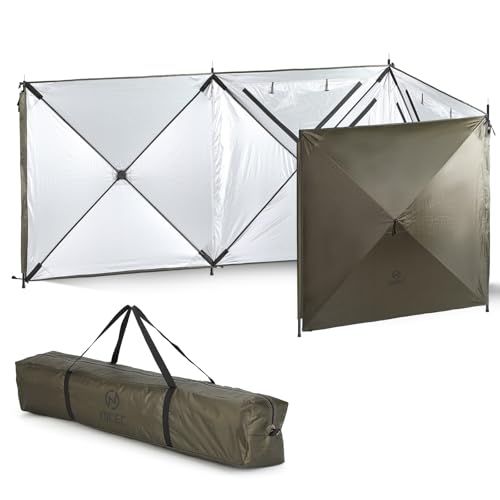
The Nice C 4FT Camping Wind Screen is a four-panel outdoor fabric barrier engineered to block wind, drifting sand, and low-angle sun around camp cooking stations, open campfires, and outdoor leisure areas. Sized at 187.6 inches long by 48 inches high, this windscreen is tailored specifically for car campers, RV travelers, overlanders, family campground groups, and beach visitors who want to create a calm microclimate in gusty conditions. Because it weighs approximately 11.75 pounds, it serves drive-up basecamps and tailgate areas rather than foot-travel wilderness expeditions.
Wind remains one of the fastest ways to lose cooking heat or fill a campsite with swirling campfire smoke. The Nice C windscreen addresses this with durable fabric panels combined with integrated mesh airflow windows. These upper vents permit just enough ventilation to equalize draft pressure and release campfire smoke, preventing the swirling eddy effects common with solid tarps. When placed around a two-burner camp stove or portable grill, the barrier helps protect flame stability and preserve fuel efficiency in breezy lakeside or desert environments.
The windscreen structure relies on reinforced support rods, tensioned pull cords, and included ground stakes to remain stable against steady breezes. Campers can adapt the four-panel barrier into several configurations, including a curved U-shape around a fire ring, an L-shape to shelter a picnic table corner, or a straight I-shape along a campsite property line for added privacy. Proper tension on the fixed ropes is critical for stability, particularly when setting up on windy coastal beaches or open dispersed camping parcels.
Constructed with reinforced fabric panels and robust vertical rods, the shelter is built to withstand repeated sun exposure and routine outdoor dust. When it is time to break camp, the unit folds down along its panel hinges and packs into a dedicated 35-inch transport bag. At under a foot wide when rolled and under twelve pounds, it packs flat in a vehicle cargo box or truck bed alongside coolers and camp cots. Maintenance simply requires wiping off sand or dust and ensuring the fabric is completely dry before long-term storage to prevent mildew.
While this windscreen excels at taming wind around sitting areas and cook stations, buyers should note its four-foot height only provides privacy while seated. Furthermore, the shelter relies entirely on ground stakes and guyline tension, which means pitching it on asphalt pads, wooden platforms, or loose powdery sand requires aftermarket weights or specialized sand pegs. For family campers, tailgate cooks, and car camping enthusiasts who regularly battle breezy afternoons, the Nice C 4-Panel Wind Screen represents a practical, versatile investment to make windy campsites significantly more comfortable.
Setting up the Nice C Wind Screen is straightforward, relying on the four hinged fabric panels, integrated upright support rods, and ground guylines. Campers unfold the panels to outline their chosen area, insert the upright poles into the ground, and secure the anchor points using the provided stakes and guy ropes. Adjusting rope tension ensures the fabric remains taut, which prevents excess flapping during sustained breezes.
The four-panel layout provides outstanding versatility across different campsite geometries. An I-shape orientation works well along property boundaries or picnic benches to shield a single prevailing wind direction. Shifting the setup into an L-shape offers corner protection for a camp kitchen table, while a three-sided U-shape encloses a fire pit or lounge chairs to create a cozy, sand-free outdoor living room.
The primary role of this shelter is interrupting sustained surface winds that can extinguish stove flames, scatter camp items, or blow sand into food. By standing 48 inches high across a broad 187.6-inch span, the fabric acts as a substantial buffer against coastal gusts and desert breezes.
The integrated mesh window design is an important engineering detail for camp comfort. Unlike solid barriers that create low-pressure pockets behind them, causing wind and campfire smoke to whip back into your face, these mesh panels allow partial air exchange. This equalizes pressure, lets smoke vent naturally upward, and preserves a clean, calm pocket of air on the sheltered side.

Pros
- Expansive 187.6-inch length provides comprehensive coverage for large camp circles, picnic tables, and cooking areas.
- Mesh window panels reduce air resistance against the fabric while actively drafting campfire and stove smoke away.
- Flexible four-panel design adapts to U-shape enclaves, right-angle corner blocks, or extended straight barriers.
- Supplied with a dedicated 35-inch carry sack, stakes, and guy lines for organized campsite pack-up.
Cons
- A 48-inch height primarily shields seated occupants and low camp stoves rather than standing adults.
- The 35-inch packed length and multi-pole design are intended for vehicle camping rather than foot-travel backpacking.
- Anchoring in loose beach sand or rocky ground may require specialized sandbags or heavy-duty aftermarket stakes.
The WGOS 4x16 FT Camping Wind Blocker is a large, four-panel freestanding windscreen engineered to shield outdoor living spaces from blustery breezes, blowing sand, and open-campground foot traffic. Measuring roughly 187.6 inches long by 48.4 inches high, this green fabric shelter is best suited for car campers, RV travelers, overland adventurers, beach enthusiasts, and family campground groups looking to establish a sheltered outdoor retreat. While the packed length and structural poles make it impractical for backpacking, it fits neatly into vehicle-supported setups where wind deflection and privacy enhance campsite comfort.
In real-world outdoor conditions, high winds can disrupt stove flame efficiency and drive irritating campfire smoke straight into camp chairs. The WGOS wind blocker addresses this challenge by incorporating breathable mesh window sections into the upper portion of the panels. This design feature lets just enough airflow pass through to relieve backdrafting and smoke swirling without sacrificing the lower windbreak needed to keep camp stoves burning steadily. On open coastal shorelines or barren plains campgrounds, the barrier effectively curbs blowing dust and sand, helping keep food prep surfaces clean.
The build quality centers on tear-resistant fabric supported by reinforced upright poles and pull-cord connection points. Because a fabric wall of this length acts naturally as a wind catch, structural stability relies on the supplied guy ropes and ground stakes. When guyed out properly at angle points, the screen forms a rigid buffer capable of withstanding steady winds. However, campers setting up on dry coastal sand or hardened gravel pads will find that standard stakes need careful placement, and substituting heavy-duty spiral stakes or sand anchors may be beneficial in demanding soil conditions.
A notable advantage of this four-panel system is setup versatility. Campers can arrange the screen in a straight-line I-shape along a campsite boundary, configure an L-shape to protect a corner camp kitchen, or set up a three-sided U-shape around a fire ring and folding chairs. Assembly and takedown proceed quickly once the poles and guy lines are laid out, and the entire system packs into the included 35-inch carry bag. Storing the fabric clean and fully dry between trips prevents moisture damage and preserves the green material for seasons of outdoor use.
While the 48-inch vertical height is well-suited for seated relaxation, campfire lounging, and standard table-height cooking, it does not create a full-height standing enclosure. Additionally, staking requires adequate clear ground around the perimeter for the guy lines. For drive-up campers, beachgoers, and tailgate hosts looking to tame gusty winds and gain campsite privacy, the WGOS 4-Panel Wind Blocker provides a durable, highly adaptable solution for vehicle-based outings.
The multi-panel articulation of the WGOS Camping Wind Blocker allows campers to customize their shelter footprint based on site constraints and wind direction. In a straight-line I-shape layout, the screen extends over 15 feet to mark a camp boundary or shield a long row of gear. An L-shape configuration creates a stable 90-degree corner barrier, which works exceptionally well for shielding portable camp stoves and food prep tables from crosswinds.
For campfire gatherings and family seating, the panels can be curved into an open U-shape that hugs lawn chairs and retains warmth from the fire pit. Proper staking is critical for stability in all shapes: each vertical pole should be kept upright while the guy ropes are tensioned outward at roughly 45-degree angles to balance the wind load evenly across the entire frame.
To ensure long-term durability, the WGOS windscreen should be thoroughly dried before long-term storage in its 35-inch carry bag. Storing synthetic fabrics while damp can encourage mildew and degrade fabric coatings over time. If the screen collects salt spray, mud, or campfire soot, wipe the panels clean with a damp cloth and mild soapy water, avoiding abrasive brushes or harsh chemical detergents.
Periodically inspect the pole sleeves, grommets, and guyline attachment points for signs of tension stress. Keeping ground stakes clean and free of caked dirt ensures easy insertion on subsequent trips, while checking guy ropes for fraying helps maintain dependable anchor strength in gusty outdoor environments.
Essential Campsite Privacy and Windbreak Questions
How do you keep a camping privacy screen stable in high winds?
Proper anchoring using angled ground stakes and tensioned guy lines keeps long fabric privacy screens stable against moderate wind gusts. Most large screens, such as eighteen-foot perimeter panels, act like sails if left unsupported. You should angle stakes forty-five degrees away from the pull direction and secure each support pole firmly into firm ground. Practicing shortening guy lines with knots allows you to eliminate slack quickly as changing weather stretches the fabric.
Can vehicle window screens provide privacy while car camping?
Yes, stretchable nylon-spandex window shades create a visual barrier from the outside while maintaining continuous insect protection and airflow inside the vehicle. High-density dark mesh restricts visibility into the cabin during daylight hours while blocking flies and mosquitoes. However, interior vehicle lights switched on after dark will silhouette occupants, so complete night privacy requires supplemental window covers.
What is the difference between a solid fabric windscreen and a screened panel with mesh windows?
Integrated mesh windows reduce wind resistance and smoke buildup, whereas completely solid fabric walls block all drafts and total line of sight. Solid polyester or nylon walls provide maximum visual seclusion around changing areas or utility spaces near emergency water storage containers. Screens featuring built-in mesh viewports allow cross-breezes to circulate around campfires or camp stoves without blowing embers into seating areas.
How much camp space does an 18-foot privacy screen cover?
An eighteen-foot privacy barrier can enclose an entire side of a standard vehicle or wrap around a picnic table in a three-sided U-shape. Straight-line setups span roughly fifteen to eighteen feet of perimeter fence, shielding parked vehicles or sleeping tents from open campground roads. In tight campsites, folding the panels into an L-shape creates an effective corner screen that requires less lateral clearance.
Are camping privacy screens light enough for backpacking trips?
No, freestanding multi-panel campsite privacy screens weigh between eight and ten pounds and are designed specifically for vehicle camping, RV sites, and car setups. The steel or reinforced poles, extensive fabric length, and steel pegs create substantial packed bulk that does not fit standard hiking backpacks. Hikers needing ultralight privacy typically rely on multi-use tarps or natural terrain features instead.
Can a camping windscreen be used safely around a campfire?
Camping windscreens must be placed several feet away from open flames to avoid heat damage and spark embers. While these screens buffer campfire smoke and stop gusts from scattering ashes, synthetic fabrics will melt or burn if placed too close to a roaring fire pit. Positioning the windscreen on the upwind side of your fire ring gives optimal wind diversion without exposing the material to intense heat.







Write Your Review
No reviews yet. Be the first to share your experience!