


A refrigerator can often keep cooling even if its water filter is removed, but the dispenser and ice maker may not work correctly without a filter or approved bypass. The answer to can i use my refrigerator without the water filter depends on the refrigerator’s design, the water line connection, and whether the model requires a filter bypass plug.
That distinction matters if a cartridge is overdue, a replacement is hard to find, or you’re trying to diagnose weak water flow. Running the refrigerator without its filter does not mean the unfiltered water is safe or suitable for your household; it only describes how the appliance may operate. Check the owner’s manual for the exact model before removing a cartridge or changing the water connection. For context on other point-of-use setups, see this guide to inline water filter installation and this overview of non-RO water purification options.
Pros
- Noticeable improvement in water taste and ice clarity by removing chlorine flavors
- Simple DIY install with color-coded quick-connect tubing and mounting hardware
- Extended 1,500-gallon filter life reduces replacement frequency on long travel seasons
- Compact folding footprint stows away easily inside tight RV and camp galley cabinetry
Cons
- Physical footprint is larger than standard internal pencil-style fridge filters
- Occasional fitting leaks reported if tubing is not pushed fully into quick-connect collars
- Initial system investment is higher than basic single-stage carbon replacements
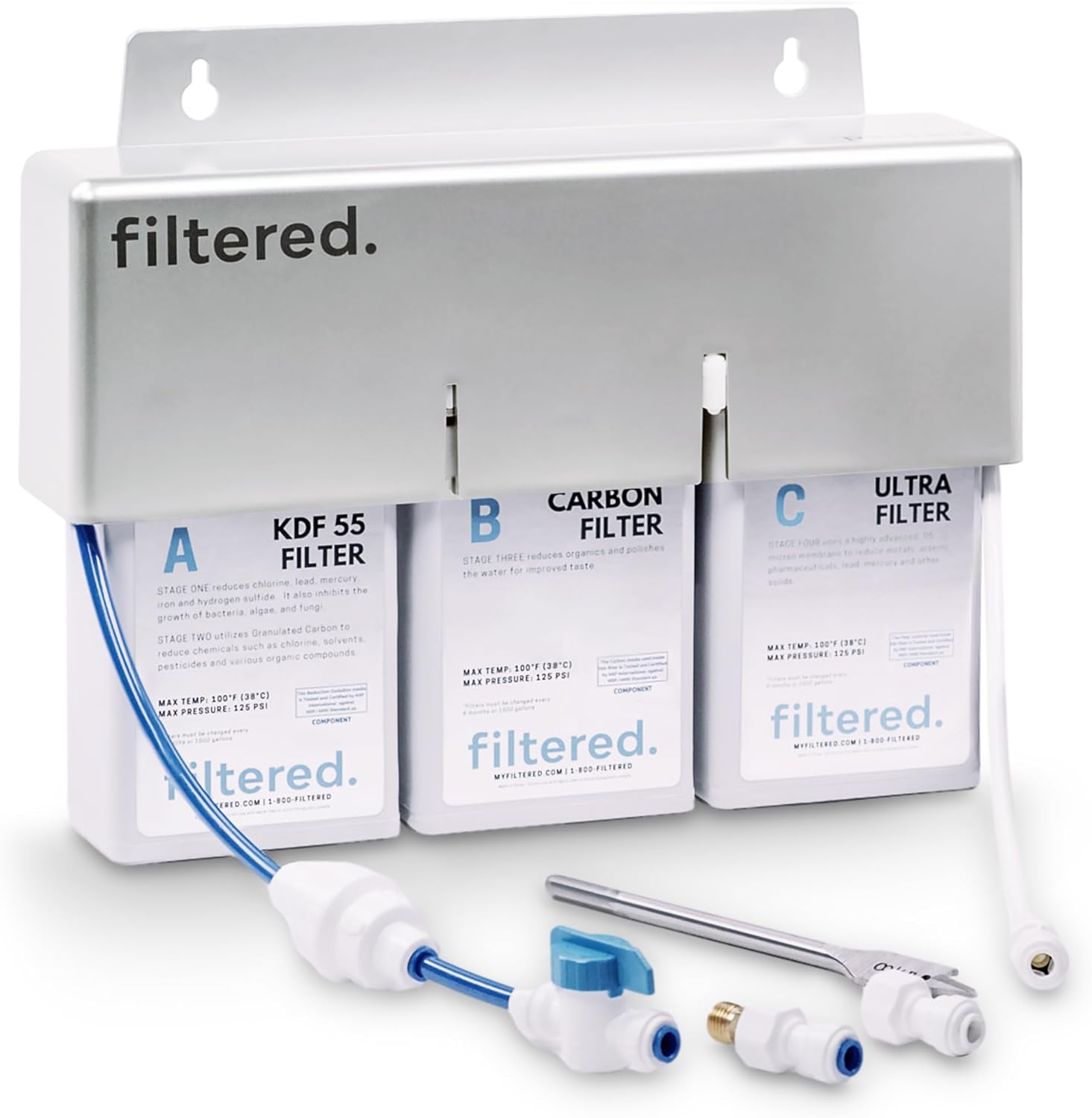
The filtered. Universal Inline Water Filter is a high-capacity multi-stage filtration system engineered to supply clean, great-tasting water directly to refrigerators, ice makers, and mobile galleys. While originally intended for residential kitchens, this inline unit has quickly become a valuable addition for RV campers, travel trailer owners, overlanders with built-in camper refrigeration, and hunting cabin caretakers. Anyone looking to upgrade their off-grid basecamp or home hydration setup without hauling flats of single-use plastic bottles will appreciate its high-volume output.
Real-world water quality can vary wildly when filling freshwater tanks at state parks, public dump stations, or well-supplied rural campgrounds. This filter addresses that challenge through a 4-stage ultrafiltration core utilizing both KDF media and granular activated carbon. The KDF layer strips out heavy metals and neutralizes chlorine before it reaches the carbon, preserving the carbon bed for deeper contaminant reduction and long-term odor control. As a result, camp coffee tastes fresher, drinking water lacks chemical aftertastes, and ice cubes freeze significantly clearer even when sourced from questionable hookups.
Constructed from durable molded plastics with a rigid mounting bracket, the unit measures 2.5 inches deep by 11.5 inches wide and 10 inches tall. Weighing roughly six pounds, it features a patented folding configuration that slips neatly into narrow gaps, such as the utility compartment behind an RV fridge or adjacent camp cabinetry. The filtration housing feels sturdy enough to withstand the vibrations of bumpy washboard backroads, while the pre-drilled bracket provides secure anchoring points to prevent bouncing while towing.
Installation is refreshingly straightforward thanks to clearly labeled color-coded tubing and standard push-connect fittings. Most users find that mounting the unit and splicing into existing 1/4-inch water lines takes fifteen minutes or less with basic household tools. The system is rated for up to 1,500 gallons or six months of regular use, which easily covers a full season of cross-country touring or weekend camping trips. When replacement time arrives, swapping the media canisters is clean and self-contained without drenching galley flooring.
There are a few considerations to keep in mind before purchasing. At nearly a foot across, it demands more clearance than skinny inline disposable cartridges, meaning tight camper van galleys need careful measurement before mounting. Additionally, users must ensure the plastic tubing is cut completely square and seated firmly to avoid slow drip leaks at the connectors under pump pressure. For RVers, weekend warriors, and cabin enthusiasts seeking reliable bottled-quality hydration right from their dispenser, this inline system represents a durable and cost-effective upgrade.
Setting up this inline filtration kit in a camper, trailer, or home kitchen requires minimal mechanical skill. The package supplies pre-drilled bracket mounting holes and color-coded push-fit lines that guide the water supply smoothly into and out of the multi-stage manifold. Splicing the kit into standard cold-water lines takes just a few minutes without soldering or specialty pipe wrenches.
For travel trailer and camper van owners, securing the system inside a neighboring cabinet or behind the refrigerator panel keeps the unit safely anchored across bumpy forest service roads. Ensuring clean, 90-degree cuts on your supply tubing and pressing each line past the inner O-ring will prevent any nuisance drips inside your living space.
Using a Refrigerator With Its Water Filter Removed
In many models, refrigeration continues normally without a water filter because cooling and water dispensing are separate functions. The dispenser or ice maker may stop, leak, deliver a reduced stream, or show a filter warning if the appliance expects a cartridge or bypass plug. The model’s manual is the deciding source, since manufacturers use different filter locations and water-routing designs. Do not assume that an empty filter slot is an approved operating configuration.
Why filter removal can affect water and ice
A refrigerator water filter sits in the appliance’s water path, usually to reduce selected substances that affect taste or odor. The filter also forms part of the plumbing connection in some designs, so removing it may interrupt the path or leave a connection that is not meant to operate open. A model designed for a bypass plug may need that part installed to route water around the cartridge. Other models may have a different arrangement, so the correct answer must come from the manufacturer’s instructions.
The filter’s presence does not determine whether the refrigerator itself can cool food. But it can determine whether the dispenser and ice maker receive water as intended. If the appliance has a separate water dispenser and ice maker, both may be affected by the same supply path, although the symptoms can vary with the model. A display warning, no water, slow dispensing, or interrupted ice production should prompt a check of the manual and connection, not an improvised plumbing workaround.
Check the model before taking out the cartridge
Find the refrigerator’s full model number, then look up its owner’s manual or manufacturer support page. Check whether the instructions say a filter bypass plug is required when the cartridge is absent, whether the appliance has an automatic bypass, or whether the water functions should not be used without the filter. A bypass plug is not necessarily universal, and a part that looks similar may not seal or connect properly. Use only the part specified for the appliance.
Also identify where the filter sits. Some cartridges install inside the refrigerator; others connect externally to the water line. That difference changes what the homeowner is actually removing: an internal cartridge, an inline filter, or a component in a plumbing connection. Follow the appliance and filter manufacturers’ directions rather than relying on a generic video or instructions for another refrigerator. If the water line connection is unclear, a licensed plumber or the manufacturer’s service team can help identify the proper arrangement.
What to expect from a bypass plug
A bypass plug is a model-specific component intended to let water pass through the refrigerator when the filter cartridge is not installed. It is not a filter and does not reduce contaminants. Whether the dispenser and ice maker operate with one installed depends on the refrigerator’s design and the manufacturer’s instructions. Check the manual for the correct part and installation guidance, and do not force a plug into a filter housing that does not accept it.
Do not treat a bypass plug as proof that the water is filtered elsewhere. If the household supply has a chlorine taste, sediment, or a contaminant concern, the bypass only changes the appliance’s water route. It does not make the water safer, and an external filter should only be relied on for substances its documentation supports. A water-quality concern may call for checking a local water report or arranging appropriate testing, especially for a private well.
How to tell whether the filter is causing a problem
A clogged or overdue cartridge can contribute to a slow dispenser, but other causes are possible, including a closed supply valve, a kinked line, a frozen line, or an appliance fault. Start with simple observations: confirm the refrigerator is connected to its water supply, look for a visible kink, and check the filter status indicator if the model has one. Compare the symptoms with the manual’s troubleshooting guidance. Do not disconnect a pressurized line or open a plumbing fitting unless you can follow the manufacturer’s safety instructions.
If water flow returns after a correctly specified replacement cartridge or bypass plug is installed according to the manual, that points toward the filter path as a factor, but it does not establish the condition of the rest of the water system. If flow remains poor, the issue may be elsewhere. A leak, unusual noise, water pooling, or a connection that will not seat correctly is a reason to stop and seek service rather than keep cycling parts. Avoid repeatedly removing and reinstalling a cartridge if the instructions do not call for it.
Ice production can take time to resume after a water-path change, and the expected timing varies by appliance. Use the manual’s directions for flushing a new cartridge and restarting water service. If it specifies discarding initial dispensed water or ice, follow that instruction. Do not invent a flush volume based on a different filter, since cartridge media and refrigerator designs differ.
Unfiltered water is not the same as filtered water
Removing a refrigerator cartridge may leave water from the home supply available, but the appliance no longer provides the reduction associated with that cartridge. The substances a filter can reduce depend on its design and verified performance information. A generic claim such as “clean water” does not identify specific contaminants or prove a particular reduction. Check the cartridge documentation for the exact claims and any relevant third-party certification rather than assuming all refrigerator filters do the same job.
Basic carbon filtration is commonly used for taste and odor concerns, but a carbon cartridge should not be assumed to remove fluoride, dissolved minerals, or every health-related contaminant. Nor does a refrigerator filter make microbiologically unsafe water safe to drink. If there is a boil-water advisory, follow the public health authority’s directions; a refrigerator filter or bypass is not a substitute. For suspected lead, PFAS, arsenic, or well-water contamination, use suitable water testing and select treatment based on documented performance for the specific issue.
Those limits matter when deciding whether to keep using the dispenser during a gap between cartridges. If the household depends on the refrigerator filter for a specific reduction, using the water path without that cartridge removes that treatment step. A separate under-sink or inline system may be an option, but only if its compatibility and performance documentation match the water concern. The refrigerator’s bypass does not add that outside treatment or confirm that it is correctly installed.
Replacing the filter versus operating without it
For regular use of filtered refrigerator water, replacing the cartridge with the correct model is usually the straightforward path. Confirm the refrigerator model and filter part number before ordering; similar-looking cartridges can differ in connection, fit, or stated treatment performance. Follow the supplied instructions for installation, flushing, and resetting the filter indicator. A reminder light is useful, but it does not independently test water quality or confirm that a cartridge is reducing a particular contaminant.
The product listed above, an inline refrigerator and ice maker filter, is described as a universal four-stage ultrafiltration system for refrigerators with a water dispensing feature. Its listing says it can be installed on top of a refrigerator or inside neighboring cabinetry, includes fittings and installation guidance, and has a stated service life of up to six months or 1,500 gallons, whichever comes first. Those are manufacturer-provided specifications, not a substitute for checking whether the specific refrigerator connection, water line, and installation location are suitable.
The supplied product information does not identify specific contaminant reduction percentages or list NSF/ANSI certifications. That absence matters if your purchase decision depends on verified lead, PFAS, or another health-related contaminant reduction. Request or locate documentation for the exact model and target contaminant before relying on it for that purpose. Also consider the recurring replacement schedule stated by the manufacturer and whether you can obtain the correct cartridges when due.
Installation and water-line precautions
An external inline filter introduces extra connections in the refrigerator’s water line. The listed kit is described as a do-it-yourself installation with color-coded tubing, fittings, and instructions, but that does not establish suitability for every plumbing arrangement. Read the product instructions and refrigerator manual together before installation. Verify the required connection points and available space, and do not cut, force, or adapt tubing based on guesswork.
Water lines can be pressurized, and an incorrectly seated fitting can leak after installation. Follow the manufacturer’s shutoff and installation directions, check local plumbing requirements, and consult a licensed plumber if you are unsure how to isolate or reconnect the line. Do not bypass a pressure regulator, check valve, or backflow device. After work is complete, inspect the connections for leakage as directed by the manuals, and address any dampness or dripping promptly.
Placement also affects serviceability. The product listing describes mounting on the refrigerator or in nearby cabinetry, so choose a location that follows its instructions and leaves access for inspection and cartridge replacement. Avoid hiding connections where a slow leak could go unnoticed. If the appliance is built in or the water line is difficult to reach, professional installation may be a sensible way to reduce the chance of damage to cabinetry or flooring.
Deciding what to do while a replacement is unavailable
If the correct cartridge is temporarily unavailable, first confirm whether the manual allows use of a specified bypass plug. If it does not, avoid assuming that removing the cartridge alone will preserve water service. You can use another source of drinking water while obtaining the correct part, particularly if the refrigerator filter is part of a treatment plan for a known contaminant. That avoids relying on an unfiltered route whose operation and treatment status you have not verified.
If the manual confirms that a bypass is supported and the plug is correctly installed, the refrigerator may be able to dispense supply water without the cartridge. The water will not receive treatment from the missing filter. Whether that is acceptable depends on the household water supply and the reason the filter was being used. A taste preference is different from a treatment need tied to a documented contaminant, so make the decision on that distinction.
Do not continue using a damaged, leaking, or incorrectly seated cartridge simply to avoid a gap in filtration. Stop using the dispenser if you see leakage or cannot establish that the connection is secure. Follow the appliance manual for service and shutoff guidance. If water has contacted electrical components or is pooling under the refrigerator, contact the manufacturer or a qualified service provider rather than troubleshooting around the leak.
A practical decision for your refrigerator
The short answer is that the refrigerator may cool without its water filter, while water dispensing and ice-making depend on the model and its approved bypass arrangement. Check the manual and model-specific parts information before removing a cartridge, and do not assume an open filter slot is safe to use. If a bypass is supported, remember that it routes water without filtering it. If filtered water is important for a known taste or contaminant concern, replace the correct cartridge or use a separately verified treatment option.
After a cartridge or bypass change, follow the manufacturer’s startup and flushing instructions and inspect the water connections as directed. Persistent low flow, a leak, or an error message that the manual does not resolve calls for appliance service or plumbing help. The safest choice is not simply “filter in” or “filter out”; it is using the refrigerator exactly as designed while being clear about whether the water is actually being treated.




Write Your Review
No reviews yet. Be the first to share your experience!