

Sharp tap taste or sluggish flow? Start here
A strong chlorine taste can make a glass of tap water less appealing, while grit and rust can collect in plumbing and clog fixtures. A high flow water filter can help address some of those everyday frustrations, but the right setup depends on where it goes and what your water needs. These picks cover under-sink drinking water, whole-house filtration, reverse osmosis, and an inline option for RV hoses.
We reviewed the listed specifications, including flow rate, filter capacity, media, and stated NSF/ANSI standards, to make the differences easier to weigh. Carbon filtration can improve taste and reduce chlorine, while reverse osmosis is designed for broader contaminant reduction; neither approach should be treated as a substitute for checking your local water report or testing a private well. For an RV connection, this inline RV water filter installation guide can help you plan the hose setup. If you’re weighing a simpler household alternative to RO, see this overview of non-RO water purifiers for home.
The products aren’t interchangeable: a whole-house system treats water at the home’s entry point, while an under-sink unit focuses on a drinking-water faucet. An RV inline filter is made for hose connections, and the iSpring RO system uses a different filtration process and requires its own under-sink space. Check your connection type, expected maintenance, and target contaminants before buying. That bit of homework can save you from mismatched fittings or a filter that doesn’t address your actual water concern.

Pros
- Massive capacity means fewer filter changes during cross-country camper travel or extended road trips.
- Simple plug-and-play installation fits standard RV and residential cold water plumbing lines without drilling.
- High 2.5 GPM flow rate delivers robust stream pressure for camp dishwashing and cooking pot fills.
- Certified lead-free construction with food-grade, BPA-free coconut shell carbon block media.
Cons
- Designed strictly for treated municipal or pre-filtered potable water lines, not for raw backcountry creek water with biological pathogens.
- Cold water supply line connection only; cannot be plumbed to hot water feeds.
- Does not reduce Total Dissolved Solids (TDS), as it intentionally retains dissolved minerals.
Clean drinking water is the backbone of any successful outdoor journey, whether you are staging an overland rig for an off-grid excursion, outfitting a camper van, or keeping an RV galley functional for extended road trips. The ICEPURE WFS5300A Under Sink Water Filter System is a high-capacity, direct-connect inline filtration unit engineered to supply crisp, refreshing water straight from your primary sink faucet. Designed to plumb directly into standard cold water feeds, it eliminates the need to carry bulky flats of disposable plastic water bottles into the backcountry or crowd your camp cooler with water jugs.
For RV campers, travel trailer owners, conversion van builders, and cabin retreat caretakers, water quality can vary wildly from campground spigots to municipal fill stations. This system tackles that unpredictability with authoritative NSF/ANSI 42 and 372 certifications. Its 0.5-micron outer layer paired with an advanced coconut shell carbon block filter captures particulate sediment, sand, and rust while significantly reducing chlorine, disagreeable odors, and harsh tastes. At the same time, it preserves beneficial minerals in the water, giving you refreshing hydration for filling camp kettles at dawn or topping off daypacks before hitting the trail.
Camp kitchen efficiency depends on good water pressure, and this unit delivers a generous full flow rate of 2.5 gallons per minute at 60 PSI. Many compact filters throttle flow down to a frustrating dribble, but this setup allows you to scrub camp cookware, wash fresh vegetables, and fill multi-gallon hydration bladders without delay. With an ultra-long service rating of 22,000 gallons or roughly three years under normal municipal conditions, it offers incredible endurance for seasonal travelers and full-time road trippers who want minimal maintenance between adventures.
Build quality and spatial practicality are paramount when outfitting mobile living quarters. Measuring just 6.81 inches long, 5.39 inches wide, and 15.55 inches tall, the cylindrical filter housing slides into tight spaces beside RV drainage pipes or under narrow van sink cabinets. The kit includes hardware compatible with both 3/8-inch and 1/2-inch female NPT cold water lines. Once the head assembly is anchored to a cabinet wall, future filter cartridge swaps take only a couple of seconds using a simple twist-and-lock mechanism, requiring no specialty tools or messy plumbing disassembly.
Prospective buyers should keep in mind that this unit is engineered strictly for municipal tap water, RV park utility hookups, or potable holding tanks. It is not designed to purify untreated raw surface water from streams, lakes, or stagnant puddles that might harbor cysts, viruses, or bacteria. For weekend warriors, overland vehicle builders, emergency preparedness organizers, and camper families looking for reliable, odor-free, high-flow water right at the galley sink, this inline system represents an exceptional, hassle-free upgrade.
Installing this filter inside a camper van or recreational vehicle is straightforward thanks to the included inline fittings that link directly into standard 1/2-inch or 3/8-inch cold water connections. Because it runs inline with your existing galley faucet, you avoid drilling additional holes in your countertop for an auxiliary dispenser.
When running off a 12-volt RV diaphragm pump, the system maintains steady output with minimal pressure drop, ensuring quick fills for coffee carafes and cookware. Ensure that the mounting bracket is securely fastened to a sturdy cabinet partition so the filter stays firmly upright during bumpy gravel road travel and trail washboards.
Taking proper care of your inline water filter ensures optimal performance throughout the camping season. If you are winterizing an RV, travel trailer, or unheated mountain cabin, always remove the filter cartridge before pumping non-toxic RV antifreeze through your plumbing lines, as antifreeze can ruin the carbon block media.
Store the detached cartridge in a cool, clean spot above freezing temperatures during the off-season. When de-winterizing your camp rig in the spring, flush your water lines completely with fresh potable water before twisting the filter cartridge back into the mounting head.
Pros
- NSF/ANSI certified for contaminant reduction, giving you peace of mind about water safety
- Easy to install – simply connect to your hose and RV or faucet – no tools required
- Made in the USA with high-quality materials and patented technology for reliable performance
- High water flow rate keeps your tank filling fast and your camp kitchen running smoothly
- Versatile enough for not just RVs but also boats, home gardening, pet water stations, and car detailing
Cons
- Designed for RV and hose use – not suitable for backpacking or hydration bladder systems due to size and weight
- Filters require periodic replacement (typically every 3-6 months) depending on water quality and usage
- The plastic housing may feel less premium than metal filters, though it is durable for typical camping conditions
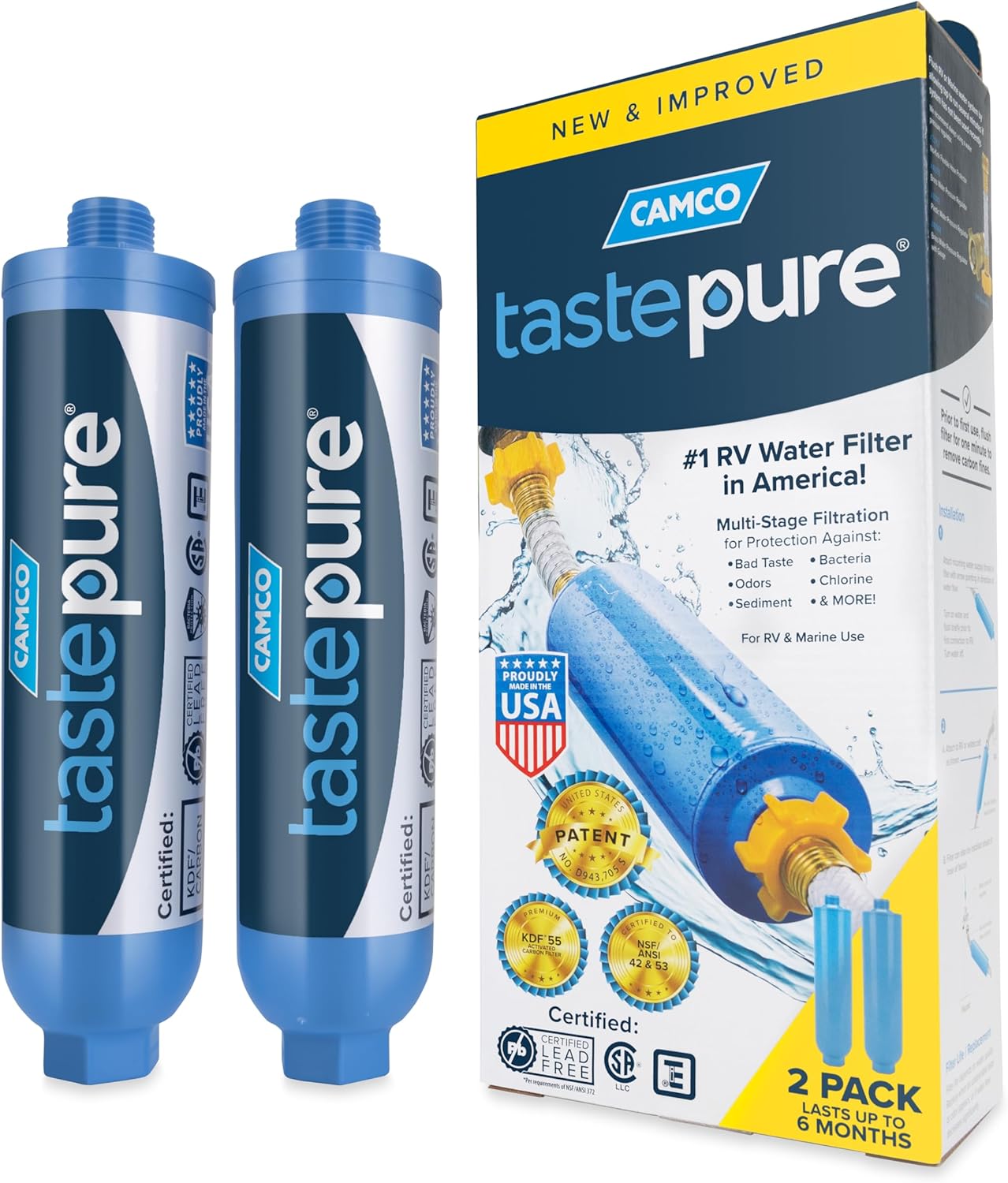
When you are out camping in your RV or setting up a base camp for a weekend trip, having access to clean, safe drinking water is more than a convenience – it is a necessity. The Camco Tastepure RV Water Filter is built specifically for that purpose. This 2-pack of inline water filters uses a patented 6-step filtration process called Hex-Flow Technology to reduce chlorine, bad tastes, odors, sediment, and even control bacteria and mold growth when the filter is not in use. Whether you are filling your fresh water tank, hooking up a hose for your camp kitchen, or using it for your dog’s water bowl, this filter helps ensure what comes out is noticeably cleaner and better tasting.
The Camco Tastepure is ideal for RV campers, car campers, overlanders, and anyone who spends time in a vehicle or trailer. It is also great for boat owners, gardeners, and pet owners who want to remove the heavy chlorine taste from tap water. Because it connects to any standard garden hose, it works well for beach camping where you might hook up to a spigot, or for festival campers looking for better water quality at the grounds. However, this is not a backpacking water filter – it is designed for pressurized hose systems and is larger than portable pump or gravity filters, so it is best for car or RV-based adventures.
In terms of real-world performance, the filter’s 20-micron sediment layer catches sand and silt before they enter your RV’s plumbing, while the granular activated carbon (GAC) and KDF media reduce chlorine and other impurities. The wide-body design maintains a high flow rate, so you won’t be waiting forever to fill a tank or a pot. Many users report a noticeable improvement in taste and odor, especially if you are used to heavily chlorinated campground water. The filter is certified to NSF/ANSI 42 (aesthetic effects) and 53 (health effects), and is also CSA lead-free certified – so you can trust it meets strict safety standards. This is especially reassuring if you are bringing kids or pets along.
Build quality is solid: the housing is impact-resistant plastic, and the O-rings provide a leak-free seal when installed correctly. Being made in the USA with patented technology adds to the confidence. One practical note – you should flush the system for a few minutes before first use to purge any loose carbon dust. The filter works best when replaced every three to six months depending on how much you use it and the source water quality. The two-pack means you have a spare ready to go, which is handy for long trips or when you forget to order a replacement.
Setup is simple: screw the filter onto your hose (male to female threads) and connect the other end to your RV inlet or faucet. No tools or special brackets are needed. The filter hangs inline, so just make sure it is supported to avoid putting stress on the connections. The only limitation is that it is not designed for hot water or continuous pressure, so you will want to disconnect it when not in use or during freezing temperatures. Also, serious backcountry backpackers will want a lighter, pump-style filter for streams.
Overall, the Camco Tastepure RV Water Filter is a practical, affordable solution for cleaner water on your camping trips. If you travel with an RV, camper van, or even just use a hose at a campground, this filter can make a real difference in water quality and taste. The two-pack offers good value, and the independent certifications give you confidence. For any American camper who wants to avoid the chemical taste and uncertainty of campground water, this is a solid choice.

Pros
- Alkaline remineralization stage balances pH for refreshing, clean-tasting drinking water
- Operates without electricity using standard water line pressure
- Clear first-stage housing allows easy monitoring of sediment accumulation
- Top-mounted faucet installation eases setup in cramped camper and cabin cabinets
- High 75 GPD output easily supports group camp kitchens and multi-day hydration prep
Cons
- Requires a pressurized water supply, making it unsuitable for unpressurized backcountry streams
- Under-sink footprint and storage tank require dedicated storage space in compact rigs
- Produces standard reverse osmosis wastewater during the purification process
The iSpring RCC7AK is a comprehensive 6-stage under-sink reverse osmosis water filtration system engineered to produce purified drinking water with added alkaline minerals. Designed to operate entirely on water line pressure without electricity, this system provides a dependable water purification solution for fixed basecamps, hunting cabins, RV campers, and home emergency preparedness stations. By combining high-level filtration with a dedicated remineralization stage, it addresses common water quality concerns encountered when sourcing water from diverse campground hookups, rural wells, or municipal systems.
This filtration system is particularly suited for RV campers, overlanders with built-in plumbing, cabin owners, and emergency preparedness planners who need consistent water purification for groups and extended stays. Family campers and weekend warriors who frequently fill large water jugs, hydration bladders, and camp kitchen cookware before heading out to remote trailheads can also benefit from having a high-output purification hub at home or in their mobile setup.
Based on product specifications, the multi-stage setup includes sediment filtration, dual carbon block stages, a reverse osmosis membrane, and an alkaline remineralization stage. It removes contaminants including chlorine, lead, fluoride, PFAS, and heavy metals, while the transparent first-stage canister makes it easy to monitor sediment accumulation from gritty campground supplies. Because the system can produce up to 75 gallons per day and includes a pressurized storage tank, users get on-demand flow suitable for washing produce, boiling camp meals, and filling multiple hydration reservoirs without long waiting times.
In terms of hardware and build quality, the unit features standard quick-connect fittings, color-coded tubing, and a brushed nickel dedicated faucet. The patented top-mounted faucet design allows the faucet to be fastened securely from above the counter, which avoids difficult maneuvering inside tight RV or cabin cabinetry. The included housing wrench and clear manual facilitate DIY installation and regular filter replacements across seasonal outdoor cycles.
A realistic limitation is that reverse osmosis systems require a pressurized water line between 45 and 70 PSI to function efficiently, meaning it cannot filter unpressurized water directly from a backcountry creek without a separate pump. Additionally, the system and its storage tank occupy noticeable space under a sink, which requires thoughtful layout planning in compact camper van conversions or small travel trailers.
For RV travelers, basecamp managers, and emergency preppers seeking dependable water treatment without relying on electrical power, the iSpring RCC7AK offers high-capacity purification and mineral balancing. It serves as a practical, high-volume hydration solution for outdoor enthusiasts who prioritize clean drinking water across their road trips, cabin retreats, and wilderness preparations.
Installing this unit in an RV, overland rig, or off-grid cabin requires a secure under-sink mounting location and adequate water pressure from an onboard 12-volt pump or city water hookup. Quick-connect push fittings make routing the color-coded lines straightforward even in tighter spaces.
Because the top-mounted faucet secures from above the countertop, securing the hardware does not require awkward reaching beneath cramped camper sinks. The included pressurized holding tank ensures that purified drinking water is readily available on demand for filling camp thermoses, boiling trail meals, or quenching thirst after a day on the hiking trail.
Routine maintenance for this reverse osmosis unit involves replacing the pre-filters on a scheduled basis to protect the RO membrane. The transparent first-stage sediment filter lets you see sediment buildup at a glance, which is especially helpful when dealing with varying water quality at different campgrounds or well water sources.
Replacing the three lower pre-filter cartridges is typically recommended every 6 to 12 months depending on water usage and source clarity, while the reverse osmosis membrane and alkaline remineralization filter generally last 1 to 3 years. Winterizing the system by fully draining the storage tank and housing canisters is essential for RV campers and seasonal cabin owners to prevent freezing damage during cold months.
Pros
- High 15 GPM flow rate supports multiple camp faucets and showers simultaneously without pressure loss
- Dual-stage filtration effectively reduces chlorine, bad taste, rust particles, and sediment down to 5 microns
- Durable food-grade housing stands up to continuous water pressures between 25 and 90 PSI
- Massive 50,000-gallon filter life keeps seasonal maintenance down for cabins and permanent campsites
Cons
- At over 18 pounds, it is strictly suited for stationary setups, RV basecamps, or cabins rather than portable car camping
- Threaded inlet and outlet ports require thorough taping or specific polypropylene fittings to prevent connection leaks
- Plastic housing wrench can slip on tight casings during filter swaps if not aligned carefully
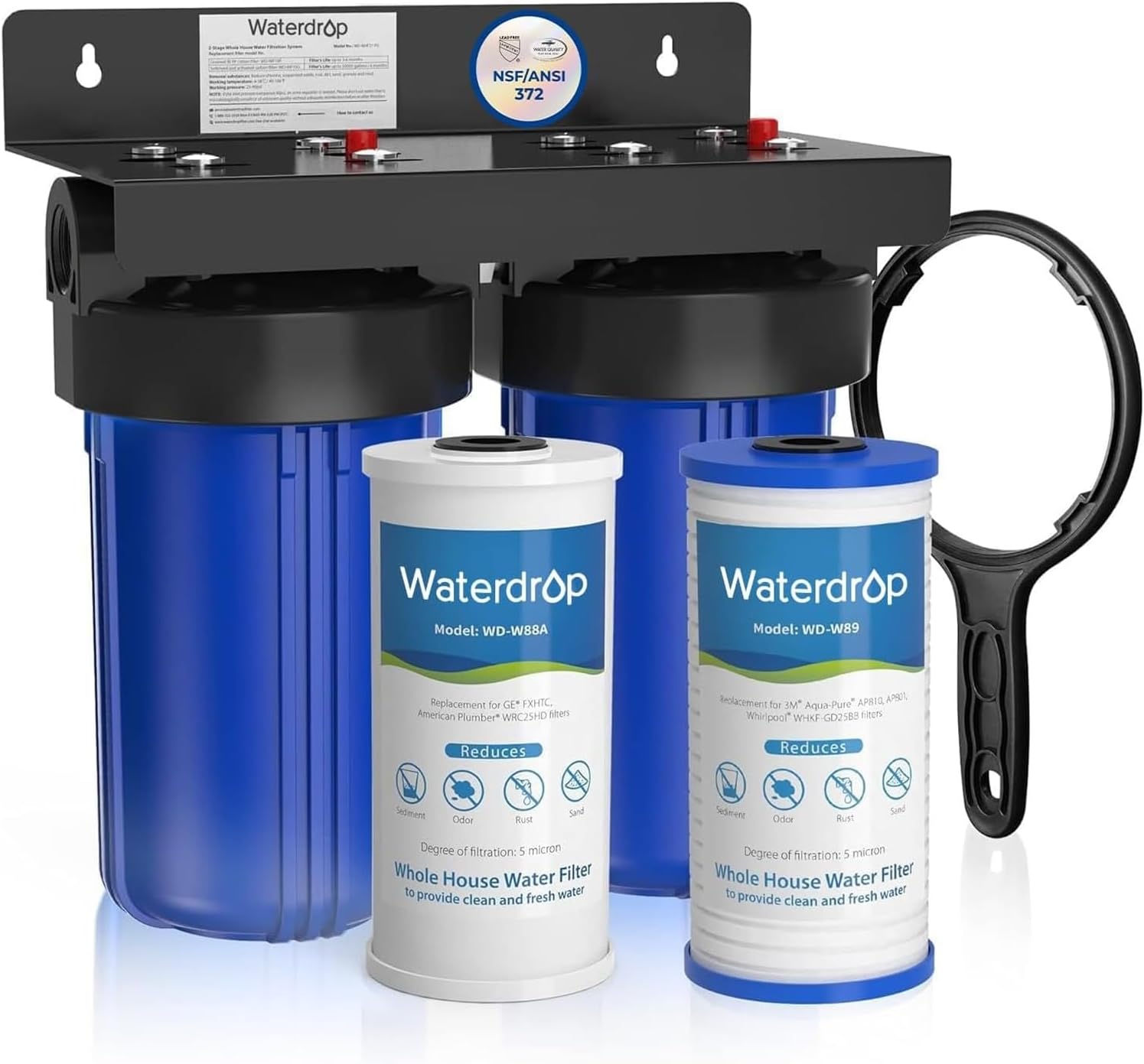
The Waterdrop WD-WHF21-PG is a heavy-duty two-stage water filtration system designed to bring high-volume water purification to off-grid cabins, RV basecamps, overlanding rigs, and emergency water storage setups. While too substantial for a backpacker's trail pack, this system shines for RV campers, rural homesteaders, family group camps, and outdoorsmen managing water hookups from wells, holding tanks, or rustic campground spigots. By tackling sediment, rust, chlorine, and unappealing organic tastes before water enters your living space, it provides continuous hydration and clean utility water for long weekends in the backcountry or extended seasonal stays.
Performance in off-grid and campsite environments depends on both filtration thoroughness and water flow rate. This unit features a dual-canister design that combines a 5-micron polypropylene sediment filter with a coconut-shell granular activated carbon filter. According to product specifications, it delivers an impressive flow rate of up to 15 gallons per minute, which means you will not experience sluggish pressure when washing cookware at an outdoor camp kitchen or taking a hot shower inside an RV. The multi-stage mechanical and carbon filtration setup targets suspended silt, sand, chlorine, and chemical odors, making questionable campground water supplies much more palatable for drinking and cooking.
The build quality centers around thick, food-grade polypropylene filter housings engineered to withstand everyday water pressure ranges between 25 and 90 PSI. The housings are built to resist cracking and have undergone pressure cycle tests, providing peace of mind when connected to unpredictable municipal campground pressures or off-grid water pumps. Integrated red pressure relief buttons on top of each canister make depressurizing the system easy before filter swaps. User feedback indicates that while the reinforced housing is sturdy, the 1-inch female threaded ports require careful handling, generous Teflon tape, or matching plastic adapters to achieve a leak-free seal against metal or PEX plumbing lines.
Setting up the filtration unit at a basecamp or cabin is relatively straightforward for anyone comfortable with basic DIY plumbing. The system includes a mounting bracket, housing wrench, Teflon tape, and expansion hardware for wall securing. Routine maintenance is manageable, with sediment cartridges lasting between three and six months and carbon filters typically lasting around six months, depending on the clarity of your water source. When winterizing your RV or packing down an off-grid shelter for the season, the canisters unscrew smoothly using the supplied wrench so you can drain the water completely and avoid freeze damage.
As with any high-capacity filtration gear, there are practical boundaries to keep in mind. At over 18 pounds, this system is strictly a stationary asset for RV trailers, hunting cabins, basecamps, and home emergency supply stations. Furthermore, some user reports note that the plastic wrench can slip against the housing if tightened excessively, and careful attention must be paid to inlet fittings to avoid small leaks. For outdoorsmen, cabin dwellers, and dedicated RV road warriors seeking a reliable, high-volume defense against murky sediment and unpleasant water odors, this Waterdrop filtration system offers substantial protection and consistent flow for all your outdoor living needs.
Integrating this filtration unit into an off-grid cabin or RV basecamp requires planning out your plumbing line connections. The system features 1-inch NPT female ports, which can easily be adapted down to 3/4-inch PEX, brass nipples, or heavy-duty polypropylene fittings to match common RV and camp plumbing.
User experiences highlight that utilizing high-grade thread seal tape combined with pipe compound or choosing polypropylene male adapters yields the tightest seal against the filter housing. Installing a bypass loop around the dual canisters allows continuous water flow during routine filter swaps without shutting down your entire camp water line.
Mounting the heavy-duty metal bracket securely against a sturdy camper exterior bay wall or cabin stud prevents strain on plumbing joints. For seasonal campers, ensuring the unit is mounted in an accessible spot allows quick visual checks for sediment buildup through the intake stages.
Maintaining proper water quality across extended camping trips involves periodic inspection of both filter cartridges. The first-stage sediment filter should typically be checked every three to four months, especially if drawing from murky well lines, while the carbon block filter generally lasts up to six months under standard municipal and recreational usage.
Before unscrewing the filter housings, turn off the water supply and depress the built-in red pressure relief buttons on top of each cap to release residual pressure. Applying a light coat of food-grade silicone grease to the housing O-rings during each filter replacement prevents friction tears and ensures an airtight seal upon reassembly.
When closing camp ahead of freezing winter weather, thoroughly unscrew both canisters, remove the wet filter media, and drain all standing water from the housing heads. Freezing trapped water can easily crack polypropylene bodies, so storing the unit dry in a temperature-controlled space between camping seasons ensures long-lasting durability.

FAQs
Which option suits a home that needs stronger flow?
The Waterdrop Whole House Water Filter System lists a 15 GPM flow rate, while ICEPURE lists 2.5 GPM at 60 PSI for its under-sink system. These figures describe different installation types, so compare them with your household demand and plumbing setup. A whole-house system may suit multiple fixtures; an under-sink filter treats water at a single point.
Can these filters treat private well water?
Not every listed system is specified for every well-water concern. The product details describe sediment and taste-related reduction for some options, but do not establish treatment for issues such as iron, sulfur, or bacteria across all models. Test well water first and match the result to a system with documented claims for those contaminants.
What is the difference between carbon filtration and reverse osmosis?
Carbon filtration is commonly used to reduce chlorine taste and odor, while reverse osmosis uses a membrane to reduce dissolved substances. The iSpring RCC7AK is a six-stage RO system listed as NSF/ANSI 58 certified and includes a remineralization stage. Choose based on the contaminants you need to address, not taste alone.
How often do the replacement filters need changing?
Replacement timing varies by model and water use. ICEPURE lists capacity up to 22,000 gallons or three years, iSpring US31 lists up to 10,000 gallons or twelve months, and Waterdrop lists six months for its carbon filter and three to six months for its PP filter. Follow the product instructions and account for incoming water conditions.
Does the Camco RV filter connect to a standard hose?
Yes, the product description says the Camco Tastepure RV Water Filter attaches to a standard garden or drinking-water hose. It uses six-step filtration and lists a 20-micron sediment filter, plus NSF/ANSI 42 and 53 testing and listing claims. Confirm the hose and intended use before connecting it.
Does the ICEPURE under-sink filter fit every faucet?
No, the listed fit is for cold-water lines with 1/2-inch or 3/8-inch female NPT threads. Check your existing connection before purchase, since other thread types may need a different fitting. The product description also states that it connects to the existing faucet without a countertop hole.
Will the iSpring US31 remove total dissolved solids?
No, the iSpring US31 product details explicitly say it does not reduce TDS. Its three-stage filters are described as reducing chlorine, sediment, rust, and odors while retaining natural minerals. For TDS reduction, consider an RO system such as the iSpring RCC7AK and review its specifications for your water needs.


Write Your Review
No reviews yet. Be the first to share your experience!