

Family camping trips create memorable outdoor experiences, yet shelter issues can quickly derail an entire weekend. Understanding what is the best tent for family camping requires looking past basic headcounts and evaluating usable floor space, ceiling clearance, and overall weather defense. Cabin structures and extended dome shelters offer dedicated spaces for sleeping pads, luggage, and moving around without stepping on fellow campers. Choosing among spacious outdoor tent options helps families stay organized and protected across varied campground environments.
Manufacturers often list tent capacities based on tightly packed sleeping bags placed side by side. Real camping conditions require extra room for cots, duffel bags, changing clothes, and children’s gear. Exploring structural details such as straight sidewalls, ventilation ports, and rapid setup mechanisms provides clarity on true livability. Focusing on durable family camping tents ensures your group remains dry, comfortable, and well-rested throughout the trip.

Pros
- Huge interior footprint gives family campers plenty of space for gear, pets, and bedding
- Ground cooling port combined with ceiling mesh creates effective cross-ventilation on hot summer nights
- Snag-free sleeve design makes setup quick and easy even when pitching camp near dusk
- Budget-friendly price point makes large-group car camping accessible without a heavy investment
Cons
- Weighing nearly 19 pounds, it is intended strictly for car camping rather than backpacking treks
- Included thin steel ground stakes should be upgraded for high-wind conditions or rocky soil
- Like most eight-person tents, it fits four to five adults comfortably once luggage and cots are inside
The Amazon Basics 8-Person Camping Tent is an expansive three-season dome shelter engineered specifically for car campers, family road trips, scout groups, and festival weekends. Boasting a massive 15-foot by 9-foot footprint and a 70-inch center height, this tent provides substantial living area for groups who want to avoid the cramped quarters of technical backpacking shelters. It caters nicely to budget-conscious campers, first-time outdoor adventurers, and weekend warriors seeking a dependable home base at state parks and organized campgrounds.
Weather protection relies on a water-resistant polyester canopy coupled with factory-welded seams designed to keep ground moisture and sudden showers at bay. The removable rainfly covers the upper mesh roof while leaving side clearance for air circulation. To manage interior condensation during humid summer nights, the shelter features a ground-level cool-air port paired with a large zippered back window. This setup draws fresh air from down low and pushes warm air out through the mesh ceiling, keeping the interior feeling fresh even with multiple campers inside.
Structural support comes from durable, shock-corded fiberglass poles that slide easily through continuous, snag-free fabric sleeves. Campers will appreciate the well-placed interior mesh organizer pockets that keep small essentials like car keys, pocket knives, smartphones, and headlamps within arm's reach. While the floor fabric is designed to resist campground wear, pairing the tent with an aftermarket groundsheet or heavy-duty tarp helps extend the lifespan of the base against sharp twigs and gravel.
Pitching this family-sized tent is straightforward thanks to the simple crossover pole design. Two people can complete the assembly process in under eight minutes, which is especially helpful when pulling into a campsite after dark. Takedown is equally quick, packing down into a dedicated carry bag that holds the folded canopy, rainfly, poles, and stakes. At roughly 18.7 pounds, the packed shelter stows neatly into vehicle trunks or SUV cargo areas alongside coolers and camp stoves.
While rated to sleep up to eight people closely side by side in sleeping bags, practical campground use is ideal for four to six campers with luggage, or parents with children and two queen air mattresses. The factory wire stakes work fine in soft campground soil, though campers heading to windy shorelines or desert bluffs should consider sturdier stakes. For casual weekend camping, summer vacations, and backyard sleepovers, this shelter offers dependable comfort, great headroom, and outstanding practical value.
With 135 square feet of usable floor area, this shelter provides an airy interior that easily handles standard camping furniture. Campers can arrange two queen air mattresses side by side with plenty of walking room down the center, or set up multiple camping cots and gear totes along the perimeter.
The generous 70-inch center peak allows most adults to stand upright without crouching, making changing clothes and organizing camp gear significantly easier. Integrated wall pockets keep personal items off the floor, maximizing available sleeping space across the entire layout.
The intuitive shock-corded frame eliminates pole confusion, while the snag-free sleeve channels prevent the poles from catching during threading. Even solo campers with a bit of practice can erect the shelter smoothly by staking down the corners first.
When it is time to break camp, the entire kit packs cleanly into the included carry bag. The package fits conveniently across the back row of an SUV or inside a car trunk, making it a reliable grab-and-go option for impromptu weekend getaways.

Pros
- Tailored specifically for tent campers looking to avoid noisy RV generator loops and concrete pads
- Lightweight 0.8-pound build slips effortlessly into a vehicle console or camping gear bin
- Offline usability ensures campsite directions and details remain accessible in remote dead zones
- Covers key scenic regions and car-camping escapes across Wisconsin for efficient trip planning
Cons
- Paperback paper pages require protection from rain, spills, and damp campsite conditions
- Printed guidebook format cannot provide real-time updates on seasonal campsite closures, fees, or reservation availability
- Scope is strictly limited to Wisconsin car camping and will not suit campers planning trips across other states
Best Tent Camping: Wisconsin by Menasha Ridge Press is a regional camping guidebook designed specifically for tent campers, car campers, and weekend road trippers seeking scenic campsites across the Badger State. Unlike generic road atlases or crowded campground directories that cater primarily to heavy recreational vehicles, this volume focuses on tent-friendly environments characterized by quiet surroundings and natural beauty. It serves as a practical navigation and scouting resource for solo adventurers, family campers, weekend warriors, and first-time campers who want reliable campsite recommendations without sorting through hundreds of commercial RV parks.
In real-world camping scenarios, having a dedicated physical directory helps eliminate the frustration of arriving at a crowded campground or searching for a spot after dark. When driving into remote state forests or national forest areas where cellular service often drops out, this paperback guide provides immediate access to essential location details, layout expectations, and nearby outdoor attractions. Campers planning multi-day car camping loops or quick weekend escapes can evaluate sites beforehand, helping avoid noisy generator loops and securing locations with better tree cover, privacy, and outdoor appeal.
Weighing approximately 0.8 pounds and measuring 6 by 0.25 by 9 inches, the book maintains a trim physical footprint that packs cleanly into vehicle door pockets, center consoles, camp kitchen bins, or daypack sleeves. The flexible paperback binding keeps the guide lightweight and manageable during transit, allowing campers to reference it easily while resting on a tailgate, sitting around a campfire, or cooking breakfast at a picnic table. While it is compact enough to slide alongside trail maps, the standard paper pages require sensible care around damp gear, sudden rainstorms, or morning dew.
Despite its useful regional curation, campers should recognize the inherent limitations of any printed outdoor resource. Published physical guides cannot reflect dynamic changes such as seasonal road washouts, campground closures, fluctuating permit fees, or live online reservation schedules. Additionally, the standard paper construction does not offer waterproof protection, meaning campers will want to store the book inside a sealed zip-top bag, dry bag, or glove compartment to prevent water damage during inclement weather.
For Midwest road trippers, car camping families, and tent enthusiasts planning trips through Wisconsin, Best Tent Camping: Wisconsin serves as a dependable scouting companion. It offers curated insights that simplify route planning and campsite selection before pitching a tent. As long as travelers verify current park regulations and campsite reservation requirements online before hitting the road, this book remains a worthwhile planning investment for anyone seeking tranquil, tent-focused outdoor retreats.
Measuring 6 by 0.25 by 9 inches with a total weight of roughly 0.8 pounds, this paperback book easily integrates into existing car camping kits and road trip setups. It fits comfortably inside glove compartments, vehicle seatback pockets, and standard dry bags without taking up valuable gear space.
Car campers and weekend travelers can readily pack this guide alongside camp stoves, coolers, and storage totes. Keeping it stored inside a sealable plastic pouch or dry box ensures the paper pages stay dry and legible through changing camp conditions and unexpected rainstorms.
This guide specifically targets tent campers and car campers who prioritize quiet, scenic sites over crowded RV hookups. It assists outdoor travelers in identifying campgrounds with pleasant natural surroundings, suitable tent pads, and access to hiking trails or waterways throughout Wisconsin.
Using a dedicated book alongside state park reservation websites gives campers a clear picture of campground layout, shade, and seclusion prior to booking. This dual approach helps outdoor enthusiasts pick the most scenic campsites while steering clear of noisy generator loops and asphalt pads.

Pros
- Pre-attached instant frame allows setup in roughly one minute, saving time and effort at camp.
- Generous 66-inch peak height and 10x9 foot base comfortably fit a queen mattress and gear for family car camping.
- Extensive B3 mesh coverage across the ceiling and four windows provides cross-breeze airflow while keeping insects out.
- Integrated E-port makes running cords from portable batteries or campsite power hookups straightforward.
Cons
- At roughly 19 pounds packed weight, it is strictly designed for vehicle car camping rather than backpacking treks.
- The inner ceiling is full mesh, requiring proper guy line tensioning and the outer rainfly to prevent water pooling in heavy downpours.
- Tent fabric near the SBS door zippers requires careful two-handed alignment to avoid catching during rapid pulls.
The FanttikOutdoor Zeta C6 Pro is an instant cabin-style camping tent engineered for car campers, family weekend warriors, and casual outdoor enthusiasts seeking straightforward campsite assembly. Measuring 120 inches long by 108 inches wide with a 66-inch peak center height, the shelter eliminates traditional pole-threading hassles by incorporating pre-attached carbon steel poles that extend into position in approximately 60 seconds. This streamlined deployment suits first-time campers and parents wrangling gear at busy state park campgrounds.
In practical camping scenarios, the Zeta C6 Pro delivers versatile interior floor space that bridges the gap between compact dome shelters and massive family cabins. While the industry sleeping-pad metric rates this layout for up to six individuals side-by-side, the manufacturer notes that it comfortably accommodates three people alongside backpacks, duffels, and camp chairs, or one queen-sized air mattress with room to spare. Internal mesh pockets keep camp lanterns, smartphones, and keys off the tent floor, while an integrated E-port cord access slot makes powering devices from a portable power station or campsite hookup clean and organized.
Air circulation is a major asset in warm-weather environments thanks to B3 mesh panels covering all four sides, ground-level floor vents, and an expansive mesh ceiling designed for open-sky stargazing. For inclement weather, the tent relies on water-resistant fabric paired with a tub-style drainage base that elevates seam boundaries above pooling ground moisture to deter leaks and ground bugs. The shelter includes stakes and guy lines capable of managing wind speeds up to 35 mph according to manufacturer specifications. Because the inner roof is entirely breathable mesh, the included outer rainfly must be pitched securely and guyed with adequate tension during rain to avoid water pooling on the fly fabric.
Structural durability comes from a carbon steel frame fitted with protective joint sleeves, supported by smooth-running SBS zippers along the entryway. The manufacturer highlights that the door zipper slider should face forward and be operated with the thumb to ensure smooth tracking without binding the nearby fabric. With an overall product weight of roughly 19 pounds, the Zeta C6 Pro is clearly intended for trunk storage, SUV packing, and drive-up campsites rather than backcountry trails where lightweight gear is paramount.
For weekend car camping, festival trips, beach weekends, and backyard family campouts, the FanttikOutdoor Zeta C6 Pro offers a balanced combination of rapid deployment, functional interior height, and breezy summertime ventilation. As long as campers recognize its car-camping weight envelope and ensure the rainfly is properly staked out when stormy weather rolls in, this instant shelter stands out as a dependable, budget-friendly basecamp.
Pitching the FanttikOutdoor Zeta C6 Pro takes approximately 60 seconds thanks to its pre-assembled carbon steel frame. Campers simply unpack the tent body, unfold the telescoping legs outward, and extend each pole section until the locking pins click firmly into place.
Takedown follows the reverse sequence by releasing the pole joints, collapsing the frame inward toward the central hub, and rolling the fabric tightly around the structure. The included carry bag provides ample room for packing without requiring excessive force, making departures fast and stress-free.
The Zeta C6 Pro incorporates water-resistant coated fabric, reinforced perimeter guy-out points, and a raised tub-style floor that blocks ground moisture and perimeter runoff. A dedicated drainage channel under the entry zipper prevents pooled rainwater from seeping across the threshold.
Because the inner canopy features full-coverage mesh for ventilation, campers must deploy the included outer rainfly when wet weather threatens. Tightening the adjustable guy lines ensures the fly remains taut, preventing water pooling on the fabric and providing stability in wind gusts up to 35 mph.

Pros
- 72-inch center height and near-vertical straight walls maximize usable headroom across the 14-foot by 9-foot floor plan
- Included room divider curtain provides instant privacy between sleeping quarters or serves as an indoor projector screen
- Color-coded pole system streamlines setup for first-time campers and quick late-day arrivals at the campsite
- Expansive mesh ceiling panels promote strong airflow to help mitigate overnight interior condensation buildup
- At roughly 17.64 pounds, it is relatively lightweight for a multi-room 8-person car camping shelter
Cons
- Water-resistant coating and partial rainfly are built for fair-to-moderate rain rather than severe windstorms or heavy downpours
- Stated 8-person capacity leaves minimal space for luggage, making it best suited for 4 to 6 campers with gear
- Packed weight and dimensions are strictly built for car camping rather than foot-travel or backpacking trips
The CAMPROS CP 8 Person Camping Tent is a spacious cabin-style car camping shelter engineered for family campers, weekend warriors, and small groups who prioritize interior livability at established campgrounds. Built around an expansive 168-inch long by 108-inch wide footprint, this tent delivers a generous 72-inch center height that allows most adult campers to stand upright while changing clothes or moving about the shelter. Car campers, festival goers, and first-time outdoor enthusiasts will appreciate the freestanding cabin profile, which maximizes vertical volume compared to traditional sloping dome tents.
Usable interior room is where this design shines, thanks to near-vertical straight walls that keep the perimeter functional for gear storage and sleeping setups. The manufacturer includes a detachable divider curtain that partitions the interior into two distinct rooms, offering welcome privacy for parents and kids or separate sleeping quarters for two couples. Additionally, the interior divider can double as a projector screen for evening campsite entertainment. While the technical sleeping capacity accommodates up to eight sleeping pads laid side-by-side on the floor, practical camping comfort typically favors four to six people when accounting for air mattresses, duffel bags, and personal gear.
Weather management relies on water-resistant coated fabric paired with factory-sealed seams and dedicated waterproof strips along vulnerable stitching points. The included rainfly shields the mesh roof during passing showers, while the vast mesh ceiling and large mesh door panels maintain active airflow across the interior. This high-volume ventilation is essential for warm summer outings and helps minimize overnight condensation buildup when multiple campers share the enclosed space. However, because the design emphasizes open airflow and partial rainfly coverage rather than a full storm cocoon, it is best suited for fair-weather summer and mild three-season camping rather than freezing winds or torrential multi-day downpours.
Setup efficiency is aided by a color-coded pole system that takes the guesswork out of structural assembly. According to product specifications, two people can assemble the tent in approximately 5 minutes without needing specialized tools or prior outdoor skills. Tipping the scales at roughly 17.64 pounds, the shelter maintains a manageable transport weight that fits neatly into a standard car trunk alongside coolers, camp chairs, and cooking bins. Campers should inspect and firmly stake out all guy lines to stabilize the tall 6-foot profile against gusty conditions, and ensure the fabric is completely dry before repacking into the carry bag to prevent mildew during home storage.
For budget-conscious families and casual campers seeking reliable campground accommodations, the CAMPROS CP 8 Person Tent represents a practical balance of headroom, multi-room flexibility, and straightforward assembly. It is not designed for backcountry backpacking treks or extreme alpine environments where ultra-low pack weight and storm-rated frames are non-negotiable. Instead, it serves as a dependable car camping basecamp for sunny state park weekends, festival tailgating, and relaxed family road trips across the country.
Measuring 14 feet by 9 feet with a 72-inch peak height, the CAMPROS CP 8 Person Camping Tent provides abundant livable volume for family car camping. The straight-wall structure prevents the walls from sloping inward aggressively, preserving full standing height through the middle of the shelter and creating ample clearance for camp cots or queen-sized air mattresses.
A removable fabric room divider allows campers to customize the layout into a two-room suite for privacy or leave it open as a single expansive hall. The divider fabric is also finished to serve as an impromptu movie projection screen, giving families and festival groups an enjoyable entertainment option inside the tent once the campfire dies down.
Assembly is streamlined through color-coded poles that match corresponding sleeves, allowing two campers to pitch the structure in roughly 5 minutes based on manufacturer guidelines. Freestanding construction makes it easy to position the tent on flat ground before driving in the stakes and tensioning the guylines to brace the 6-foot tall frame.
For weather protection, the tent utilizes a water-resistant coating combined with sealed seams and waterproof strips to resist light-to-moderate rain. The rainfly covers the expansive mesh ceiling to block rainfall while leaving open mesh doors and roof zones beneath to ensure steady cross-ventilation, helping prevent moisture and condensation from gathering inside on humid nights.
Pros
- Generous 86-inch peak height and near-vertical walls deliver walk-around headroom throughout the shelter.
- Included room divider quickly converts the large open space into a private two-room suite.
- Equipped with H20 Block Technology, taped rainfly seams, and 1200mm water-resistant fabric to help repel rain.
- Spacious 16x11-foot floor plan easily fits four queen airbeds or a mix of cots and family camping gear.
- Supplied steel stakes and guylines provide reliable tie-down support on established campground tent pads.
Cons
- Substantial 16 by 11-foot footprint requires a large, level campsite clearing to pitch correctly.
- The 1200mm water-resistant fabric coating is built for three-season recreation and may require extra seam care during extended severe storms.
- Tall vertical cabin walls and large fabric panels generally require two adults for smooth setup.
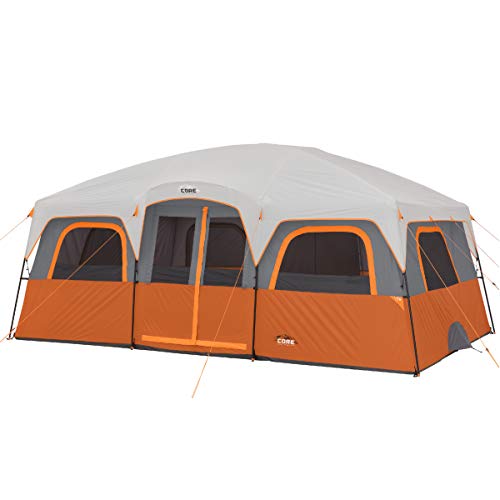
The CORE 12 Person Tent is a large-format multi-room cabin shelter engineered specifically for family car camping, group outings, and extended campground weekends. With an expansive 16 by 11-foot floor plan and a towering 86-inch center peak height, this shelter provides standing-room comfort that appeals directly to family campers, multi-generational groups, and weekend warriors who prioritize liveable interior space over ultralight trail specs. Instead of crouching through low-profile doors, campers can walk upright throughout the center of the structure, making it well-suited for state park campsites, festival camping grounds, and drive-in holiday setups.
Usable interior space represents the defining feature of this cabin tent. The nearly vertical wall profile avoids the sloping sides common to traditional dome designs, allowing the floor to comfortably fit up to four queen-size air mattresses or accommodate six campers alongside duffel bags, storage totes, and personal gear. For groups requiring spatial separation, the included fabric room divider splits the interior into two distinct spaces, functioning effectively as separate sleeping quarters or a combined bedroom and dry staging area. Integrated wall storage pockets keep flashlights, phones, and small camp accessories elevated away from floor clutter.
Weather protection relies on CORE proprietary H20 Block Technology paired with 1200mm water-resistant coated fabric. The tent utilizes a fully taped rainfly to shed incoming precipitation, along with sealed seams and fully zipped window panels that prevent wind-driven moisture from entering during passing rain showers. While 1200mm fabric handles typical three-season rainfall, the high, broad vertical walls naturally catch crosswinds more than aerodynamic backpacking structures. CORE includes sturdy steel stakes and tensioning guylines to anchor the frame into hard-packed campground soil, providing essential stability against gusty conditions.
Managing a cabin tent of this scale requires realistic campsite handling and site selection. Due to the 16 by 11-foot footprint, pitching requires a wide, cleared camping pad free of large roots and sharp rocks. While solo setup is theoretically possible with practice, the upright frame structure and tall center peak make assembly significantly smoother when handled by two adults. An included zippered carry bag simplifies packing the folded tent fabric, poles, and stake bundle into an SUV, crossover, or truck bed, keeping vehicle-based transport organized between camping trips.
For families and outdoor groups seeking a spacious, partitioned camping headquarters, the CORE 12 Person Tent delivers practical floor space and dependable three-season shelter. It is best chosen by car campers, festival crews, and family vacationers who value walk-around standing height, private room separation, and organized gear storage. Backcountry backpackers should opt for compact lightweight shelters, but drive-in campers will appreciate the shelter's residential layout for comfortable outdoor living.
The CORE 12 Person Tent provides a generous 16 by 11-foot footprint that delivers 176 square feet of floor space, comfortably accommodating up to six campers with full gear setups or twelve sleepers using compact sleeping pads. An 86-inch center height combined with straight cabin walls ensures that even tall adults can stand upright and move around freely without stooping.
An included removable room divider allows campers to customize the layout into two separate private suites. This configuration works well for parents wanting privacy from kids, mixed groups sharing camp costs, or campers who prefer a dedicated sleeping area on one side and a dry changing or gear staging room on the other.
Engineered with CORE H20 Block Technology, this tent features 1200mm polyurethane-coated fabric designed to bead and shed moderate rainfall. Factory-taped seams along the rainfly and tent body work in tandem with sealed window seams to prevent leaks at common needle puncture points.
Windows feature full-coverage zippered panels that can be closed tight during blustery rainstorms or unzipped to reveal mesh screens for cross-ventilation during warm summer nights. Steel ground stakes and heavy-duty guylines come standard, giving campers the essential anchor points needed to brace the tall cabin walls against breezy conditions.

Pros
- Full 6.5-foot center height allows tall adults to stand upright without crouching
- Rigid steel frame provides reliable stability against unexpected campground winds
- Four large mesh windows and floor vents maintain constant cooling airflow
- Integrated zippered e-port lets you run cords directly from an outdoor power station
- Spacious 10x9-foot footprint easily accommodates a queen air mattress or multiple cots
Cons
- Weighing around 19 pounds, it is suited strictly for car camping rather than backpacking
- Sleeping six adults side-by-side leaves little remaining floor space for gear storage
- Steel pole sections make the packed carry bag relatively heavy to lift into high vehicle cargo areas
The WildFinder 6-Person Camping Tent is an expansive shelter built primarily for car campers, family road-trippers, and weekend outdoor enthusiasts looking for generous living quarters at state parks or private campgrounds. Measuring 120 by 108 inches, this shelter provides ample room for a small family or a crew of three to four friends spreading out with duffel bags and sleeping pads. Because it provides a towering 78-inch (6.5-foot) center peak height, adults can walk around, change clothes, and move about without having to crouch uncomfortably, making prolonged stays inside camp far more pleasant.
Camp ventilation and weather defense are standout priorities in this shelter's layout. High-density mesh spans all four perimeter walls, supported by lower ground-level air intakes that pull cool night air in while releasing warm interior moisture through the wide-open mesh ceiling. This continuous airflow works effectively against interior condensation during humid summer nights. When rain clouds roll in, the included waterproof rainfly covers the canopy and anchors tightly using reinforced guy lines. On crisp, cloudless evenings, shedding the outer fly reveals panoramic views of the starry sky while the ultra-fine insect netting keeps biting pests outside.
Rather than relying solely on slender fiberglass rods that can flex excessively in heavy gusts, the WildFinder utilizes a four-pole steel frame structure that gives the tent a rigid, stable backbone. Heavy-duty zippers line the main entry points for snag-free operation, while elevated interior organizer pockets ensure smartphones, flashlights, and car keys remain off the floor. A dedicated zippered e-port flap near the base lets campers safely bring an outdoor extension cord or portable power station cable into the tent to run fans, charge electronics, or power devices overnight.
Assembling the tent follows an intuitive multi-pole configuration that two adults can manage in roughly ten to fifteen minutes once familiar with the layout. The entire kit packs down into an included 21.7 by 8.7 by 8.7-inch carry bag that fits neatly into the trunk of a family sedan or SUV. While the tent lists a nominal capacity of six people, that rating implies campers sleeping shoulder-to-shoulder with zero personal gear. For genuine comfort, it serves best as a spacious retreat for two adults on a queen air bed, or three to four campers using standard pads. Furthermore, with a total weight of around nineteen pounds, this model is built for drive-up campsites rather than backcountry packing.
For budget-conscious families, first-time campers, and festival goers seeking reliable weekend shelter with full stand-up headroom, this WildFinder tent delivers solid everyday outdoor value. Its steel frame resilience, open-air stargazing roof, and user-friendly interior accents make it well-suited for summer vacations, lake trips, and state park getaways across the country.
With a 120 by 108-inch floor plan and a 78-inch peak ceiling, this tent removes the cramped feeling common in basic low-profile dome designs. Campers can set up a queen-size air mattress or two twin cots while still retaining clear walking paths to the door.
Built-in storage pouches hang along the interior walls to keep pocket items off the floor, while the generous headroom allows tall campers to change clothes upright without bending over.
A 360-degree airflow system combines four large mesh windows with ground-level intake vents and an open mesh roof to encourage steady cross-ventilation, helping reduce interior humidity on warm nights.
The protective rainfly shields against downpours, while four sturdy steel poles and heavy-duty guy lines keep the shelter anchored firmly when unexpected gusts blow through camp.

Pros
- Dedicated focus on scenic tent-camping destinations rather than large commercial RV parks
- Zero reliance on cell phone batteries, power stations, or network coverage when exploring off-grid public lands
- Compact 6 x 9-inch dimensions make it quick to grab from a seatback organizer or center console
- Practical layout helps campers organize weekend getaways and multi-day Southwestern itineraries efficiently
Cons
- Paperback construction requires safe storage in a ziplock bag or dry box to prevent water damage around camp
- Print editions cannot reflect sudden seasonal campground closures, recent fee adjustments, or active fire restrictions
- Coverage is strictly limited to New Mexico, requiring alternative guides for neighboring Southwestern states
Best Tent Camping: New Mexico by Menasha Ridge Press is a dedicated regional guidebook designed for car campers, tent campers, overlanders, and road trippers looking to explore the diverse public lands of the Southwest. Unlike broad travel directories that lump massive commercial RV resorts together with primitive trailheads, this volume zeroes in on tent-friendly environments where scenic beauty, relative quiet, and proximity to nature take priority. It serves as an accessible resource for first-time visitors planning a Southwestern desert road trip as well as seasoned regional outdoorsmen searching for lesser-known national forest spots.
In real-world trip planning, a physical regional guide solves one of the most common obstacles encountered in remote New Mexico terrain: the complete loss of mobile service. While digital mapping apps and campsite locator websites are convenient in suburban hubs, cellular reception regularly disappears in deep canyons, mountain passes, and broad desert basins. Having a physical reference book on your passenger seat or camp table allows you to browse alternative campgrounds, confirm access expectations, and plan day excursions without depleting your phone battery or portable power bank.
From a storage and packing standpoint, the volume measures 6 by 0.5 by 9 inches and weighs just under 0.6 pounds (approximately 9.6 ounces). These proportions allow it to slide neatly into a vehicle glove compartment, door pocket, seatback pouch, or standard plastic camp storage tub alongside your headlamps and maps. Because it adds negligible weight, you can easily slip it into a daypack or day-hike sling when taking an afternoon scouting walk around a lake basin or national monument recreation area.
Regarding build quality and outdoor handling, the book features standard paperback binding and clean, readable typography. Because it is printed on traditional paper rather than waterproof synthetic stock, campers must exercise reasonable care around outdoor hazards. Keeping the guide sealed in a simple zip-top freezer bag or protective dry sack will prevent damage from unexpected mountain rain showers, morning dew on picnic tables, or melted ice from an open camp cooler.
Every printed field guide carries inherent practical limitations, primarily regarding dynamic operational details. A physical book cannot reflect real-time campground closures, localized fire bans, seasonal road maintenance, or campground fee adjustments implemented after publication. Campers should view the guide as a strong foundational planning tool while remembering to verify local ranger district regulations whenever an internet connection or visitor center is accessible.
For outdoor enthusiasts preparing to explore the Land of Enchantment by vehicle, Best Tent Camping: New Mexico provides a practical, self-contained overview of scenic places to pitch a tent. Whether you are assembling a weekend car-camping getaway from Albuquerque, planning an extended road trip across Carson and Gila National Forests, or seeking a thoughtful gift for a Southwestern adventurer, this paperback delivers reliable planning utility at an accessible entry point.
Measuring 6 inches wide, 9 inches tall, and half an inch thick, this guidebook occupies minimal space within your camp storage system. It fits conveniently into standard dashboard glove compartments, vehicle door pockets, center consoles, and car seat organizers, keeping regional navigation within arm's reach during long highway drives.
At approximately 0.6 pounds, the book adds almost no noticeable weight to your overall payload, making it easy to store in a camp kitchen tote, plastic gear bin, or carry-on travel bag. While backpackers will typically leave guidebooks at the trailhead vehicle to minimize pack weight, car campers and overlanders will find it easy to integrate into their everyday vehicle camping setup.
Using a printed campsite guide streamlines the trip-planning process by eliminating the endless scrolling and conflicting reviews typical of digital travel apps. The curated focus on tent-centric locations helps campers avoid noisy generator-heavy recreation parks in favor of quieter natural scenery.
Around the campsite, the book serves as an excellent evening reference under a lantern or around the picnic table. It lets you discuss the next day's driving route, nearby hiking trails, and potential camp spots with travel companions without needing to pass around a small smartphone screen or worry about spotty wireless service.
Evaluating Family Camping Tents and Shelter Design
Selecting the ideal shelter for a family outing comes down to balancing floor dimensions, livable height, and effortless pitching. A reliable shelter provides a secure home base where parents and kids can rest, store belongings, and stay dry during unexpected rain showers. Examining practical specifications gives campers a realistic assessment of how a shelter will function at an actual campground.
Realistic Sleeping Capacity Versus Stated Occupancy Numbers
Stated tent capacity rarely matches real-world comfort when traveling with family members. A shelter marketed for six people generally assumes six adults sleeping directly on the floor in tightly arranged sleeping bags. In standard car-camping setups, families typically use air mattresses, bulky sleeping pads, and multiple duffel bags. A smart guideline is to subtract two to four people from the stated rating to find the true comfortable occupancy.
The FanttikOutdoor Zeta C6 Pro illustrates this dynamic clearly with its 120-inch by 108-inch floor dimension. While the industry standard rates this footprint for six people, the manufacturer notes that it most comfortably accommodates three campers with gear or a single queen mattress. Similarly, large models like the CORE 12 Person Cabin Tent measure 16 by 11 feet, providing the floor space needed for four queen-size air mattresses or six campers traveling with full gear bins.
Planning around mattress dimensions prevents frustrating surprises when arranging your campsite. A standard queen air bed occupies approximately 60 by 80 inches of floor space, quickly consuming floor plans in compact shelters. When camping with children, reserving a designated central aisle keeps sleeping zones clean and prevents gear from being trampled. Choosing a generous footprint ensures everyone has breathing room without crowding the door.
Peak Height, Standing Room, and Cabin Architecture
Center height dictates whether adults can stand comfortably while changing clothes or assisting children inside the shelter. Traditional dome tents slope downward sharply from the center, which restricts standing room to a tiny apex directly beneath the roof peak. Cabin-style silhouettes solve this issue by using nearly vertical side walls that extend headroom across the entire perimeter.
The WildFinder 6 Person Tent features an impressive 78-inch peak height, allowing most adults to stand completely upright throughout the interior. Cabin designs like the CAMPROS CP 8 Person Tent provide a 72-inch ceiling alongside straight walls that maximize corner utility. The CORE 12 Person Tent expands this vertical clearance even further to an 86-inch peak height. These elevated ceilings reduce feelings of confinement when unpredictable weather forces your family to spend extended hours indoors.
Vertical wall angles also maximize the placement of camping furniture such as folding cots, storage bins, and portable playards. Cots placed against sloped tent walls often push into the inner fabric, reducing usable floor width and potentially transferring exterior moisture. Straight perimeter walls allow cots and air beds to sit flush against the edges, leaving the central room open for daily family activities.
Privacy Layouts and Room Divider Functionality
Multi-room configurations transform a single open shelter into distinct living and sleeping quarters. When camping with kids or multiple couples, hanging dividers provide visual privacy for changing clothes and organizing bedtime routines. These curtains typically attach via toggles or clips along the tent ceiling and walls, allowing campers to customize the layout as needed.
The CORE 12 Person Tent utilizes a built-in room divider to split its 16-foot width into two dedicated rooms. In models like the CAMPROS CP 8 Person shelter, the removable privacy curtain is designed to double as a projection screen for family movie nights. Having the option to section off sleeping quarters gives young children an undisturbed area to rest while parents relax in the front room.
Door positioning becomes especially critical when managing a partitioned interior layout. A single central door forces campers in the rear partitioned room to step over sleepers in the front section during middle-of-the-night bathroom visits. Tents engineered with dual entryways or side doors allow campers to enter and exit each room independently without disturbing others.
Frame Materials, Pole Geometry, and Setup Efficiency
Setup convenience plays a massive role in overall camping satisfaction, especially after a long drive to the campsite. Families arriving near dusk need intuitive pole systems that can be pitched without confusion. Pole materials typically range from shock-corded fiberglass to rigid steel uprights, each offering specific structural benefits.
Instant shelters such as the FanttikOutdoor Zeta C6 Pro use pre-installed poles and seamless construction designed for rapid deployment. Campers can erect the structure in around a minute simply by extending the telescoping carbon steel frame. For traditional manual builds, color-coded pole assemblies like those in the CAMPROS CP model eliminate guesswork, allowing two adults to pitch the frame smoothly. Checking easy-pitch shelter designs helps identify mechanisms that streamline campsite arrival.
Frame rigidity also determines how well the tent maintains its structural shape in changing outdoor conditions. Carbon steel and rugged steel corner poles provide substantial vertical support against gusts, keeping tall cabin walls from bowing inward. Snag-free pole sleeves, like those found on the Amazon Basics 8-Person tent, speed up assembly and prevent fabric tears during installation.
Weather Protection, Seam Sealing, and Water Resistance
Rain protection depends on a combination of water-resistant fabric coatings, sealed seams, and smart floor geometry. While light afternoon drizzles pose little threat, persistent storms can quickly expose weak points along needle perforations and corner seams. Understanding how fabric ratings function prevents unrealistic expectations regarding total waterproof performance.
The CORE 12 Person model incorporates H20 Block technology with a 1200mm polyurethane fabric rating, fully taped seams, and hooded rainfly coverage. Tub-style floor designs, featured on shelters like the FanttikOutdoor Zeta C6 Pro, raise floor seams several inches above ground level. This elevated basin prevents surface runoff from creeping through the bottom perimeter when rainwater pools around the campsite. Examining weather-resistant camping shelters clarifies how seam taping and floor construction work together.
Rainflies require proper guylines and peg tension to perform effectively in wet weather. If a rainfly sags against the inner tent mesh, water can transfer directly through the fabric into the sleeping quarters. Adjusting guyline tension keeps the fly taut, allowing moisture to run off smoothly into the grass while maintaining an air gap for continuous ventilation.
Wind considerations are equally important when pitching tall family cabins with large surface areas. The FanttikOutdoor tent specifies wind resistance capabilities of up to 35 mph when secured with its included stakes and guy ropes. Campers should always angle tent stakes at 45 degrees into firm ground and guy out all corner anchors to ensure structural stability during breezy conditions.
Airflow Dynamics and Moisture Management
Condensation is a natural byproduct of warm human breath meeting cool ambient air on the inner walls of a tent. In a family shelter containing four or more occupants, moisture builds up rapidly overnight if airflow is restricted. Proper ventilation channels moist air out of the tent before it can condense into interior droplets.
Shelters like the Amazon Basics 8-Person tent feature a dedicated cool-air ground port alongside rear mesh windows to draw fresh air from the ground up. The WildFinder 6 Person model utilizes a 360-degree airflow layout with high-density mesh on all four sides, lower floor vents, and an open mesh roof. This chimney effect pulls cooler air through floor vents and exhausts warm, humid air through the ceiling.
Stargazing roof panels offer exceptional airflow during warm summer nights when the rainfly is removed. Fine B3 anti-insect mesh keeps mosquitoes and midges out while allowing clear visibility of the night sky. When rain threatens, attaching the rainfly provides essential overhead coverage while built-in fly vents preserve air circulation.
Interior Storage, Power Ports, and Organization
Maintaining an orderly living space is essential when multiple family members share a single shelter footprint. Loose headlamps, phones, car keys, and wet socks quickly clutter the floor without dedicated organization pockets. Elevated mesh pockets sewn into the inner tent walls keep fragile devices safely off the ground.
Modern family tents also integrate power cord access ports for running campsite electricity into the shelter. Both the WildFinder 6 Person and FanttikOutdoor Zeta C6 Pro models include specialized e-port zipper flaps. These closures allow campers to route an extension cord inside for powering small fans, charging mobile devices, or running low-voltage lighting without leaving the main entrance unzipped.
Ceiling lantern hooks represent another practical convenience for family camping trips. Hanging a central diffused lantern illuminates the entire cabin without taking up valuable floor or table space. Keeping small essentials in hanging organizers ensures quick access during nighttime emergencies or early morning departures.
Portability, Packed Dimensions, and Camp Maintenance
Weight and packed size matter when loading a vehicle alongside coolers, sleeping bags, camp chairs, and food storage. While family camping focuses primarily on car camping rather than backpacking, trunk space remains a finite resource. A compact carry bag simplifies loading and keeps components organized between seasonal adventures.
Packed weights vary according to frame construction, with the FanttikOutdoor C6 Pro weighing 16.8 pounds and the WildFinder packing down to 18 pounds in a compact 21.7-inch bag. Larger steel-frame cabin tents naturally require more storage space and heavier carry bags to support their expanded dimensions. Verifying packed bag measurements against your vehicle’s cargo capacity prevents awkward packing on departure day.
Drying your shelter completely before long-term storage is the single most critical step in preserving fabric coatings and seams. Packing away damp polyester promotes mildew growth and can degrade factory polyurethane water-resistant treatments over time. After returning home, pitch the tent in a garage or yard until all seams, floors, and rainfly panels are bone-dry before storing it in a cool, ventilated space.
Choosing the right shelter for your family ultimately centers on realistic floor space, sufficient peak height, and dependable weatherproofing. Assessing your family size, vehicle cargo space, and preferred setup style ensures you select a shelter that makes every camping trip enjoyable and stress-free. With the right shelter pitched and secured, your family can focus on enjoying the great outdoors together.


Write Your Review
No reviews yet. Be the first to share your experience!