

Selecting the Right Naturehike Camping Shelter
A cramped interior after hiking all day quickly ruins an otherwise peaceful backcountry trip, especially when a two-person shelter barely fits a single sleeping pad. Weight and weather resistance dictate how comfortably you rest on the trail or at a campground. Evaluating materials, vestibule space, and pole stability helps identify the best naturehike outdoor tent for your specific packing style. Whether you need a freestanding ultralight shelter for a backpacking route or a tall cabin model for family car camping, matching the structure to your terrain keeps gear dry and sleep comfortable. You can also pair your campsite shelter with practical gear like a rechargeable camping fan to improve air circulation on humid nights.
Naturehike offers shelters spanning ultralight silicone-coated nylon backpacking options to spacious instant-pitch cabin structures. Tents like the Cloud-Up and Mongar series focus on compact packability, aluminum pole durability, and taped seam rainflies to manage wet conditions without burdening your pack. Larger setups incorporate blackout fabrics and upright peak heights, giving group campers generous room to sit upright or organize gear. Comparing verified specs like floor dimensions, fabric denier, and rainfly coverage ensures your tent holds up against sudden storms and rocky ground. For casual backyard trips or younger adventurers, you might also compare these rugged outdoor designs against a dedicated kids play tent before finalizing your shelter plan.
Pros
- Includes a matching ground footprint, carry bag, and 14 stakes without requiring separate purchases
- Compact packed dimensions of 15.7 by 5.1 by 5.1 inches fit easily inside backpacks or bike panniers
- Durable 7001 aluminum alloy frame offers structural strength compared to standard fiberglass poles
- Listed PU3000mm+ waterproof rating with factory-taped seams and corners for rain protection
- Upgraded ventilation window positioned above the front door helps promote air exchange
Cons
- Single front door design means occupants must share one entry and exit point
- Listed 4.25-pound base weight excludes the footprint, so total carry weight will be higher with all included gear
- Minor discrepancy in documented interior width between the description (49.2 inches) and specification table (51.2 inches)
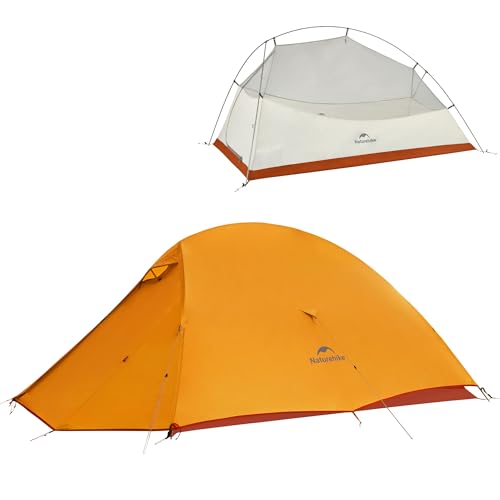
The Naturehike Cloud up Base is a double-layer, two-person backpacking tent engineered for outdoor enthusiasts who need a compact, transport-friendly shelter. As an upgraded version of the standard Cloud up 2, this model is built for backpackers, cycle tourists, and hikers looking to keep weight manageable without moving to complex or ultra-expensive ultralight setups. Its design focuses on lightweight construction, double-wall condensation mitigation, and all-in-one packability.
Regarding interior space, the manufacturer lists dimensions of 82.7 inches long, 41.3 inches high, and an interior width specified as 49.2 inches in the product description and 51.2 inches in the specifications table. The stated capacity accommodates two people, but comfortable usable space depends heavily on individual sleeping pad widths and body sizes. While two standard sleeping pads can fit side by side, personal backpacks and bulkier items are best stashed outside the sleeping compartment in the covered front vestibule area.
The structural layout features a 7001 aluminum alloy pole assembly, providing a durable skeletal frame that supports the inner tent and rainfly. The inner canopy is built predominantly from high-density B3 mesh to encourage cross-breeze airflow, while the outer rainfly utilizes 210T polyester with a PU3000mm+ waterproof coating and taped seams. Notable upgrades on the Base model include an enlarged, higher front door for easier access and a dedicated ventilation window placed directly above the entrance to assist in expelling moisture before condensation accumulates.
For transport and camp routines, the tent packs down into an included carry bag measuring 15.7 by 5.1 by 5.1 inches. The base weight is listed at 4.25 pounds, though users should account for the footprint, 14 included stakes, and 5 wind ropes when calculating total pack weight. Pitching involves laying out the groundsheet, securing the inner tent, seating the pole structure, clipping the canopy, and guying out the rainfly. To maintain longevity, the tent and footprint should be completely dried and cleared of debris before long-term storage.
A practical limitation of this design is its single front entrance. With only one door, the occupant sleeping further from the opening must climb over sleeping gear to exit, which can be inconvenient during night trips outside. In addition, while the PU3000mm+ coating and aluminum poles are geared toward wind and rain resistance, stability in severe weather remains dependent on proper tensioning with the supplied guy ropes and stakes. Shoppers should also keep the slight width measurement ambiguity in mind when sizing wider sleeping mattresses.
Overall, the Naturehike Cloud up Base offers solid utility for solo hikers desiring extra interior room or pairs who prioritize low packed volume on budget-conscious backpacking trips. When comparing it against alternative two-person shelters, buyers should weigh the convenience of the included footprint and aluminum hardware against the practical trade-offs of a single front door layout.
The Cloud up Base utilizes a double-layer design engineered to manage airflow and precipitation. Its outer rainfly is made from 210T polyester treated with a waterproof coating rated at PU3000mm+, paired with factory-taped seams and reinforced corners to mitigate water seepage during rain.
For ventilation, the inner body incorporates high-density B3 mesh that allows interior air to circulate outward toward the rainfly. The upgraded vent window positioned above the front door provides an additional escape channel for warm, humid air, which assists in managing overnight condensation.
The framework consists of a 7001 aluminum alloy pole set, accompanied by 14 ground stakes and 5 wind ropes. Securing all guylines ensures the rainfly remains taut and separated from the inner tent mesh, maintaining proper weather coverage and airflow in breezy conditions.
With a packed size of 15.7 by 5.1 by 5.1 inches, this tent is designed to fit inside most internal-frame backpacks, bicycle panniers, or bikepacking fork mounts without occupying excessive cargo volume.
The manufacturer states a base weight of 4.25 pounds, explicitly noting that this figure excludes the ground footprint. Campers who choose to carry the full kit, including the footprint, 14 stakes, and guylines, should expect a slightly higher trail carry weight.
For pairs traveling together, the packed bundle can easily be divided between two packs, with one person carrying the fabric inner tent and fly while the other carries the poles, footprint, and stake sack.

Pros
- Automatic frame with pre-attached poles allows fast setup without assembling separate pole sections
- Tall 74.8-inch peak height offers substantially more vertical clearance than traditional dome tents
- High-performance 150D blackout fabric blocks 99.9% of incoming light and harmful UV rays
- Double-wall configuration with snow skirts provides seasonal versatility for year-round campground outings
- Front awning and vestibule expand usable exterior living space for gear storage and shade
Cons
- Packed weight and packed bag dimensions are not stated in the official product specifications
- Specific millimeter waterproof rating (hydrostatic head) is omitted from the listing data
- Floor dimensions will feel tight if four adult campers use large cots or bulky sleeping systems
The Naturehike Village Instant Tent (Size: 4 Person) is a cabin-style camping shelter designed primarily for car campers, couples, and small family groups who prioritize quick camp setup and upright interior clearance. Built around an integrated automatic hub mechanism with pre-attached poles, the shelter eliminates the traditional task of sorting and threading pole segments through fabric sleeves. This mechanism makes the tent accessible for beginners while saving valuable time at the campsite for experienced campers arriving late in the day.
Regarding interior dimensions, the tent features a rectangular footprint measuring 102.3 inches long by 90.55 inches wide, coupled with an interior center height of 74.8 inches (approximately 6 feet 2 inches). While the manufacturer lists the sleeping capacity at four people, comfortable space depends heavily on pad selection and gear volume. Couples using a wide air mattress will have plenty of clearance for luggage, and three campers on standard pads can fit comfortably. Fitting four full-sized adults will leave minimal room for interior equipment, though the vertical cabin walls prevent the claustrophobic feel common to low-slung dome structures.
The structural layout utilizes a double-wall design where the inner tent body can function independently during fair conditions or be paired with the full rainfly when weather strikes. Outdoor living space is expanded by an integrated front vestibule and canopy configuration that creates a covered porch area for camp chairs and muddy footwear. For airflow, the tent incorporates two large mesh windows and a dedicated top screen window, which help facilitate cross-ventilation and manage the condensation typical of multi-person enclosed spaces.
Fabric construction centers on 150D material treated with proprietary blackout technology. With a listed UPF 12500+ rating and 99.9% visible and infrared light reflection, the shell helps keep the interior dark for sleeping past sunrise while moderating interior cabin temperatures. Naturehike also incorporates a perimeter snow skirt to seal against drafts and drifting precipitation, giving the shelter multi-season utility for cooler weather. However, the listing does not publish a specific hydrostatic head waterproof rating in millimeters, nor does it disclose packed weight or transport bag dimensions.
For maintenance, the automatic joint hinges and coated fabrics should be thoroughly air-dried and brushed clean of sand before long-term storage to prevent mildew or mechanical jamming. Backed by a 2-year limited warranty when purchased through the brand store, this shelter is an appealing choice for drive-up campsites, family weekends, and festival camping. Backpackers will need to look elsewhere due to the rigid nature of instant frames, but car campers seeking rapid assembly and true stand-up headroom will find strong functional value here.
The Naturehike Village 4-Person model features a measured floor layout of 102.3 inches in length and 90.55 inches in width, creating a footprint of approximately 64 square feet. The vertical cabin architecture allows campers to sit upright along the perimeter without contacting the walls, maximizing the usable floor space compared to tapered dome designs.
With a center peak height of 74.8 inches, most adult campers can stand comfortably inside the center of the shelter. While technically sized to accommodate four standard sleeping pads shoulder to shoulder, the interior layout is most practical for two or three occupants who wish to keep duffel bags, clothing bins, or camp cots inside the primary sleeping chamber.
Pitching this cabin tent relies on an automatic frame system with pre-attached structural poles that extend into position in approximately 60 seconds. This pre-assembled design eliminates pole-matching confusion, allowing a single person to erect the primary inner cabin structure quickly and securely.
The double-wall setup includes a detachable inner body with extensive mesh panels that can stand alone in clear weather for stargazing. When adverse weather is anticipated, the full-coverage rainfly installs over the frame and includes tie-outs to support the extended front canopy and entry vestibule area.
The shell is manufactured from 150D fabric using specialized blackout technology engineered to block 99.9% of UV rays, visible light, and infrared radiation. This dense weave helps maintain a cooler interior in bright sun while preventing early morning light from disturbing sleep.
For multi-season use, the tent includes integrated snow skirts around the base to deflect cold wind gusts and blowing snow during winter car-camping outings. Two oversized mesh windows and an upper screen panel provide cross-ventilation to help reduce moisture accumulation inside the cabin.


Pros
- Symmetrical two-door, two-vestibule layout prevents occupants from climbing over one another.
- Includes a matching groundsheet at no extra cost to help protect the tent floor from abrasion.
- Stated 3,000 mm waterproof rating on both the 210T polyester rainfly and tent floor.
- Lightweight 7001 aluminum alloy frame offers freestanding stability with a simple Y-pole hub.
- Compact packed size of under 20 inches in length fits easily onto bike racks or inside backpacks.
Cons
- Listing indicates a 5.3-pound total set weight with a 4.2-pound base tent listing, which may feel heavy for solo ultralight trekking.
- At 53.2 inches wide, interior space will feel snug for two full-width sleeping pads and interior gear storage.
The Naturehike Mongar 2 Person Backpacking Tent is a freestanding, double-layer shelter tailored for three-season outdoor trips including backpacking, hiking, and cycle touring. Built with a unified pole system and dual vestibules, it is designed for campers who want a balance of straightforward assembly, weather coverage, and manageable packability without spending top-tier outdoor brand money.
When looking at interior dimensions, the tent floor measures 82.7 inches long by 53.2 inches wide, yielding slightly over 30 square feet of floor space beneath a 41.3-inch peak height. While the manufacturer rates this as a two-person shelter, usable interior room is best evaluated by your choice of sleeping gear. At roughly 53 inches across, two standard 20-inch sleeping pads will fit side by side with room to spare, but wider 25-inch pads will occupy virtually the entire floor. Fortunately, the dual-door layout ensures neither camper has to crawl over the other, while twin exterior vestibules provide dedicated, covered space outside the sleeping compartment for muddy boots and backpacks.
Structurally, the shelter relies on a freestanding Y-frame design made from 7001 aluminum alloy, engineered for intuitive pitch and reliable stability. The inner canopy is constructed from high-density B3 mesh to promote airflow and keep insects out, making it well suited for warmer spring and summer nights. For rain protection, both the outer rainfly and the bathtub floor utilize 210T polyester coated to achieve a manufacturer-stated 3,000 mm waterproof rating. The rainfly vestibules can be staked out completely shut to block wind and precipitation, or partially rolled back when extra shade and cross-ventilation are needed.
Transport and handling are straightforward thanks to the included stuff sack, which packs down to approximately 19.7 inches long by 5.9 inches in diameter. The total set weight is listed at 5.3 pounds when carrying all components, including the free matching groundsheet, though the base tent weight is listed separately near 4.2 pounds. Pitching instructions are sewn directly into the storage bag so they cannot be misplaced at camp. As with any coated polyester shelter, routine care involves clearing debris from the floor, allowing the fabric and groundsheet to dry thoroughly before long-term storage, and following the manufacturer-provided pitching directions to protect the pole joints.
Potential buyers should keep a few realistic considerations in mind before purchasing. A 5.3-pound total packed weight is reasonable for weekend backpacking, bike tours, or car camping, but dedicated ultralight thru-hikers carrying gear solo may find it on the heavier side. Additionally, while the 3,000 mm rating and aluminum framework provide solid three-season design parameters, performance in severe weather depends heavily on proper staking, taut guylines, and campsite selection.
For couples, solo backpackers wanting extra elbow room, or bike packers seeking a reliable freestanding shelter with two private access points, the Naturehike Mongar 2 presents a well-rounded package. The inclusion of a custom-fit groundsheet adds upfront value, helping protect the tent floor against rough terrain from day one. When comparing it to alternatives, weigh its 5.3-pound packed weight and 53.2-inch floor width against your trail distance and gear dimensions.
The Naturehike Mongar 2 features a symmetrical dual-door layout, allowing each camper to enter and exit without disturbing the other. Outside each door, a dedicated vestibule extends the rainfly outward to create covered exterior storage for backpacks, boots, and wet gear.
These vestibules can be secured fully closed during rainy conditions to safeguard equipment, or adjusted to a partially open configuration to encourage cross-ventilation and provide sun shade during mild weather.
The Mongar 2 utilizes 210T polyester for both the outer rainfly and the floor, each treated with a manufacturer-stated 3,000 mm waterproof polyurethane coating. The inner tent body incorporates high-density B3 mesh to maintain airflow and provide an insect barrier during warmer outings.
The structural skeleton is supported by 7001 aluminum alloy poles joined in a freestanding Y-frame configuration. This setup balances frame rigidity with light weight, while the included matching groundsheet provides an extra layer of protection against abrasive ground surfaces.


Frequently Asked Questions
How do Naturehike 20D nylon and 210T polyester fabrics compare for weather protection?
Naturehike 20D nylon models offer lighter carry weights and a higher PU4000mm waterproof rating, making them ideal for weight-conscious hikers facing wet weather. In contrast, 210T polyester versions like the Cloud Up Base are slightly heavier at 4.25 pounds and feature a PU3000mm coating that provides reliable water resistance at a budget-friendly price point. Both materials use taped seams to prevent moisture seepage during persistent rainfall.
Are Naturehike backpacking tents spacious enough for two adults?
Two adults can fit inside models like the Mongar and Cloud-Up 2, but shoulder room will feel snug if you use wide sleeping pads. The Mongar measures 53.2 inches wide and provides two side doors with separate vestibules, which makes entry and gear management much easier for pairs. The Cloud-Up 2 measures 49.2 inches wide with a single front door, meaning one camper must crawl over the other to exit.
What makes the Naturehike Village instant tent suitable for family car camping?
The Village instant tent features pre-attached poles that allow for a rapid 60-second setup without manual pole threading. With peak heights reaching up to six feet and a footprint measuring over twelve feet long in larger variants, occupants can stand comfortably inside. The Ti Black technology fabric also blocks excess sunlight and UV rays to help maintain cooler interior temperatures on sunny mornings. Campers setting up in open sites often pair this setup with a sturdy mountain canopy shelter for added shade and shared outdoor dining space.
Do Naturehike outdoor tents include a footprint in the package?
Yes, models such as the Cloud-Up 1, Cloud-Up 2, Cloud Up Base, and Mongar 2 include a custom groundsheet in the package. Using the provided footprint protects the tent floor from sharp stones, sticks, and ground moisture, extending the lifespan of your shelter. This inclusion eliminates the need to purchase a separate tarp before heading out on the trail.
Can the Naturehike Village 6.0 handle winter and cold-weather camping?
The Village 6.0 features a dedicated snow skirt and double-wall construction designed to block cold wind and drifting snow during winter conditions. While the skirt keeps drafts out, campers must always maintain proper ventilation through the roof vents to manage condensation. Never operate fuel-burning stoves or heaters inside the enclosed cabin because of hazardous carbon monoxide and fire risks.
How well do Naturehike tents manage interior condensation during rainy trips?
Upgraded Naturehike models address interior moisture by placing dedicated ventilation windows above the entry doors and using high-density B3 mesh inner walls. This double-layer design encourages constant airflow between the rainfly and the sleeping compartment, moving warm exhaled air outside before it condenses. Pitching the rainfly taut and staking out all guylines ensures maximum separation between the fabric layers during sustained rain.


Write Your Review
No reviews yet. Be the first to share your experience!