


Selecting the Right Bed Canopy and Privacy Tent
Shared bedrooms, dorms, and group bunk spaces often make restful sleep difficult due to ambient light and unwanted drafts. Creating a dedicated personal sanctuary over an existing mattress helps block outside distractions while keeping your sleeping space quiet and secluded. When evaluating the best long range bed tent, key specifications like frame stability, fabric ventilation, and ceiling clearance dictate how comfortable your setup feels every night. Breathable mesh panels and light-reducing walls let you rest easily without feeling trapped or overheated during warm summer nights.
Portable privacy shelters also provide practical flexibility if you need an enclosed pod for seasonal travel, cabin bunks, or guest rooms. For those who enjoy outdoor setups, browsing a budget outdoor tent or using a rechargeable camping fan shows how airflow management improves enclosed comfort. Units featuring resilient fiberglass or PVC ribs assemble rapidly and fold down into an included travel storage bag when not in use.
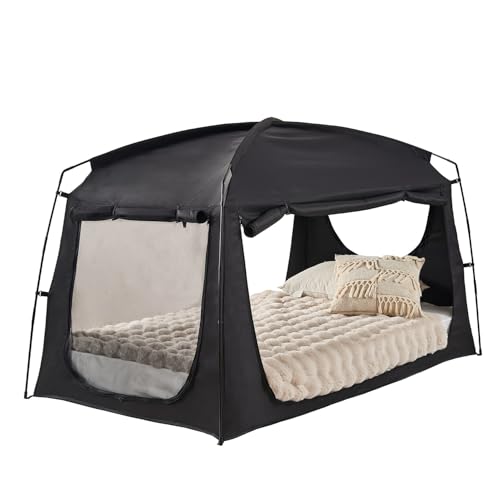
Pros
- Blocks up to 90% of light to create a darkened personal sanctuary in shared rooms, dorms, or shift-worker setups
- Three-door layout paired with breathable mesh panels offers adaptable entry and customizable airflow
- Generous 47.2-inch peak height provides ample vertical clearance to sit up comfortably on a twin bed
- Weighs only 6.5 pounds and packs down into an included travel storage bag for convenient portability
- Backed by a documented 365-day warranty and round-the-clock customer support
Cons
- Intended strictly for indoor use and lacks weather resistance, a rainfly, or anchoring stakes for outdoor campground sites
- Does not include a mattress or sleeping pad, requiring users to supply their own bedding
- Exact packed carry bag dimensions and specific fabric composition are not detailed in the specifications
The HRYJ Twin Size Bed Tent is a specialized indoor privacy canopy engineered to create a personal sanctuary within shared sleeping environments. Unlike traditional outdoor camping shelters that focus on resisting rain, wind, and soil moisture, this structure is tailored for dormitories, shared bedrooms, shift workers, and sheltered bunkhouses. It provides an enclosed micro-environment that fits around a standard twin mattress, bunk bed, or cubby bed to manage light exposure and maintain personal privacy.
In terms of interior dimensions, the shelter measures 78.7 inches in length, 41.3 inches in width, and 47.2 inches in height. This layout accommodates a single twin-size mattress on the floor, on a bed frame, or atop a suitable cot. With a total weight of 6.5 pounds, the unit remains lightweight enough to move easily between rooms or take along for temporary stays. A travel storage bag is included to assist with packing and carrying, although exact packed dimensions are not listed in the manufacturer specifications.
Airflow and access are addressed through a three-door configuration equipped with 100% breathable mesh windows. The main fabric is engineered to block roughly 90% of ambient light, helping to darken the sleeping area during daytime hours for night-shift workers, students, or light-sensitive sleepers. The multi-door arrangement allows campers in indoor or cabin settings to enter from either side or the end, while the mesh panels help maintain airflow to reduce stuffiness when all outer fabric flaps are closed.
The structural support relies on a resilient fiberglass frame paired with three-layer reinforced fabric seams and industrial-strength stitching. The manufacturer notes an estimated setup time of under five minutes, making it straightforward to pitch over an existing bed or take down when not in use. As with most fiberglass pole structures, feeding the poles through the sleeves steadily without excessive bending helps protect the frame during assembly. Routine care includes spot cleaning and allowing all fabric to air dry thoroughly before returning it to the storage bag.
Buyers should note several practical limitations regarding use cases. This is strictly an indoor sleep canopy and is not equipped for outdoor campsite use. It features no waterproof rainfly, no taped seams for precipitation, and no outdoor guylines or ground stakes to anchor against wind. Additionally, a mattress is not included with the tent, so shoppers must ensure their own twin-size mattress or sleeping pad fits within the 78.7 by 41.3 inch footprint.
For anyone seeking to carve out private, darkened sleeping quarters in a dorm room, shared apartment, or indoor cabin bunk, the HRYJ Bed Tent offers an accessible and functional solution. Its combination of light-blocking fabric, triple-door access, and ventilated mesh windows meets the specific needs of indoor privacy seekers. Those planning outdoor campground trips, however, should look toward weather-rated camping tents designed specifically for open-air conditions.
Managing airflow inside an enclosed sleep space is essential for overnight comfort, especially when using light-blocking materials. The HRYJ Bed Tent features 100% breathable mesh window panels integrated alongside a three-door design. This multi-opening layout allows occupants to unzip individual panels to encourage cross-ventilation across the twin-sized interior.
When maximum privacy or darkness is required, the fabric door panels can be fully closed to block up to 90% of ambient light. During warmer indoor conditions, rolling back one or more doors exposes the fine mesh, allowing air to circulate freely while keeping the sleeping area distinct from the surrounding room.
The manufacturer backs the HRYJ Twin Size Bed Tent with a 365-day warranty covering manufacturing defects. According to the product details, free replacements are provided if any defects arise within the one-year warranty period.
In addition to warranty coverage, the brand provides 24-hour live chat customer care. This offers purchasers direct access to support for assembly guidance, replacement inquiries, or general product assistance at any time.

Pros
- Fast pop-up construction with integrated flexible frame and shock-corded support poles
- Light-reducing dark grey pongee fabric creates a private sleeping nook in communal rooms
- Full floor sits under a twin mattress to keep the canopy stable and prevent shifting
- Dual large side doors and mesh end panels provide straightforward access and ventilation
- Weighs 5.8 pounds and folds down into a compact 23 x 22 x 2.4-inch carry bag
Cons
- Not built for outdoor camping; lacks waterproof fabric, rainfly, stakes, and wind resistance
- Internal height of 44 to 47 inches restricts posture to sitting or lying down
- Folding the spring frame into a figure-8 pack-down shape requires practice
The Alvantor Twin Bed Canopy is a specialized indoor privacy shelter rather than an outdoor wilderness camping tent. It is engineered primarily for individuals seeking solitude, light reduction, and personal space in communal sleeping environments such as dormitories, barracks, group cabins, or family guest rooms. Campers looking for shelter options should recognize that this model is built specifically for indoor use over an existing twin-size mattress or directly on an indoor floor.
In terms of interior dimensions, the shelter measures 75 inches in length, 39 inches in width, and between 44 and 47 inches in peak height, closely matching standard twin bed proportions. The full floor base is designed to slip beneath a twin mattress to keep the structure anchored without shifting. While the interior provides dedicated clearance for a single sleeper to sit up or lie down, gear storage is minimal, consisting of an internal mesh pocket for small items like a phone or book and an overhead loop for hanging a small light.
The structure combines a pop-up flexible PVC rib framework with three shock-corded fiberglass poles that reinforce the arch and maintain side-to-side stability without a heavy metal frame. The canopy is constructed from soft, dark grey pongee fabric intended to reduce incoming light while allowing occupants to look out without outsiders seeing inside. Double-sided zippered doors on both long sides provide full access, while integrated mesh panels at the head and foot promote cross-ventilation and allow airflow through the enclosed sleeping space.
Transport and maintenance are relatively straightforward thanks to a total weight of 5.8 pounds and a circular carry bag measuring 23 by 22 by 2.4 inches. Dismantling the shelter involves folding the flexible frame into a figure-8 coil, after which the unit slides into its zippered bag. When the fabric requires cleaning, the ends of the arc pole sleeves unzip so the fiberglass poles can be withdrawn, allowing the pongee curtain to be washed before reinserting the poles.
Prospective buyers comparing this product against traditional camping tents must account for critical functional differences. The Alvantor Bed Tent lacks waterproof coatings, sealed seams, rainfly coverage, ground stakes, and guylines, meaning it cannot withstand outdoor rain, wind, or ground moisture. Its primary utility is confined to indoor sheltered settings, glamping cabins with existing cots, or enclosed RV spaces where personal privacy and light suppression are the primary objectives.
For individuals staying in shared living quarters, indoor bunkhouses, or summer camp cabins seeking an immediate privacy screen and light-dampening sleep nook, this pop-up canopy delivers practical utility and simple maintenance. However, outdoor tent buyers seeking reliable weather protection for backcountry or campground use will need to look toward purpose-built three-season or four-season camping shelters instead.
Assembly utilizes a pop-up frame design that expands into shape quickly upon release from the carry bag. To finish the pitch and provide rigid overhead structure, three shock-corded fiberglass poles insert into dedicated sleeves across the top arcs.
Taking down the canopy involves removing the three arch poles and collapsing the perimeter ribs. The flexible frame must be twisted into a figure-8 pattern to fold down to its compact 23 x 22 x 2.4-inch packed size before fitting into the zippered transport bag.
The canopy shell is made of a breathable, soft pongee fabric in a charcoal or dark grey color. This material is designed to reduce incoming ambient light while permitting breathability across the enclosed area.
Structural support is provided by flexible PVC perimeter ribs combined with shock-corded fiberglass rods. Metal frames are eliminated to maintain a total carry weight of 5.8 pounds, while dual-sided zippers provide internal and external door operation.
The fabric canopy features zippered openings at the ends of the arc pole sleeves, enabling users to slide the fiberglass poles out completely for laundering. After washing, the poles are reinserted and zipped into place.
Because the unit is intended for indoor applications, it should be kept away from open flame and heated appliances, and it must be completely dry before prolonged storage in its circular carry case.
Frequently Asked Questions
Can you use a bed tent directly on a mattress without a bed frame?
Yes, bed tents work directly around standard mattresses without needing an attached bed frame. The base sits flat under your twin mattress, utilizing bed weight to stay stable and upright. This design prevents shifting when entering through zipped doors and works on floor setups or bunks.
How does ventilation work in the best long range bed tent to prevent stuffiness?
Built-in mesh windows and large zipper openings facilitate steady airflow through the enclosed sleeping area. Breathable pongee fabric and head-to-foot mesh panels let fresh air circulate while blocking unwanted light. For broader shelter ideas, checking a canopy tent for campsite shade illustrates how breathable overhead coverage keeps enclosed spaces cooler.
How long does it take to assemble these portable privacy shelters in 2026?
Most models set up in less than five minutes using pop-up ribs or shock-corded fiberglass poles. Pop-up PVC frames snap open with minimal effort, requiring simple pole insertion into arc sleeves for extra stability. Takedown is equally quick, folding into a compact figure-eight shape that fits neatly inside the provided travel bag.
Will a twin-size bed tent fit standard bunk beds?
Yes, twin privacy shelters measuring 75 to 78.7 inches long fit standard twin bunk beds. You should measure the vertical clearance between the bunks before purchase to ensure proper overhead clearance. Models with heights between 44 and 47.2 inches require sufficient clearance so the roof arches do not bend against upper bunk frames.
Does a bed tent block outside light effectively for day sleeping?
Yes, light-reducing fabrics block substantial ambient illumination to help shift workers and light-sensitive sleepers. Many designs feature up to 90 percent blackout fabric along with zipped privacy curtains. While minimal light can enter through ventilation mesh, closing outer door flaps creates a darker, distraction-free rest area.


Write Your Review
No reviews yet. Be the first to share your experience!