


Pumping silty river water by hand after a ten-mile trek drains your remaining trail energy in minutes. Motorized filtration units remove that physical strain by pumping automatically, while rugged gravity and manual systems offer fail-safe backups when charging sources stay miles away. Selecting the best battery water purifiers off grid camping setups requires balancing flow rates, micron ratings, and off-grid charging methods against the total pack weight of your gear. Pairing an automated pump with a dependable water storage container for emergencies gives any remote campsite a steady supply of clean drinking water without constant manual labor.
Reliable backcountry hydration also depends on how well a filtration system manages sediment before reaching fine hollow-fiber membranes. Automated models like the Greeshow electric purifier incorporate internal rechargeable batteries with multi-stage pre-filters, while high-volume gravity systems from Katadyn and Uzima eliminate electronic failure points entirely. Campers who combine battery-driven systems with a sturdy canteen for boiling water ensure multiple layers of defense against waterborne cysts, sediment, and bacteria in unpredictable wilderness conditions.

Pros
- Fast water delivery rate of 1.5 to 3.0 liters per minute quickly hydrates multiple campers without long wait times
- Multi-stage filtration setup includes ultrafiltration membrane and mineral pre-filters for cleaner-tasting backcountry water
- Ceramic core micro-pressure check valve creates an effective seal to prevent cross-contamination
- Built from BPA and BPS-free heavy-duty plastics that hold up to rugged camp use
- Replaceable internal filter cartridges eliminate the expense of discarding the entire pump housing
Cons
- At 4 pounds and 13.5 inches long, this unit is significantly heavier and bulkier than ultralight personal backpacking straw filters
- Manual hand-pump operation requires physical effort to produce continuous high-volume water output
- Multi-stage filter elements require periodic replacement and proper drying between trips to prevent clogging
The P Polerden Emergency Water Filter is a high-capacity manual pump filtration system designed to process drinking water quickly from natural freshwater sources. Measuring 13.5 x 3.5 x 10 inches and weighing 4 pounds, this unit is engineered specifically for family campers, basecamp operators, overland travelers, and emergency preparedness planners who prioritize rapid output over ultralight compactness. Unlike miniature pocket straws, this larger platform addresses the hydration needs of small groups, making it suitable for communal campsites where boiling multiple gallons of water would consume valuable camp stove fuel.
In terms of filtration performance, the system utilizes a multi-stage approach featuring an adsorbent mineral pre-filter, a polypropylene (PP) cotton filter, and an ultrafiltration membrane filter. The manufacturer states that this sequential setup achieves up to 99.999% purification purity while significantly reducing murky odors and suspended particles common in backcountry streams or quiet lakes. Pumping performance is a standout characteristic, delivering a rated flow rate of 1.5 liters per minute with a maximum potential output of 3 liters per minute under optimal conditions, which cuts down the waiting time when filling large hydration reservoirs or camp kettles.
Build quality centers on heavy-duty BPA and BPS-free plastics engineered to endure rough outdoor conditions and storage inside vehicle gear bins. A key mechanical highlight is the high-precision ceramic core micro-pressure check valve. This check valve creates an effective hydraulic seal with strong suction capability, keeping untreated intake water isolated from processed clean water to minimize contamination risks. The robust external housing and stable footprint allow users to steady the pump on riverbank rocks or campsite tables while applying manual leverage.
Setting up and maintaining the system is practical for regular outdoor outings. Pumping requires no electricity or batteries, making it dependable during off-grid excursions or unexpected storm power outages. Maintenance is similarly cost-conscious, as the ultrafiltration membrane and pre-filter components can be replaced individually without discarding the entire pump housing. Between outdoor excursions, users should thoroughly flush and air-dry the internal filter assembly to prevent stagnation and preserve membrane longevity before packing the device into storage.
Prospective buyers should weigh the system's weight and physical dimensions against their typical camping style. At 4 pounds, this filtration station is too heavy and voluminous for solo backpackers or long-distance hikers looking to minimize base pack weight. Additionally, manual hand pumping still requires consistent arm effort, especially when processing murky raw water that gradually coats the pre-filter. Like all membrane-based filters, owners must protect the damp internal elements from freezing temperatures to prevent physical damage to the micro-pores.
For car camping groups, scout troops, remote cabin stays, and home disaster readiness kits, the P Polerden filtration system offers dependable, high-volume water purification. Backcountry travelers seeking an ultralight personal filter should consider smaller squeeze pouches or straw units instead, but those managing water for several people will appreciate the fast 1.5 to 3 liter per minute flow rate and rugged mechanical construction.
The core filtration mechanism relies on a sequential multi-stage design comprising an adsorbent mineral pre-filter, a PP cotton layer, and an ultrafiltration membrane. This staged setup removes silt, sediment, and natural organic odors before the water reaches the final microscopic purification stage. According to product documentation, this multi-tier approach achieves up to 99.999% purity without relying on chemical tablets that can impart unpleasant tastes.
Water output is tailored for multi-person demands, boasting a rated delivery of 1.5 liters per minute and a maximum rate of 3 liters per minute. The high-precision ceramic core check valve ensures continuous suction and prevents backflow. This allows users to fill multi-liter water bladders, cooking pots, and camp washbasins in a fraction of the time required by standard single-stage trail filters.
Routine care for the P Polerden filtration unit ensures consistent flow rates and extends the operational lifespan of internal filter cartridges. Users should periodically inspect and rinse the pre-filter assembly, particularly after drawing from turbid or silt-heavy water sources. Because the ultrafiltration membrane and pre-filters are individually replaceable, long-term maintenance costs remain economical compared to discarding an entire pump body.
Before storing the unit after a camping trip or emergency deployment, flush the system with clean water and allow all components to dry thoroughly in an open environment. Storing a damp filter in an airtight container can promote mildew buildup. In cold-weather camping environments, keep wet filter cartridges insulated inside your sleeping bag or jacket, as frozen residual water can expand and compromise the filtration membrane.

Pros
- Automated motorized pump delivers up to 700ml per minute without physical fatigue
- Triple-source recharging includes solar, hand crank, and USB-C for off-grid redundancy
- Integrated 3000mAh power bank and emergency LED flashlight add practical survival utility
- Built-in electric backwash system simplifies filter maintenance and clears sediment
- Filtration pore size of 0.01 microns provides thorough physical impurity protection
Cons
- At approximately 1.06 pounds, it is heavier than ultralight manual squeeze filters
- Contains motorized and battery components that require pre-trip charging checks and routine battery care
- Solar panel and hand-crank charging methods are intended primarily for emergency top-offs rather than rapid full recharges
The Greeshow Portable Electric Water Filter is an automated, battery-powered outdoor water purification device designed to streamline backcountry hydration. Unlike conventional manual pump filters or squeeze pouches that require strenuous arm effort, this unit provides an automated pump that delivers up to 23.7 fluid ounces (700ml) per minute at the press of a single button. Based on manufacturer specifications, it is an ideal choice for car campers, survivalists, overlanders, family campers, and backcountry backpackers who prefer rapid water processing without physical exertion at the water source.
At the core of the system is a 5-stage filtration setup featuring a 0.01-micron hollow fiber ultrafiltration (UF) membrane. According to product documentation, this physical barrier is SGS-tested to meet rigorous NSF/ANSI standards, targeting microscopic impurities found in backcountry streams, lakes, and rivers. The cartridge provides a stated lifespan of up to 264 gallons (1,000 liters), which translates to substantial multi-trip utility before a replacement cartridge is necessary.
Off-grid reliability is reinforced through three distinct charging methods: an integrated solar panel for sunny layover days, an emergency fold-out hand crank, and a USB-C port for rapid pre-trip wall charging. Built into the 1.06-pound housing is a 3000mAh power bank capable of delivering a vital charge to a smartphone or GPS unit in emergency situations. The device also incorporates an integrated LED flashlight with an SOS emergency strobe mode, eliminating the need to hold a separate light source when filtering water at camp after nightfall.
Operating the device around camp is straightforward, requiring users to connect the intake hose to the water source and press the power button to fill canteens, hydration bladders, or camp cookware. To maintain consistent flow over time, the unit includes an electric backwash feature designed to reverse water flow and clear sediment buildup from the internal membrane. This automated maintenance reduces the manual syringe flushing typically required by standard trail filters, keeping the intake functioning smoothly in murky water conditions.
While the motorized mechanism offers exceptional convenience, prospective buyers should consider the operational tradeoffs. At roughly 1.06 pounds (17 ounces) and dimensions of 2.8 x 6.5 x 3.7 inches, it carries a noticeable weight penalty compared to minimalist ultralight gravity or squeeze filters. Furthermore, while the solar panel and hand crank provide critical emergency backups, both methods replenish the internal 3000mAh battery slowly compared to standard USB-C charging. Campers should view the manual crank and solar surface primarily as emergency failsafes rather than primary everyday charging sources.
For weekend campers, overland explorers, and emergency preparedness planners seeking reliable hydration without the fatigue of manual pumping, the Greeshow Electric Water Filter offers an impressive blend of capability and peace of mind. Its combination of 0.01-micron physical filtration, push-button operation, multi-source power backups, and emergency lighting makes it a well-rounded tool for remote adventures and home survival caches alike.
Maintaining the Greeshow Electric Water Filter centers on regular backwashing and proper off-season storage. Utilizing the built-in electric backwashing function after each trip flushes out silt and debris, which preserves the 0.01-micron membrane and maintains consistent flow rates.
Before packing the unit away for long-term storage, ensure all water is thoroughly drained from the internal pump and filter chambers to prevent internal mildew or freezing damage in cold conditions. Keep the 3000mAh lithium battery partially charged every few months to protect battery longevity, and store the unit in a dry, temperate environment alongside replacement filter cartridges.
Weighing approximately 1.06 pounds with a compact form factor of 2.8 x 6.5 x 3.7 inches, this water purification unit fits neatly into vehicle emergency kits, bug-out bags, and camping gear totes. The housing protects the internal motor, filter cartridge, and electronics during rugged transit.
The triple-charging design ensures power redundancy across varied outdoor conditions. The standard USB-C input enables fast recharging before heading out into the backcountry, while the integrated solar panel and emergency hand crank provide self-reliant backup power when grid electricity is entirely inaccessible.

Pros
- Delivers an extensive filtration capacity of up to 150,000 liters across the lifespan of the ceramic elements.
- Requires zero pumping or electrical power, using natural gravity to pull water through the filtration stages.
- Ceramic elements can be scrubbed in the field to restore flow rates after processing turbid lake or river water.
- Excellent high-volume water solution for stationary base camps, hunting cabins, and family preparedness plans.
Cons
- Weighs approximately 7.28 pounds with a 12 x 12 x 18-inch footprint, making it too bulky for foot travel or backpacking.
- Requires a solid overhead hook, tree branch, or timber beam capable of supporting the unit when filled with water.
- Ceramic elements require careful handling and maintenance to avoid cracking in freezing temperatures.
The Katadyn TRK Drip Ceradyn is a large-capacity stationary gravity water filter designed specifically for base camps, off-grid cabins, RV camping, overlanding setups, and long-term emergency preparedness reserves. Rather than functioning as a pocket trail filter, this freestanding drip system serves as a centralized hydration hub for group settings where continuous water treatment is needed without constant manual effort. It best fits family campers, expedition leaders, remote cabin owners, and preparedness-focused buyers who require dependable bulk water processing at a fixed campsite or homestead.
Filtration performance centers on three cleanable 0.2-micron ceramic elements engineered to screen out sediment and fine particles without reliance on chemical treatments or electrical power. Katadyn rates the operational lifespan of the system at up to 150,000 liters, though overall longevity varies according to source water turbidity. Operation is completely passive: campers fill the upper chamber, suspend the system from a secure overhead anchor, and allow gravity to draw water downward through the ceramic substrate into the lower clean reservoir.
Build quality reflects Katadyn's Swiss manufacturing standards, utilizing durable white housings measuring 12 x 12 x 18 inches and weighing approximately 7.28 pounds dry. The structure is built for stationary durability rather than ultralight packing, featuring robust connection hardware that withstands the physical demands of extended outdoor seasons. When hung securely from a cabin beam, sturdy awning strut, or strong tree branch, the gravity drip mechanism operates silently around the clock, ensuring clean water is available for morning camp cooking and hydration bladder refills.
Maintenance and field serviceability remain major practical advantages of the ceramic design. When fine river silt or mineral sediment begins to choke flow performance, outdoor users do not need to replace the cartridges immediately. Instead, the ceramic elements can be removed and scrubbed clean with an abrasive pad to expose fresh porous ceramic, quickly recovering drip speed. This field-cleaning capability provides peace of mind in remote regions where replacement supplies are unavailable.
The primary limitation of the Katadyn TRK Drip Ceradyn is its physical bulk and weight, which clearly rules it out for ultralight backpacking, thru-hiking, or fast-and-light trail travel. Additionally, ceramic elements contain porous micro-structures that can be damaged if frozen while wet, requiring careful temperature management in late-season alpine hunting camps. For vehicle-supported expeditions, established group campsites, hunting outposts, and emergency home readiness, it remains a proven, heavy-duty solution for sustainable, off-grid water production.
Maintaining the Katadyn TRK Drip Ceradyn requires regular attention to the ceramic filter elements, especially when drawing from turbid streams or sediment-heavy lakes. When output volume slows, remove the elements and gently scrub the outer ceramic surface with clean water and a non-soapy scouring pad, working evenly to restore water passage while checking cartridge thickness against wear gauges.
Before seasonal storage, thoroughly air-dry the ceramic elements and rinse the upper and lower reservoirs with clean water to prevent microbial growth. Never allow wet ceramic elements to freeze during late-fall car camping or winter emergency outages, as expanding moisture within the 0.2-micron pores can fracture the ceramic material and compromise filtration integrity.

Pros
- Effortless gravity filtration requires zero hand pumping or electrical power
- 0.1-micron hollow fiber membrane provides trusted protection against bacteria and protozoa
- Freestanding rigid design creates a stable, shared hydration hub for basecamps
- Comes complete with a backflush syringe for easy maintenance in the field
Cons
- At over 4 pounds with a rigid jug body, it is too bulky for lightweight backpacking
- Hollow fiber filters do not remove dissolved chemicals, heavy metals, or viruses on their own
- Filter membrane must be protected from freezing temperatures once wetted
The Uzima UZ-2 is a gravity-powered bulk water filtration station designed for outdoor groups who need dependable hydration without tedious hand pumping. Built with a freestanding bucket-style reservoir and a 0.1-micron hollow fiber membrane filter, this unit delivers high-volume water processing for basecamps, car campers, hunters, overlanders, and emergency preparedness planners. Unlike small squeeze filters or fragile personal straws, this setup creates a central camp drinking station that keeps multiple campers hydrated throughout the day.
When setting up camp near a backcountry lake, river, or creek, this system allows you to gather untreated water and let natural gravity do the hard work while you pitch tents or prepare meals. The hollow fiber membrane blocks 99.999% of bacteria and protozoa, delivering clean water at a maximum flow rate of approximately one liter per minute under optimal head pressure. The freestanding 10 by 10 by 17-inch container rests stably on picnic tables, tailgate platforms, or flat boulders, making filling water bottles, hydration bladders, and camp cookware completely hands-free.
Constructed from rugged, food-safe plastics, the UZ-2 is engineered to withstand the knocks and scrapes of outdoor travel. The core filter cartridge utilizes standard hollow fiber technology with an upper temperature tolerance suitable for warm-weather use. The kit includes a dedicated backflushing syringe that restores flow when silt, sediment, or murky pond water begins to slow filtration. While the system handles typical suspended particulate well, the internal membrane should never be exposed to freezing conditions once primed, as expanding ice crystals can rupture the microscopic fibers.
Operating the system is intuitive and tool-free: secure the filter cartridge into the reservoir, fill the container with source water, and allow gravity to draw clean water through the spout. Routine care is equally manageable, requiring only a clean water push back through the cartridge using the included syringe to clear out captured debris. In terms of realistic limitations, the 4.16-pound dry weight and rigid shape make it impractical for ultralight backpackers or minimalist thru-hikers who count every ounce. Additionally, hollow fiber membranes filter biological pathogens and micro-particulates, but they do not reduce dissolved minerals, heavy metals, or chemical runoff.
For family campers, hunting parties, overlanding rigs, and homeowners preparing for severe weather or municipal outages, the Uzima UZ-2 offers dependable, high-volume water purification. It eliminates the physical fatigue of manual pumping and saves valuable camp stove fuel that would otherwise be spent boiling water. If your adventures center around car camping or off-grid readiness where group water access is essential, this gravity purifier is a durable and practical investment.
Setting up the Uzima UZ-2 requires no specialized tools or technical experience. The filter cartridge attaches firmly to the interior base of the container, creating a secure seal to ensure untreated water cannot bypass the 0.1-micron hollow fiber membrane. Once the jug is filled from a stream, lake, or tap, gravity pushes water through the filter bundle and out of the dispenser tap.
Field maintenance is essential when filtering from sediment-heavy water sources. The included backflushing syringe allows you to push clean, filtered water in reverse through the filter fibers, dislodging trapped mud and organic matter to restore flow rates. For long-term off-season storage, the entire system should be rinsed thoroughly, dried completely, and kept indoors away from sub-freezing temperatures to protect membrane integrity.
With dimensions of 10 by 10 by 17 inches and an empty weight just over four pounds, the Uzima UZ-2 is built primarily for vehicle-supported adventures rather than backcountry foot travel. It packs easily into car trunks, truck beds, RV storage compartments, and overland gear bins alongside coolers and camp stoves.
At a group campsite, having a centralized gravity water reservoir keeps everyone supplied with clean drinking water without creating clutter. Campers can walk up to the station to refill water bottles, rinse vegetables, or fill coffee pots without needing an extra pair of hands to hold a pump or squeeze a pouch.
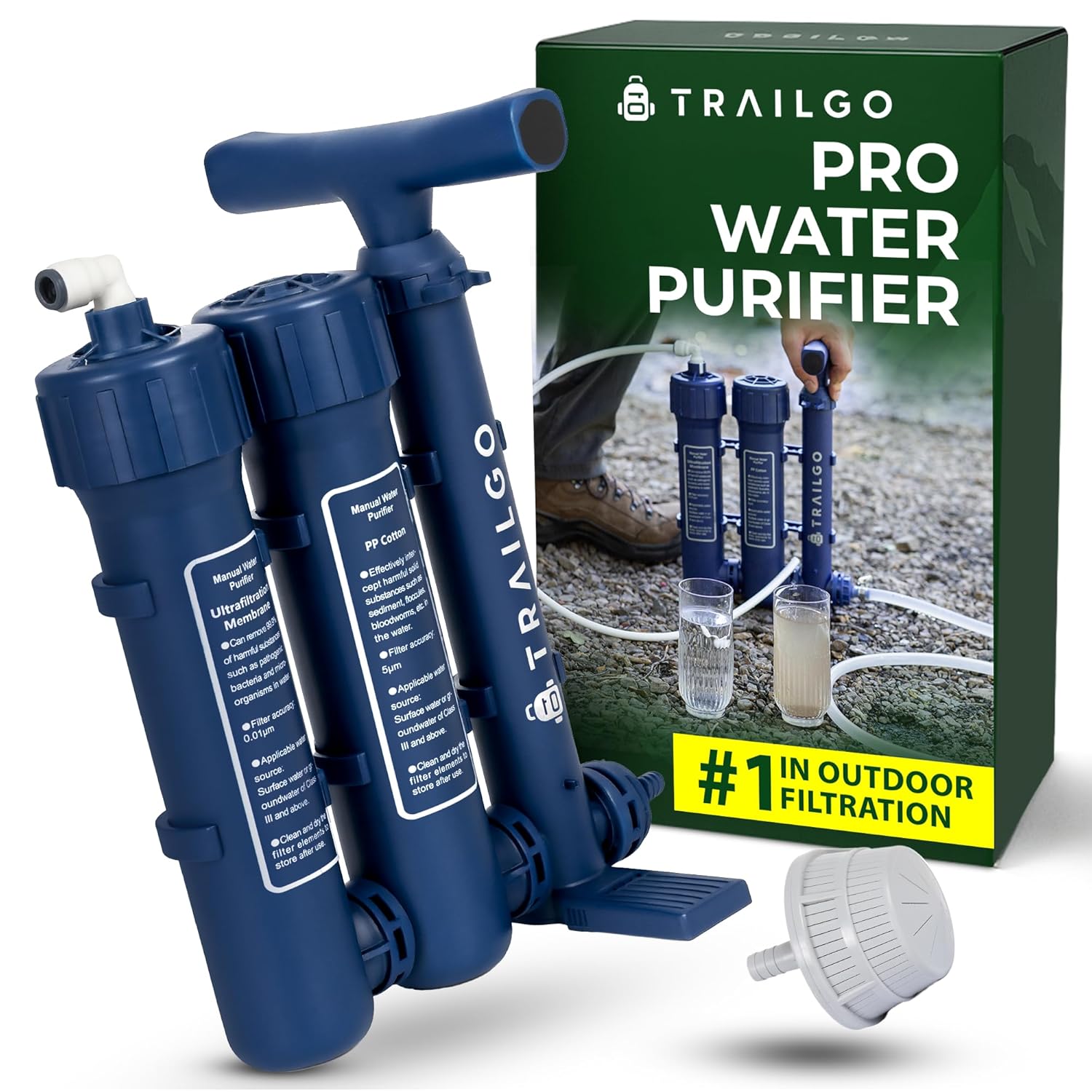
Pros
- Fast 1.5 L/min flow rate hydrates families and large groups rapidly
- Freestanding base eliminates the awkward balancing act common with smaller hand pumps
- Impressive 0.01-micron hollow fiber ultrafiltration provides reliable protection against contaminants
- Complete field kit includes hoses, clamps, pre-filter, and dedicated storage bag
Cons
- At roughly 4 pounds, it is heavier and bulkier than ultralight squeeze filters for solo hikers
- Requires manual pumping effort to process large volumes of water
- Not designed for high TDS or brackish saltwater sources
The TRAILGO Pro is a high-volume portable hand pump water purification system tailored for group hydration in rugged settings. Rather than forcing outdoor enthusiasts to sip through restrictive personal straws or slowly squeeze tiny pouches, this freestanding unit processes large volumes of drinking water at a camp kitchen or stream bank. It serves car campers, hunting parties, overlanders, off-grid homesteaders, and emergency preparedness planners who need quick, reliable water production for multiple people.
The standout feature of this system is its 3-stage filtration structure featuring a 5-micron PP cotton pre-filter and a 0.01-micron ultra-filtration hollow fiber membrane. Delivering a rapid flow rate of up to 1.5 liters per minute, it can fill hydration bladders, cooking pots, and gallon jugs in just a few minutes. Whether drawing from mountain creeks, remote lakes, or murky backup cisterns, the pre-filter blocks suspended sand and coarse debris, while the ultra-filtration stage targets microscopic pathogens, sediment, and silt.
Constructed from heavy-duty, BPA-free plastics free of phthalates and BPS, the purifier body is sturdy enough to handle rough outdoor handling. Its freestanding profile provides solid grounding on flat rocks or picnic tables, allowing you to pump with leverage instead of fumbling with floating hoses in mid-air. The package includes inlet and outlet tubing, tubing clamps to keep lines secure on bucket rims, a pre-filter assembly, and a dedicated zippered carry bag that keeps wet hoses separate from dry camp gear.
Although the system excels at base camp, its four-pound weight and larger footprint mean it is not the ideal pick for fast-and-light thru-hikers or solo backpackers counting every ounce. The manual hand pump mechanism also requires sustained physical effort to process several gallons, and the system is designed for freshwater with moderate dissolved solids rather than heavy chemical or brackish saltwater runoff.
For family campground outings, multi-person hunting trips, overland vehicle adventures, and household emergency storm prep kits, the TRAILGO Pro delivers the water volume and filtration reliability you need. It turns water collection from a tedious backcountry chore into a quick, straightforward camp task that keeps everyone hydrated and safe.
While ultralight backpackers generally gravitate toward pocket-sized squeeze filters, those solutions struggle when tasked with supplying water for multiple camp dinners, morning coffee, and hydration packs. The TRAILGO Pro bridges the gap between bulky gravity bags and fragile pocket pumps by offering high-output processing that fits naturally into a car trunk, RV storage bay, or gear duffel.
The included carry case ensures that the tubes and pump components pack away neatly, preventing snagged hoses inside your overland storage box. For scout troops, river rafting expeditions, or base camps where quick turnarounds at the stream are crucial, having a stable, multi-liter pumping station is well worth the modest weight investment.
Maintaining flow rate and extending the 3,000-liter cartridge lifespan requires basic post-trip upkeep. After drawing from silty creeks, backwashing or rinsing the pre-filter clears away sediment before it can choke the finer 0.01-micron ultrafiltration membrane. Always pump clean water through the unit before storing it between trips.
To protect the internal components, thoroughly air-dry the hoses, filter body, and housing prior to long-term storage in your emergency pantry. In freezing weather, ensure no residual water remains inside the pump cylinder or filter housing, as expanding ice can compromise the ultrafiltration fibers.
Frequently Asked Questions About Off-Grid Water Purification
How do battery-powered water purifiers compare to manual hand pumps for off-grid camping?
Battery-powered water purifiers eliminate pumping fatigue by using an internal motor to draw and filter water automatically. For example, electric units deliver flow rates up to 700 milliliters per minute at the touch of a button. Manual pumps like the TRAILGO or P Polerden systems require physical pumping but never rely on stored electrical power, making them dependable mechanical backups during extended wilderness trips.
Can you recharge an electric water filter when camping away from electrical outlets?
Yes, battery purifiers designed for outdoor survival support off-grid recharging through integrated solar panels, USB-C power banks, and emergency hand cranks. The Greeshow unit includes all three charging methods to ensure continuous operation away from standard wall outlets. Campers can also use the integrated 3000mAh battery pack to provide emergency power to small mobile devices on the trail.
What filter pore size is necessary to stop bacteria and protozoa in the backcountry?
A pore size between 0.1 and 0.01 microns provides an effective physical barrier against 99.999% of common waterborne bacteria and protozoa. Systems utilizing ultrafiltration membranes, like the Uzima UZ-2 or Greeshow electric purifier, capture microscopic contaminants without chemical additives. Unlike backcountry purifiers, basecamp users at permanent cabins often evaluate a glass water filter jug for indoor taste improvement rather than wilderness pathogen removal.
Why do off-grid campers carry gravity filters alongside battery purifiers?
Gravity-fed systems provide large-volume water processing for basecamps without demanding electrical power or physical effort. Heavy-duty options like the Katadyn TRK Ceradyn process thousands of liters using suspended reservoir chambers and dense ceramic elements. Campers frequently set up gravity bags to fill bulk cooking kettles while reserving lightweight battery-powered filters for on-the-go trail refills.
How does backwashing protect electric and manual camping water filters from clogging?
Backwashing reverses clean water flow through the internal membrane to dislodge trapped silt and organic particles. Electric filters often include dedicated motorized backwash cycles that automate this flushing step, whereas manual units require syringe flushing or physical scrubbing. Regular backwashing preserves factory flow rates and prevents premature clogging when filtering turbid lake or stream water.








Write Your Review
No reviews yet. Be the first to share your experience!