

Selecting the Right AYAMAYA Camping Shelter
Arriving at a campsite late in the afternoon makes wrestling with complex tent poles frustrating. Quick-pitch shelters solve that hassle by springing open in seconds, giving you more daylight to arrange your sleeping gear. If you want convenient campsite shelter without assembly headaches, exploring the best ayamaya camping tent options leads directly to instant pop-up frames and compact tunnel layouts. These designs feature pre-assembled frames that expand automatically upon release. Many models also include a front vestibule to keep dirty boots and damp bags outside the main sleeping area.
Deciding between a four-person pop-up shelter and an extended tunnel tent depends on how much living room your group requires. Stated occupant capacities reflect close sleeping arrangements, so sizing up provides a more comfortable layout for car camping. Proper airflow makes a major difference on warm nights, and pairing built-in roof vents with rechargeable camping fans helps minimize condensation against the coated fabric. Guyline tension and solid stake placement also keep the pre-curved frame stable against sudden gusts of wind.

Pros
- Instant deployment eliminates traditional sleeve-and-pole assembly at the campsite
- Documented PU 3000mm coating and factory heat-sealed seams provide listed rain protection
- Overhead mesh skylight offers stargazing opportunities during clear, fair-weather nights
- Dual-door layout allows campers to enter and exit without climbing over each other
- Reflective guylines provide visible tie-out points in low-light campground conditions
Cons
- Broad 30-inch circular packed dimensions can be awkward to load into compact car trunks
- A 4.1-foot center height requires occupants to crouch, as it does not allow standing upright
- Housing 4 adult campers leaves virtually no interior floor space for luggage or gear bags
The AYAMAYA 4-Person Pop Up Tent is an instant-pitch shelter engineered for car campers, weekend travelers, and casual outdoor enthusiasts who want to skip the chore of threading poles through fabric sleeves. Built with a pre-integrated, spring-loaded internal frame, the structure expands into form once removed from its carry bag and unstrapped. This design targets frontcountry campgrounds, backyard sleepouts, and music festivals where fast, hassle-free shelter pitching takes priority over compact trail transport.
In terms of interior space, the manufacturer lists dimensions of 9.8 feet in length, 7.2 feet in width, and a peak center height of 4.1 feet. While the manufacturer states that this tent accommodates up to four occupants, that rating represents shoulder-to-shoulder sleeping on standard narrow pads. Campers packing larger air mattresses or duffels will find the usable living area better suited to two or three adults, or a small family with children. The 4.1-foot peak ceiling provides enough room to sit up and change, but it requires crouching to move around inside.
Ventilation and airflow rely on a balanced window and door layout. The tent features two large zippered doors, two side mesh windows, and a wide overhead mesh skylight panel. This combination allows campers to establish cross-ventilation during warm summer evenings. A small, removable rainfly cap fits directly over the skylight to shield the top opening when precipitation threatens. While mesh openings help move air through the shelter, internal condensation levels can still vary depending on local humidity, ambient temperature shifts, and the number of sleepers inside.
Weather-related specifications include 190T polyester fabric treated with a PU 3000mm waterproof coating and factory heat-sealed seams. This rating provides documented resistance against moderate rainfall, and the included reflective guylines offer anchoring support for the structure. However, because the rainfly design functions as a top cap rather than a full-coverage double wall, this shelter is best aligned with three-season, mild-to-moderate weather profiles rather than driving mountain storms or freezing winter conditions.
Transport and packability reflect the inherent trade-offs of the pop-up category. The shelter packs down into a flat, circular carry bag measuring 30 by 30 by 2.7 inches and weighs approximately 10 pounds. This circular disc profile makes it entirely unsuitable for backpacking, and buyers should verify that their vehicle trunk or cargo area has sufficient width to lay the package flat. Take-down requires folding the flexible frame into interlocking loops, a process that relies on following the proper folding sequence. As with all synthetic tents, ensuring the fabric is completely dry before long-term storage prevents mold and fabric deterioration.
For campers who prioritize a five-minute campground arrival and want the novelty of stargazing through an overhead ceiling vent, the AYAMAYA Pop Up Tent provides clear utility. Those needing standing headroom, expansive vestibules for muddy boots, or an ultra-compact packed shape should compare this model against conventional pole-supported family dome tents before purchasing.
The core attraction of this AYAMAYA model is its automatic spring-steel style pitch. Setup requires unzipping the round transport case, unclipping the safety strap, and gently allowing the frame to spring outward into its three-dimensional dome shape. Staking down the base corners and securing the included reflective guylines completes the pitch, ensuring the tent maintains tension across its perimeter.
Packing the tent away requires learning the specific figure-eight coil folding technique common to pop-up shelters. Campers must fold the opposite frame arches flat against one another, stand the unit upright, and guide the upper hoops down into concentric circles that fit inside the 30-inch carry bag. Reviewing the folding instructions prior to departure helps avoid forcing or bending the internal frame sections out of alignment.
AYAMAYA specifies a triple-layer water-protection build consisting of 190T polyester body fabric, a PU 3000mm polyurethane coating, and heat-sealed seam tape across stitch lines. In tent design, a 3000mm rating indicates fabric capacity to withstand substantial hydrostatic water pressure before moisture penetrates the weave.
The overhead skylight features a dedicated, removable waterproof rainfly that hooks securely over the top mesh panel to block rain. Campers should remember that pop-up tents feature integrated single-wall constructions with a cap fly, which perform best when properly guyed out to prevent fabric sagging during sustained wind or steady precipitation.
Pros
- Spacious 6.6 ft x 6.6 ft vestibule includes an integrated footprint to store bikes, packs, and gear away from the sleeping area.
- Outer-first pitching method keeps the inner mesh sleeping compartment sheltered from rain during assembly.
- Double-wall construction pairs a 210T ripstop outer shell with a breathable 190T polyester and B3 mesh inner room.
- Inner bedroom unhooks easily so the outer fly can be used independently as a sun or rain canopy.
Cons
- Peak height of 4.3 feet (51.6 inches) requires occupants to sit or crouch rather than stand.
- Non-freestanding tunnel structure requires secure stake placement and tensioned guy points to remain upright.
- Listing does not state packed dimensions, carry bag details, or specific pole materials.
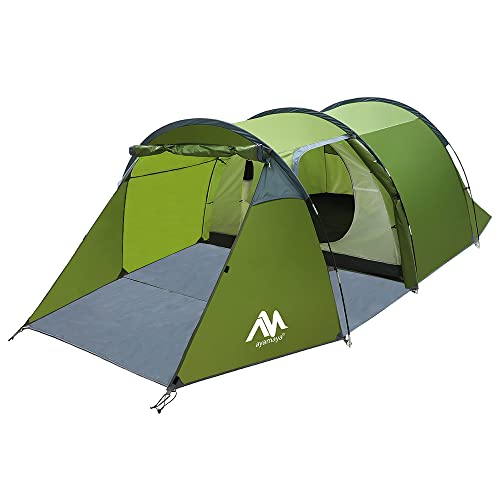
The AYAMAYA 4-Person Tunnel Tent is an extended double-wall ground shelter configured with a dedicated sleeping compartment and an oversized front vestibule. Measuring 14 feet long by 6.6 feet wide overall, this shelter is built for campers who want separated living and storage zones. The design is particularly relevant for car campers, motorcycle campers, and bicycle tourers who need a protected space to stash gear, transport bags, or bikes out of the weather without cluttering their sleeping quarters.
Inside, the tent is split evenly between an enclosed 7.4-foot by 6.6-foot bedroom and an adjoining 6.6-foot by 6.6-foot front porch. While the manufacturer states that the sleeping section accommodates up to four people, prospective buyers should assess their sleeping pads and elbow room against the 6.6-foot width, as four adults side by side will occupy the entire floor width. With a peak ceiling height of 4.3 feet (approximately 51.6 inches), this tent provides comfortable space for sitting, kneeling, and changing, but does not allow standing upright.
Pitching follows a practical outer-first system where three shock-absorbing poles are slid through exterior sleeves on the outer shell and staked into place. Once the outer fly is secured, the inner cabin simply clips inside, a process the manufacturer notes can be managed by one person. This design offers a significant advantage when pitching camp in wet weather, as the rainfly goes up first and keeps the breathable 190T polyester and B3 mesh cabin dry before you hang it. If you need a simple daytime shade shelter, the inner tent can be left out entirely, leaving the outer fly standing as a long tunnel sun canopy.
For weather protection, the outer fly is made from 210T rip-stop polyester with a listed waterproof rating exceeding 3000mm. The porch area includes its own groundsheet footprint to keep equipment off damp grass, while dual vestibule doors and two corner vents on the front door allow cross-ventilation. Because tunnel tents depend on outward tension to maintain their structural integrity, campers must anchor all stake points and guylines firmly into the ground to ensure stability in windy conditions.
Weighing 8.625 pounds, this tent provides substantial covered floor area for its weight, making it manageable for vehicle trunks, motorcycle panniers, or multi-person bicycle tours where gear can be divided. However, shoppers should note that the listing does not provide packed dimensions, carry bag specifications, or pole composition details. Furthermore, because it is a non-freestanding tunnel shelter, it cannot be erected on solid rock or wooden campground platforms without specialized anchor points.
Overall, this AYAMAYA tunnel tent is best suited for couples, small families, or pairs of outdoor travelers who prioritize dedicated gear storage and sheltered porch space over standing height. When comparing it with standard dome designs, evaluate whether the added convenience of a 6.6-foot front vestibule and dry outer-first pitching outweighs the lower clearance and mandatory stakeout requirements.
The two-room floor plan divides the 14-foot total length into an enclosed 7.4 ft by 6.6 ft sleeping cabin and an adjoining 6.6 ft by 6.6 ft vestibule. This distinct boundary keeps damp equipment, muddy footwear, and bulky packs out of the clean sleeping area.
Because the vestibule includes an integrated groundsheet footprint, it provides clean, sheltered ground storage for bicycles, motorcycle gear, or campsite coolers. If extra interior space is required for daytime shade, unhooking the bedroom converts the entire 14-foot footprint into an open tunnel canopy.
Setup utilizes three shock-absorbing poles fed through dedicated exterior sleeves on the outer tent body. After pinning the poles and staking out the structure, the inner mesh bedroom clips into place under the fly, a workflow the manufacturer states can be completed in about five minutes by one person.
The outer-first pitch ensures that the inner tent remains completely dry when setting up during rainfall. As with all non-freestanding tunnel tents, firm ground anchoring at both ends is necessary to keep the arches upright, tensioned, and stable.
The outer tent uses 210T rip-stop polyester fabric with a manufacturer-documented waterproof rating of over 3000mm. The inner tent is built from breathable 190T polyester combined with fine B3 mesh to foster airflow while providing insect protection.
Ventilation is aided by two large doors on the vestibule and two corner vents positioned near the front entrance. Campers should align the narrow tunnel profile parallel to prevailing winds and stake out all guy attachment points to minimize buffeting and condensation buildup.

Pros
- Pre-assembled pop-up frame allows for fast pitching without threading individual poles.
- PU 3000mm coating and heat-sealed taped seams provide documented multi-layer moisture protection.
- Multiple airflow openings, including two doors, two side windows, and a top roof vent, assist with interior air circulation.
- Removable rainfly cap allows users to switch between open stargazing and overhead weather coverage.
- Reflective guylines improve perimeter safety around the campsite at night.
Cons
- Peak height of 47.2 inches restricts interior movement to sitting or crouching rather than standing.
- The 30-inch wide circular packed profile is awkward to carry over distances and is unsuited for backpacking.
- The product data does not specify included ground stake details, interior pocket configurations, or bathtub floor dimensions.
The AYAMAYA 4-Person Pop Up Tent is an instant-pitch shelter designed for outdoor recreationists who want to eliminate the hassle of traditional pole assembly. Built around an integrated spring-loaded frame, this shelter is aimed at casual car campers, weekend festival attendees, and families looking for a fast shelter solution at designated campgrounds. Its pre-attached internal frame expands automatically as soon as it is released from its compression strap, making it an approachable choice for first-time campers or anyone arriving at camp late in the day.
Regarding interior space, the manufacturer lists the floor measurements at 118 inches long by 78.7 inches wide (approximately 9.8 by 7.2 feet), with a peak height of 47.2 inches (roughly 3.9 feet). While marketed to hold up to four people, shoppers should separate total stated capacity from practical usable room. Fitting four adults side by side will consume most of the floor area with little room remaining for duffels, packs, or bulky air mattresses. For greater comfort, a couple or a solo camper with gear will find the floor dimensions far more manageable. The 47.2-inch ceiling height requires occupants to sit, crawl, or change while seated, which is typical for low-profile pop-up dome designs.
The tent incorporates an overhead mesh skylight that allows occupants to view the stars in clear weather. When rain threatens, the included removable rainfly cap covers the skylight opening to prevent water intrusion. Ventilation is further supported by two full-sized doors and two large mesh windows, creating multiple paths for cross breezes to move through the tent body. For nighttime security, the manufacturer includes reflective guylines that stand out under flashlight beams to help prevent tripping around the shelter perimeter.
Transport and packing are defined by the tent's pop-up frame. The shelter packs down into a flat circular carrying case measuring 30 by 30 by 2.7 inches, with a total weight of 10 pounds. This circular disc shape fits easily into vehicle trunks, truck beds, or car backseats, but it is entirely incompatible with trail packs or long-distance trekking. Campers must carry the disc using the case handles, making it strictly appropriate for vehicle-supported camping or short strolls from the parking area to the campsite.
On the materials side, the shelter is made of 190T polyester backed by a PU 3000mm waterproof coating and heat-sealed tape over the seams. These specifications indicate thoughtful moisture protection for general three-season rains, though proper guying and site selection remain crucial for shedding water effectively. Buyers should note that certain specifications are left unstated in the listing, such as the exact denier or material of the tent floor, the number or style of included stakes, and whether interior gear organization pockets are present.
For car campers who prioritize rapid deployment, good cross-ventilation, and casual weekend use, the AYAMAYA Pop Up Tent provides a straightforward, user-friendly shelter. Those needing standing room, extended gear vestibules, or compact cylindrical packing for hiking trips should compare this model against standard cabin or multi-pole dome tents instead.
The AYAMAYA tent features documented floor dimensions of 118 inches by 78.7 inches, which translates to roughly 9.8 by 7.2 feet. The manufacturer assigns this footprint a maximum capacity of four people. In practical camping scenarios, accommodating four full-grown adults will leave minimal margin around sleeping pads and little to no floor space for storage bags or dry gear.
The interior height tops out at 47.2 inches at the center point. This height allows campers to sit up comfortably, read, or change clothes while kneeling, but it does not permit standing. Couples or small families with young children will find the space much more functional, providing adequate floor room for sleeping pads alongside duffel bags.
Setup relies on an integrated spring-steel frame structure that springs open automatically. Once the shelter is taken out of its portable carry bag and the securing strap is unfastened, the frame expands into shape within seconds. This removes the need to thread shock-corded fiberglass or aluminum poles through sleeves.
Taking down a pop-up tent requires folding and twisting the coiled frame back into its circular disc shape before sliding it back into the 30-inch carry bag. New users should practice the folding technique at home prior to their trip to become comfortable with the tension of the internal frame.
The manufacturer details a triple-layer moisture defense consisting of 190T polyester fabric, a PU 3000mm waterproof coating, and heat-sealed seam tape along structural stitching. This coating rating is designed to resist water penetration during typical campground rain showers.
Overhead weather coverage is handled by a removable rainfly cap that attaches securely over the mesh skylight. While this cap shields the top opening from rain, overall weather stability depends on firmly anchoring the tent to the ground and staking out the reflective guylines to support the structure against changing winds.
This tent has a total listed product weight of 10 pounds and packs into a circular carry case measuring 30 inches by 30 inches by 2.7 inches. Because the internal frame remains coiled within the fabric, it cannot be broken down into a narrow cylindrical stuff sack.
The 30-inch disc profile makes the tent best suited for car trunks, hatchbacks, and cargo areas. It is too wide and awkward for hiking or backpacking, so shoppers should plan on using it exclusively for car camping, beach day trips, and drive-up campsites where gear carrying is minimal.

Pros
- Instant pop-up frame sets up in seconds without manual pole threading
- PU 3000mm waterproof coating combined with heat-sealed taped seams
- Generous floor dimensions of 118 x 78.7 inches with dual doors for convenient entry and exit
- Overhead skylight with a dedicated removable rainfly for stargazing in fair weather
- Included reflective guylines enhance nighttime visibility to help prevent tripping
Cons
- Peak ceiling height of 47.2 inches requires occupants to crouch or sit rather than stand
- Circular packed disc measuring 30 inches in diameter and weighing 10 pounds is not practical for backpacking
- Rainfly covers only the top skylight rather than providing full-coverage fly protection over the entire tent body
The AYAMAYA 4-Person Pop-Up Tent is an instant-pitch camping shelter designed for car campers, weekend outdoor enthusiasts, and campers who prioritize fast, effortless pitching over technical alpine performance. Pitching traditional pole-sleeve shelters can be tedious after a long drive; this tent is engineered to spring into shape immediately once removed from its carry bag and unstrapped. With its combination of an automatic frame, dual doors, and an overhead mesh skylight, it primarily targets couples, small groups, or solo campers who want quick setup at established campgrounds, music festivals, or backyard campouts.
The manufacturer lists the tent as a 4-person model with floor dimensions of 118 by 78.7 inches (approximately 9.8 by 7.2 feet) and a peak height of 47.2 inches (roughly 4.1 feet). While the floor area technically provides space for four standard sleeping pads placed side by side, doing so leaves virtually no remaining interior floor space for duffels, backpacks, or gear storage. For greater comfort, couples or parties of two or three with gear will likely find the layout far more functional. Campers should also consider the 47.2-inch center height, which allows for comfortable sitting or crouching but does not accommodate standing upright.
Structural setup relies on an integrated spring-steel pop-up frame that expands automatically in seconds, eliminating loose poles, hubs, and threading sleeves. For airflow and interior comfort, the tent features two large doors and two mesh windows, paired with a roof skylight designed for stargazing on clear evenings. The tent fabric is constructed from 190T polyester paired with a PU 3000mm waterproof coating and heat-sealed taped seams. When inclement weather rolls in, an included removable rainfly cover attaches over the skylight opening to shield the top mesh from overhead moisture.
At a stated weight of 10 pounds and a packed size of 30 by 30 by 2.7 inches, this tent is designed to travel inside a vehicle trunk or back seat in its included zippered carry bag. Because the packed shape is a wide, flat disc, it is not practical for multi-day backpacking or strapping to a trail pack. Take-down requires folding and twisting the internal spring frame back into a circular disc, a technique that may require a few practice attempts at home before hitting the campsite. Once packed, the flat profile stows easily in a closet or under a car bed.
Potential buyers should assess both the weather design and accessory requirements before purchasing. The partial rainfly covers only the top skylight, leaving the main tent walls exposed directly to the elements; therefore, while the PU 3000mm coating and taped seams provide water resistance, it is best suited for fair to moderate weather conditions rather than severe storms. Additionally, the listing highlights included reflective guylines for nighttime visibility, but campers should verify their campsite anchoring needs and ensure proper staking into the ground. For casual car campers seeking a fast pitch, straightforward ventilation, and clear-night stargazing at an accessible price point, the AYAMAYA 4-Person Pop-Up Tent presents a practical, time-saving option.
The AYAMAYA Pop-Up Tent is engineered around an integrated, pre-assembled spring frame that expands automatically. Campers simply remove the tent from its circular travel bag and release the security strap, allowing the entire shelter to pop into shape within seconds. This design completely removes the hassle of threading poles through sleeves or clipping hubs together.
Packing the tent down involves collapsing the spring hoops and twisting the structure back into its flat 30-inch circular disc. Campers unfamiliar with pop-up tents will benefit from practicing the folding motion at home prior to their trip. Once folded, securing the frame with the retaining strap allows it to slide cleanly back into the included zippered carry bag.
The AYAMAYA tent body is built with 190T polyester fabric treated with a PU 3000mm waterproof coating and heat-sealed seam taping along the stitching. The PU 3000mm rating indicates a listed capacity to withstand water pressure up to 3000 millimeters, offering protection against light to moderate rainfall.
A removable rainfly cap is included to shield the overhead mesh skylight during rain. Because this is a partial fly rather than a full-coverage double-wall rainfly, the outer fabric of the tent body remains directly exposed to wind and rain. In windier conditions, deploying the included reflective guylines provides additional tension and structural stability while enhancing campsite visibility at night.
The tent features documented interior floor dimensions of 118 inches by 78.7 inches (approximately 9.8 by 7.2 feet) and a peak ceiling height of 47.2 inches (roughly 4.1 feet). The manufacturer lists a capacity of up to 4 people, which assumes occupants sleep side by side across the floor width.
For practical camping, sleeping four adults leaves minimal floor space for backpacks, coolers, or clothing bags. The interior space is best utilized by two to three adults or a small family with children, allowing ample room to store gear inside the tent. With a peak height of 47.2 inches, occupants can sit up comfortably to change or read, though the shelter is not designed for standing upright.

Pros
- Pitches in moments without the need to assemble or thread loose poles
- Separate vestibule area keeps wet gear and footwear out of the primary sleeping quarters
- Double-wall construction and low ground vents assist with moisture management and airflow
- Substantial listed waterproof ratings on both the polyester rainfly and Oxford groundsheet
- Four mesh windows and hooded vents allow flexible airflow and privacy control
Cons
- Center height of roughly 51 to 53.5 inches requires occupants to crouch rather than stand
- Large circular packed diameter of nearly 35 inches can be awkward to fit in compact car trunks
- Folding the flexible spring-steel frame back into the bag requires practice to master
The AYAMAYA 6-Person Pop Up Tent is an instant-pitch ground shelter designed for car campers, weekend family outings, and festival attendees who prioritize fast campsite arrival over complex pole assembly. Built around an integrated, pre-assembled spring frame, this shelter deploys right out of its storage sleeve. While the manufacturer assigns it a six-person sleeping rating, the layout works most comfortably for four campers or couples who want plenty of breathing room for gear and sleeping pads.
Regarding interior volume, the tent features a broad 12.5 by 8.5 foot floor plan (measured at 150 by 102 inches in product specifications) with a peak center height between 51 and 53.5 inches. Because of the domed geometry and relatively low ceiling, campers must sit, kneel, or crouch inside rather than walk upright. A key functional asset is the integrated front vestibule, which adds a sheltered zone at the entry door where dirty boots, storage bins, or outdoor equipment can rest without cluttering the primary sleeping area.
The tent structural design combines an inner breathable canopy and an outer protective fly attached via hooks. This double-layer build leaves a continuous air gap that forms ground-level ventilation, which aids in reducing interior moisture buildup. Airflow is further enhanced by four large zippered side mesh windows, hooded rear vents, and a roll-up front doorway. The inner cabin also includes practical organizational touches, such as small wall pockets for personal items, an overhead lantern loop, and a dedicated electrical cord access port for powered campsites.
For transport and handling, the entire tent collapses into a circular disc-shaped carry bag measuring 34.6 by 34.6 by 1.2 inches and weighs 10 pounds. This flat, wide package fits neatly across standard car trunks, truck beds, or backseats, though it is clearly unsuited for backpacking or long trail carries. Taking the tent down involves twisting the flexible spring poles into a figure-eight and folding them down into concentric loops, a technique that requires some patience and practice before heading outdoors.
Weather protection features include a 3000mm PU-coated polyester roof and an integrated rainfly, paired with a 4000mm PU-coated Oxford fabric groundsheet. The seams across the critical connection points are factory heat-sealed to resist water penetration. While these listed hydrostatic ratings are respectable for a recreational pop-up shelter, overall stability during windy conditions depends heavily on properly staking down the corners and tensioning all guy lines.
For car campers who want to eliminate the hassle of traditional tent pitching while retaining covered vestibule storage, the AYAMAYA 6-Person shelter offers strong utility. Buyers should simply weigh the rapid setup against the low ceiling height and wide circular packed shape when comparing it with taller, pole-assembled cabin or dome alternatives.
Pitching this tent takes minimal effort because the frame poles come pre-assembled within the fabric channels. Once removed from the storage sleeve and the safety strap is released, the spring-loaded structure expands into full shape in moments.
Packing the tent away requires a specific technique to twist and coil the circular spring frame down to its flat 34.6-inch diameter disc. First-time owners should follow the folding instructions carefully and practice in a yard before camping, ensuring all air is expelled and the fabric is neatly tucked into the carry bag.
The tent is constructed with a 3000mm PU-coated polyester roof and an integrated rainfly to resist precipitation. Factory heat-sealed seams reinforce the fabric joints to reduce the chance of water penetration during rain showers.
The groundsheet is made from 4000mm PU-coated Oxford fabric designed to resist ground moisture. For ventilation and humidity management, the double-layer wall construction provides an air gap between the inner mesh wall and the outer fly, complemented by hooded rear vents and double-panel zippered windows.
With floor dimensions of 12.5 by 8.5 feet, the interior provides ample ground footprint for standard sleeping arrangements. The manufacturer rates the space for five to six sleeping bags, though a group of four campers will have a noticeably more practical experience with room for personal items.
The peak center height measures between 51 and 53.5 inches, creating a low-profile dome that prioritizes wind shedding and pop-up mechanics over stand-up clearance. The integrated front vestibule adds separate covered floor area at the front door to organize packs and footwear outside the sleeping quarters.

Pros
- Instant pop-up mechanism eliminates pole threading and expedites campground arrival setup
- Front vestibule provides separate covered storage space for muddy boots and gear
- Dual-layer design with built-in air gap actively helps minimize interior condensation
- Multiple ventilation points including 4 mesh windows, ground vents, and double doors promote steady airflow
- Documented PU3000 waterproof coating on the roof and heat-sealed seams provide rain resistance
Cons
- Center height of 4.5 feet (53.5 inches) requires adult campers to sit or crouch rather than stand
- Listing does not state packed dimensions or carry disc diameter, which is important for trunk fitting
- Pole material and exact included accessory counts, such as stakes and guylines, are not specified
The AYAMAYA Waterproof 6 Person Easy Pop Up Tent is an instant-pitch shelter designed primarily for car campers, families, and casual weekend groups who want to minimize pitching effort. Built with pre-assembled poles, this pop-up tent springs into shape quickly compared to traditional pole-and-sleeve models. Its integrated front vestibule and navy blue double-layer shell make it a distinctive choice for campers who want built-in gear storage paired with rapid campsite assembly.
Regarding interior space, the shelter features a floor measuring 150 by 102 inches, which translates to 12.5 by 8.5 feet. The manufacturer rates this as a 6-person capacity, noting that it can accommodate four to six adult sleeping bags or three to five people when bringing along bags and camping gear. Although the floor footprint provides ample horizontal room, the center height reaches 53.5 inches (approximately 4.5 feet). This lower profile means adult campers will need to crouch or sit, making it better suited for sleeping and lounging rather than standing to change clothes.
The structural layout includes a dedicated front vestibule alongside a two-layer canopy design. The vestibule creates a separate sheltered entryway where muddy boots, gear bins, or pets can stay dry without cluttering the sleeping quarters. To counter condensation, the shelter uses two distinct fabric layers with an air gap between them to promote airflow and separate occupants from outer moisture. Ventilation is further supported by large front and rear double doors, four mesh windows to deter bugs, and dedicated ground vents designed to draw cooler air across the floor.
For weather-related features, the tent incorporates a polyester roof with a PU3000 waterproof rating and heat-sealed seams to mitigate water penetration. The floor is crafted from a waterproof-coated Oxford fabric, offering added defense against damp campsite ground. Weighing in at 10 pounds, the shelter is sufficiently light for handling in and out of a vehicle trunk, though its pop-up frame makes it intended for drive-up campsites and car camping rather than trail-bound backpacking.
Prospective buyers should keep a few practical considerations in mind. The manufacturer highlights an instructional video for folding the shelter, pointing to the reality that collapsing spring-loaded pop-up frames often requires specific technique and practice before achieving a smooth takedown. Furthermore, the product data does not document the folded package diameter, pole material composition, or the exact count of included stakes and guylines, leaving some accessory questions open.
Overall, this AYAMAYA pop-up tent is a practical match for car campers, couples, and small families who value rapid setup and separated gear storage over full standing height. If your camping plans involve warm to moderate conditions with potential rain, the documented PU3000 roof coating, extensive mesh venting, and built-in vestibule offer solid everyday utility, provided you take the time to practice the takedown fold at home.
The AYAMAYA 6-person tent provides an interior footprint of 12.5 by 8.5 feet (150 by 102 inches), giving campers substantial floor area to organize their sleeping arrangements. The manufacturer indicates that this space can fit four to six standard sleeping bags, or three to five occupants when luggage and camping equipment are brought inside. Group comfort will naturally depend on the size of sleeping pads or mattresses used, so measuring your gear against the 102-inch width is recommended.
A major design feature is the integrated vestibule area. By creating a partition between the outdoors and the sleeping quarters, the vestibule allows campers to stow dirty footwear, coolers, or camp chairs under shelter without tracking debris inside. Double doors located at both the front and rear allow easy entry and exit, preventing campers from having to climb over one another during nighttime exits.
Setting up the AYAMAYA tent relies on an instant pop-up mechanism featuring pre-assembled poles. Once released from its packed state, the integrated frame springs open in seconds, removing the time-consuming process of assembling and threading shock-corded poles. This rapid pitch is especially useful when arriving at a campground after dark or in unsettled weather.
Packing the tent away requires a specific twisting and folding sequence to collapse the frame back down. The manufacturer references a dedicated instructional video to guide campers through this process. Practicing the takedown and folding method at home before your trip is advisable, as pop-up frames require familiarizing yourself with the folding motion to pack cleanly.
Condensation management is built into the tent via a two-layer design. The engineered gap between the inner tent body and outer shell encourages air movement, which helps keep internal humidity from accumulating on the inner walls. Air circulation is further enhanced by four insect-proof mesh windows, ground-level vents, and large screened double doors that allow cross-ventilation on warm summer evenings.
For precipitation protection, the roof fabric is polyester treated to a PU3000 waterproof rating, accompanied by heat-sealed seams to resist leakage through stitching lines. The floor utilizes waterproof-coated Oxford fabric to guard against ground moisture. While these specifications provide documented rain protection, overall shelter security in high winds or torrential weather will depend on proper pitching, adequate staking, and campsite selection.
Frequently Asked Questions
How many people realistically fit inside a 4-person AYAMAYA tent?
Two to three adults fit comfortably with standard sleeping pads inside a four-person model. Stated capacity ratings assume occupants sleep shoulder to shoulder without extra baggage. Campers who prefer extra elbow room or carry bulky gear totes typically benefit from stepping up to a six-person shelter.
Are AYAMAYA pop-up tents completely waterproof in heavy rain?
Most AYAMAYA pop-up models feature water-resistant fabrics and taped seams suited for light to moderate rain. Severe storms with blowing rain can still stress seams and zipper flaps. Staking out every guyline keeps the outer shell taut and sheds rainfall effectively. For rough alpine weather, reviewing a dedicated mountain canopy shelter remains a safer choice.
How does the front vestibule design benefit campers?
The integrated vestibule provides a protected buffer between the campsite and your sleeping quarters. Storing muddy hiking shoes, wet outerwear, and packs in this area keeps the inner tent clean. Keeping damp gear outside the sleeping zone also reduces condensation buildup during cool nights.
Can one person fold down an AYAMAYA pop-up tent easily?
Yes, a single person can fold down an AYAMAYA pop-up tent using the figure-eight rolling method. The flexible frame collapses into concentric rings that slide into the circular carry bag. Practicing the motion once at home makes packing up on campsite departure morning quick and stress-free.
What is the main difference between an AYAMAYA tunnel tent and a pop-up tent?
Tunnel models use manual pole sleeves to create a long profile, while pop-up tents deploy automatically via sprung internal frames. The tunnel layout offers extended vestibule length for extra storage, whereas pop-up shelters prioritize fast setup. Campers seeking compact extra sleeping rooms can also evaluate a kids tent under 200 dollars for separate family setups.
How do you prevent condensation buildup inside an AYAMAYA camping tent?
Opening the built-in roof vents and mesh windows maintains cross ventilation to clear out humid air. Condensation naturally develops when body heat and breath meet cold exterior tent fabric. Orienting the tent entrance toward mild breezes ensures fresh airflow circulates steadily through the interior.


Write Your Review
No reviews yet. Be the first to share your experience!