

Pitching a sleeping setup directly atop a vehicle has become a common sight across trailheads and recreation areas, yet many travelers still ask: do campsites allow roof tents without special permits or vehicle-specific reservations? The short answer is that most developed campgrounds do welcome vehicle-mounted shelters, but regulations vary depending on whether a site is classified for tent camping, standard passenger vehicles, or recreational vehicles. Understanding these policies beforehand helps avoid unexpected check-in disputes or being turned away by campground hosts.
While traditional ground campers often look for spacious outdoor tents that pitch on dirt pads, rooftop campers must consider parking spur lengths, vehicle weight limits, and designated parking surfaces. Park managers frequently distinguish between a vehicle parked on an asphalt driveway and a sleeping structure pitched on delicate vegetation. Taking time to review property regulations ensures your hard shell or soft shell rooftop setup stays compliant while keeping your outdoor adventure smooth and stress-free.

Pros
- Durable aircraft-grade aluminum alloy shell offers rigid protection compared to plastic or soft-sided designs
- Hydraulic stainless steel air pressure rods streamline opening and closing at the campsite
- Layered sleeping setup features a 5cm non-deforming mattress, condensation pad, and recessed marine pad
- Comes equipped with a 7.5-foot telescoping ladder, integrated LED strip, and multiple gear storage bags
- Heavy blackout polyester fabric provides enhanced privacy and light blocking
Cons
- Substantial weight of roughly 198 pounds requires careful verification of vehicle roof load ratings and multi-person installation
- Crossbars are not included and must be verified for fit and dynamic capacity prior to mounting
- Listing does not state interior open peak height, leaving upright sitting room unconfirmed
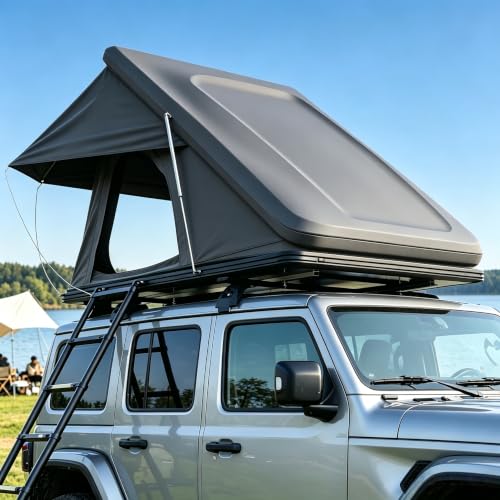
The WildFinder Hard Shell Rooftop Tent is an all-metal vehicle-top shelter engineered for truck, SUV, Jeep, and van camping. Designed for overland travelers and car campers seeking an elevated sleeping platform away from uneven ground, damp soil, and crawling insects, this model uses a rigid outer shell made of aircraft-grade aluminum alloy. By moving away from plastic composites, the aluminum housing is designed to minimize thermal expansion and contraction across changing seasonal conditions.
Regarding dimensions and interior room, the hard shell measures 83 inches long, 52 inches wide, and 9 inches tall in its closed state. While the manufacturer does not specify an exact occupant number, a 52-inch width approximates a standard full-size mattress footprint, making it best matched for solo campers or couples who prioritize a compact roof profile. The sleeping platform is layered with a 5cm non-deforming mattress, backed by both a condensation pad and a recessed marine pad intended to reduce moisture accumulation beneath the sleeping pad.
Setup relies on stainless steel air pressure levers that assist in raising the top shell automatically once the latches are released, removing the need for manual pole assembly. For airflow and privacy, the tent body utilizes a waterproof blackout polyester fabric paired with three mesh windows that allow cross-ventilation while keeping bugs out. The manufacturer lists weather specifications including a 5000 mm rainproof rating, Level 6 wind resistance, 99.99 percent sun blocking, and Level 4 heavy snow protection, though stability in severe weather still requires an anchored and level vehicle setup.
Transport and installation represent significant practical factors. With a listed weight of roughly 198 pounds, this tent requires a vehicle roof rack system with an adequate dynamic load capacity to handle highway transit and sufficient static capacity for parked occupancy. Luggage crossbars are not included, meaning buyers must supply their own compatible rack crossbars. Mounting and dismounting will require at least two people due to the overall weight and 83-inch length.
Primary limitations to weigh include the unlisted open interior height and the missing capacity rating. Because the manufacturer does not publish the peak ceiling height when raised, shoppers cannot verify exact upright headroom before purchase. Additionally, the hefty 198-pound weight may exceed the dynamic roof ratings of smaller crossover vehicles or factory-installed crossbars.
For vehicle owners with capable trucks, full-size SUVs, or vans equipped with sturdy aftermarket rack systems, the WildFinder Rooftop Tent presents a durable aluminum option packed with accessories like a 7.5-foot telescoping ladder, internal LED lighting, and shoe organizers. Shoppers should carefully verify their vehicle dynamic roof ratings and crossbar spacing before committing to this heavy hard-shell platform.
The exterior housing is constructed entirely from aircraft-grade aluminum alloy. According to the manufacturer, this metal structure resists aging, sun degradation, and seasonal thermal expansion far better than plastic shells, reducing the likelihood of joint leaks over multiple seasons of outdoor exposure.
The tent body fabric uses a heavy-duty polyester material designed for privacy and light control. It offers 99.99 percent sun protection and blackout characteristics, alongside a listed 5000 mm waterproof rating. The lifting mechanism is powered by stainless steel air pressure rods designed to resist rust and maintain hydraulic assist over long-term use.
The WildFinder rooftop tent comes packaged with a comprehensive selection of camping accessories. Access is handled via an included 7.5-foot telescoping ladder that adjusts to various vehicle heights, complete with a dedicated ladder organizer.
The interior bedding arrangement includes a 5cm non-deforming comfort mattress, a moisture-reducing condensation pad, and a recessed marine pad. Organization and utility are supported by ten organizer bags, two exterior shoe organizers, and an integrated LED strip light. Note that vehicle mounting crossbars are explicitly excluded and must be purchased separately.


Campground Regulations and Rooftop Tent Guidelines
Vehicle roof camping has expanded rapidly across outdoor destinations, but campground regulations have not always updated their language at the exact same pace. In the vast majority of situations, campsites that allow standard vehicles also permit visitors to sleep inside a roof-mounted tent. Problems only arise when a camper attempts to deploy a vehicle shelter in an area restricted strictly to ground tents or walk-in access. Understanding how campground managers categorize their sites helps you select the correct reservation category and avoid common logistical headaches.
The Core Answer: Are Vehicle-Mounted Tents Permitted at Campsites?
Campers can feel confident knowing that most developed drive-in campsites welcome vehicle-mounted shelters without hesitation. Because your sleeping platform sits directly on the roof rack of your truck, SUV, or crossover, it occupies the exact space reserved for your primary transport. Facility operators typically view these shelters as a hybrid between a traditional tent and a compact camper van. As long as your vehicle remains parked entirely on the designated driveway surface, you are usually within the rules.
The primary exception occurs at sites specifically designated as walk-in or tent-only locations where cars must stay in a central parking lot. In those areas, park authorities require visitors to transport their gear to a separate earthen pad or timber platform. Sleeping in a vehicle in a shared day-use parking area often violates local overnight parking rules. Campers must therefore verify whether a reservation provides a dedicated driveway space directly adjacent to the campsite amenities.
Another factor involves local safety or wildlife regulations that apply to specific recreation zones. In certain bear habitats, park officials occasionally enforce hard-sided camping rules during peak animal activity seasons. While hard shell aluminum models offer rigid top and bottom barriers, their fabric side walls often categorize them as soft-sided shelters under wildlife protocols. Always consult local ranger district notices if your travel takes you through active bear country where specialized food storage and shelter rules apply.
Navigating Tent-Only Sites Versus RV Sites
Campground reservation portals typically ask travelers to choose between tent spaces, standard vehicle spaces, and dedicated recreational vehicle sites. For rooftop tent owners, the standard drive-in site is almost always the ideal selection. These spots feature a dedicated parking spur along with a picnic table, fire ring, and open space. Standard drive-in spots allow your vehicle to stay parked legally while you climb into your sleeping quarters without encroaching on protected vegetation.
Booking a dedicated tent-only site can lead to misunderstandings if the parking spur is detached from the campsite living area. Many state and national parks design tent-only spurs to protect fragile ground cover and prevent vehicle congestion. If you arrive with a rooftop tent at a site with a distant parking slip, the campground host may prohibit you from deploying your ladder in the roadway. Choosing a site labeled as standard non-electric or drive-in avoids this layout issue entirely.
Reserving an RV site is another viable option, particularly during busy travel weekends when standard drive-in spots are completely booked. RV spaces feature wide, level parking pads designed for larger travel trailers and motorhomes. While these sites sometimes come with an additional utility fee for electrical and water hookups, they provide plenty of space for vehicle-mounted gear. You do not strictly need hookups to enjoy a rooftop shelter, but the generous space guarantees zero boundary disputes with neighboring campers.
Public Lands and Agency Policies: National Parks, State Parks, and Public Land
Federal and state agencies oversee vast networks of outdoor recreation land, each operating under specific recreation standards. Within the National Park Service, campgrounds generally treat rooftop tents like any standard vehicle camping arrangement. As long as your vehicle fits within the designated parking pad boundaries, park rangers will permit the setup. The key requirement across all national parks is that all four tires and any support ladders must remain on the hardened asphalt or gravel pad.
State park systems across the country follow very similar operational procedures, though enforcement intensity can vary by region. Some state parks have strict limits regarding how many sleeping units can occupy a single site. If your travel party pitches both a rooftop unit and a ground tent, you should confirm that the park allows multiple shelters per spur. Some locations charge a nominal second-shelter fee, while others strictly limit occupancy to one primary shelter per reservation.
Dispersed camping on Bureau of Land Management territory or United States Forest Service roads offers the greatest operational freedom for overland travel. In these undeveloped areas, campers can pull off designated roads and set up camp on existing bare ground without formal site reservations. You must still adhere to standard motor vehicle use maps and avoid driving over native vegetation. Leaving no trace remains mandatory, meaning you must pack out all refuse and respect fire restriction notices throughout your stay.
Private Campgrounds and Commercial RV Parks
Private campgrounds and franchise networks such as KOA present a varied landscape of operational rules for overland rigs. Many commercial campgrounds cater heavily to family travel and readily accept rooftop setups in their dry-camping or standard vehicle sections. These businesses appreciate that modern rooftop campers bring self-contained sleeping setups that create minimal ground disturbance. Friendly communication during the booking process ensures management assigns you a spot with adequate overhead tree clearance.
Exclusive RV resorts, however, occasionally enforce strict vehicle policies that exclude overland rigs and roof-mounted tents. Some high-end motorcoach resorts have minimum length requirements or mandate fully self-contained interior plumbing. Others enforce age limits on recreational vehicles or prohibit canvas and fabric shelters entirely to preserve a uniform aesthetic. Reviewing private campground guidelines online or calling ahead prevents awkward situations upon arrival.
Noise considerations and campsite density also come into play at private RV parks where spaces sit close together. Because these properties often pack sites tightly, closing vehicle doors and climbing metal ladders late at night can carry sound to neighbors. Being mindful of campground quiet hours helps maintain a welcoming atmosphere for all guests. Respecting property rules ensures private operators continue to view rooftop tent travelers as responsible outdoor enthusiasts.
Physical Site Constraints: Parking Spur Dimensions and Leveling
Campground reservation systems always state the maximum vehicle length for each numbered parking spur. When calculating your total footprint, remember that your setup extends beyond the bumper of your vehicle. A telescoping ladder angles outward from the side or rear, requiring several feet of clear, unobstructed ground. If you deploy an attachable side awning or shower annex, your total campsite width increases substantially.
Ground slopes represent another physical reality of vehicle-based camping that traditional tent campers solve differently. Ground campers can scout flat dirt patches within the site, but vehicle campers are confined to the angle of the parking spur. If the driveway features a noticeable incline, you will sleep at an awkward angle unless you carry leveling blocks or recovery boards. Investing in a small bubble level and durable plastic leveling ramps ensures a restful night on uneven pavement or gravel.
Overhead hazards also demand close attention before you park and pop the top of your shelter. Low-hanging tree branches, campground utility lines, and wooden site markers can damage vehicle racks or puncture exterior tent fabric. Park rangers will not permit you to prune native tree limbs to accommodate an opening hard shell. Taking a few moments to inspect the vertical clearance above your vehicle avoids costly gear repairs and environmental damage.
Hard Shell Rooftop Tent Features That Simplify Camp Life
Modern rooftop shelters make complying with campground rules remarkably straightforward compared to older designs. Sturdy aluminum hardshell models, such as the WildFinder Rooftop Tent, Hard Shell Roof Top Tent, open smoothly using stainless steel gas pressure struts. This quick mechanical assist allows campers to set up within minutes of arriving at their site, even during late evening hours. Because the shell lifts vertically, the entire structure stays safely confined within the footprint of the vehicle.
Fast deployment is especially helpful when dealing with unpredictable weather or arriving at a site after dark. Shelters like the Adventurer Pro Rooftop Tent Hard Shell utilize hydraulic automatic pop-up struts that open or close in roughly five seconds without requiring extensive staking. For travelers who also carry ground gear, comparing these systems with heavy duty water resistant camping tents highlights the distinct setup advantages of roof mounts. You spend less time hammering stakes into rocky ground and more time enjoying your evening.
Internal organization and low-profile aerodynamics also contribute to a smoother campground experience. Compact units like the Hardshell Rooftop Tent for SUV Truck Jeep maintain a streamlined folded height that fits easily under lower park entry gates. Inside, features like recessed marine pads and anti-condensation layers keep sleeping pads dry despite overnight atmospheric shifts. These integrated features ensure you sleep comfortably without cluttering picnic tables or common camp areas with drying gear.
Weather Protection, Fabric Durability, and Condensation Control
Staying protected against rain, wind, and fluctuating temperatures is essential for any successful camping trip. Advanced models such as the Rooftop Tent Hard Shell with Winter incorporate heavy 320g polyester fabric with fully taped seams to resist water ingress during heavy downpours. In cold climates, a detachable thermal liner provides extra insulation against wind chill and cold drafts. These heavy-duty materials ensure your living space remains secure regardless of seasonal conditions.
Managing interior condensation is another critical aspect of rooftop tent ownership that mirrors ground camping challenges. Warm breath and damp outdoor air naturally create moisture buildup against fabric walls and cold aluminum frames. To minimize dampness, modern shelters incorporate triangular mesh windows and dedicated ceiling vents to maintain continuous cross-ventilation. Similar principles apply when choosing dark room camping tents, where dense fabric coatings require active airflow to stay dry and comfortable.
Sun protection and darkness coatings also dramatically improve your sleep quality during bright summer mornings. High UPF coatings and blackout window layers prevent harsh sunlight from turning your vehicle sleeping pod into a sweltering greenhouse. Stargazing windows allow you to enjoy evening night skies while keeping bug netting securely zipped against insects. Having these protective features integrated into the tent shell eliminates the need to rig separate tarps across campground trees.
Practical Etiquette and Essential Verification Steps Before You Travel
A successful rooftop camping journey begins with proactive communication before you leave home. When booking reservations through federal or state portals, check the site photos and specific parking spur notes carefully. If the online description mentions a walk-in distance or tight driveway clearance, choose a different numbered site. Calling the campground host or local ranger station directly provides immediate clarification if the property rules seem vague.
Practicing good campsite etiquette helps maintain a welcoming environment for all outdoor enthusiasts. Keep built-in LED light strips dimmed to a modest level after quiet hours begin so you do not illuminate neighboring campsites. Secure ladders and loose exterior straps firmly to eliminate metallic rattling in breezy conditions. When packing up early in the morning, latch your hard shell quietly and avoid revving vehicle engines near sleeping neighbors.
Rooftop tents offer an exceptional balance of elevated comfort, rapid deployment, and overland versatility when used responsibly. As long as you choose drive-in sites, respect vehicle parking boundaries, and confirm local park regulations, campgrounds will readily accommodate your setup. Verifying your site dimensions and reviewing facility guidelines in advance ensures a smooth trip from arrival to departure. By preparing thoroughly, you can explore public parks and private resorts with complete peace of mind.


Write Your Review
No reviews yet. Be the first to share your experience!