

Pitching a shelter on solid bedrock, loose sand, or an elevated wooden deck often makes driving metal pegs into the earth impossible. In these demanding environments, learning how to pitch a tent without stakes prevents damaged gear and ensures a secure night in the wilderness. Freestanding shelters provide structural shape on their own, but they still require firm downward and outward resistance to resist blustery gusts. Campers exploring rugged backcountry locations frequently encounter surfaces where hammer-driven pegs cannot bite into the terrain. Exploring dependable weather resistant camping tents highlights how external anchoring maintains rainfly separation during sudden storms.
Alternative anchoring relies on natural friction, tension knots, and surrounding ballast to replace traditional ground hardware. Using heavy rocks, deadman rigs, or platform gaps allows you to maintain correct guyline angles without bending aluminum pegs. While modern easy setup tents simplify the initial frame assembly, proper tie-outs remain vital for structural integrity and ventilation. Understanding how to secure corners and guyout points across hard surfaces keeps your shelter stable throughout the night. Careful adjustments ensure the canopy stays taut, condensation vents remain open, and your living space stays dry.


Pros
- Lightweight 0.46-ounce individual weight minimizes overall gear load for backpackers.
- Rugged 7000-series aluminum resists bending during routine ground insertion.
- Y-beam geometry delivers reliable multi-directional holding resistance in medium to firm soil.
- Reflective cord loops aid nighttime campsite navigation and stake pullout.
- High-visibility red finish stands out against dirt, grass, and forest duff.
Cons
- A 6-pack may not provide enough stakes for larger tents or shelters requiring extra guy-line points.
- Not engineered for specialized terrain such as loose coastal sand, deep snow, or solid rock beds.
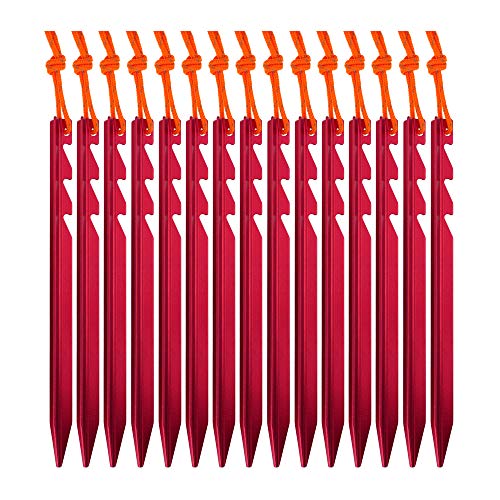
The MSR Groundhog Tent Stake Kit is a six-pack of 7.5-inch replacement and upgrade stakes intended for camping and backpacking shelters. Many factory tents come equipped with basic shepherd-hook stakes that can easily bend under foot pressure or twist loose in shifting winds. This kit caters to solo backpackers, couples, and family campers who want dependable anchoring hardware that balances low carry weight with solid structural rigidity across standard campground and backcountry soil types.
Each stake measures 7.5 inches long with profile dimensions of roughly 0.47 by 0.1 inches and weighs just 0.46 ounces, bringing the entire six-piece kit to around 0.22 pounds. Rather than relying on a simple flat or cylindrical shaft, the Groundhog uses a three-sided Y-beam design. This triangular profile maximizes ground surface contact in multiple directions, enhancing resistance to pullout forces without adding excess bulk to your pack.
Setup and usability are supported by practical head features on each stake. An integrated notch just below the top crown catches tent guy lines or stakeout loops, holding cordage securely under tension so lines do not slide upward or slip free. Additionally, each stake comes fitted with an attached reflective pull loop. This cord helps campers spot the anchor point with a headlamp at night to prevent tripping, while also providing adequate leverage to pull the stake out of packed earth during morning take-down.
Transport is straightforward due to the compact footprint of the set. The stakes slide neatly alongside tent poles or into an accessory pocket inside a shelter sack. The vibrant red finish helps prevent hardware from getting lost in tall grass, leaf duff, or dark topsoil. For basic maintenance, wiping away residual soil and drying the stakes before stashing them next to your shelter fabric prevents abrasive grit from damaging rainfly or tent floor coatings in long-term storage.
While the 7000-series aluminum construction offers high strength for its weight class, campers should remain mindful of campsite ground conditions. The three-sided design is built for standard dirt, forest loam, and mixed gravel, but driving any aluminum stake directly into solid rock or heavily compacted caliche can bend the metal. Furthermore, very loose beach sand or powdery snow typically demands specialized wide snow or sand anchors. Buyers should also verify how many tie-down points their tent requires, as a six-pack may leave larger tents or complex guy-line configurations short on stakes.
For backpackers and campers looking to improve the holding reliability of their shelter setup without adding significant weight, the MSR Groundhog 6-Pack is a well-engineered accessory. It provides a noticeable upgrade in stability over generic wire stakes, provided that six stakes meet your pitching requirements and you match the hardware to compatible soil conditions.
The MSR Groundhog kit utilizes a classic three-sided Y-beam structure to create anchoring resistance across multiple axes. This shape provides greater surface area against surrounding dirt compared to smooth cylindrical pegs, helping the stake hold fast under lateral guy-line tension.
A molded notch near the top rim acts as a dedicated catch point for tent webbing and guy lines, keeping them seated under shifting wind conditions. Attached reflective pull loops make extraction simple and provide clear visual markers around your campsite perimeter when illuminated by a flashlight.
These stakes are fabricated from 7000-series aluminum, an alloy recognized for its high strength-to-weight ratio in outdoor hardware. This formulation provides rigidity during installation while keeping individual stake weight down to 0.46 ounces.
The stakes feature a durable red finish that offers high visibility against forest floors, dirt, and grass, reducing the chances of leaving gear behind when breaking camp.
Each stake in the regular kit measures 7.5 inches in length with cross dimensions of 0.47 by 0.1 inches. At 0.46 ounces per unit, carrying the complete six-pack adds only about 0.22 pounds to your pack.
This low weight profile makes the kit well-suited for weight-conscious backpacking trips as well as streamlined car-camping kits where efficient pack space is valued.
Pros
- Complete anchoring bundle includes 20 stakes, a multi-use mallet, and a fitted carrying pouch
- Galvanized steel shafts and reinforced polypropylene heads resist rust and handle regular mallet impacts
- Integrated reverse hook on the hammer head facilitates smooth, low-strain stake removal from hard ground
- Multipurpose hammer tail doubles as a mini shovel for clearing debris and leveling minor ground imperfections
- Lightweight individual stake design keeps the weight of each peg down to roughly 0.07 pounds
Cons
- Total kit weight of roughly 2.38 pounds may be heavier than solo ultralight backpackers prefer to carry
- Polypropylene stake heads may show surface wear more quickly than solid one-piece forged metal stakes
- Standard 7.1-inch stake length is designed for typical soil and may not hold securely in loose sand or deep snow
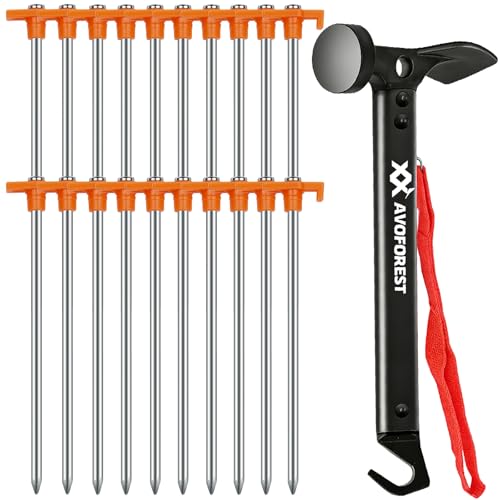
The AVOFOREST 20-Piece Tent Stakes and Camping Hammer Set is an all-in-one anchoring and pitching accessory kit designed for outdoor shelters. It caters to campers, hikers, and backyard shelter setups requiring dependable ground security and practical campsite tools. Rather than relying on flimsy factory-included wire pegs that frequently bend in tough soil, this package supplies a generous quantity of durable ground stakes along with an 11.8-inch multi-function hammer.
In terms of specifications and transport, the kit features twenty 7.1-inch stakes weighing approximately 0.07 pounds each, accompanied by an aluminum alloy mallet. The overall package weight is listed at approximately 2.38 pounds, which includes a dedicated storage bag. For car campers, this entire bundle easily stashes inside a trunk or gear tub without consuming meaningful space. While the manufacturer notes suitability for backpackers, solo hikers watching every ounce may find carrying the full 2.38-pound assembly excessive, though dividing the lightweight stakes among group members offers a practical trail solution.
The hardware design prioritizes functional campsite utility. Each stake is crafted from galvanized steel with precision-milled tips engineered to penetrate hard-packed dirt and firm turf. Molded polypropylene (PP) heads cap the top of each stake to provide a secure striking surface and cord-hooking point. The included hammer is constructed from rust-resistant aluminum alloy and features an ergonomic handle. Beyond driving pegs, the hammer head incorporates an integrated reverse hook for lifting stubborn stakes out of the earth, as well as a small shovel blade designed to assist with clearing campsite debris or leveling small pitching areas.
Campsite setup and strike-down are streamlined by the dedicated tool combination. Campers can drive the milled pegs directly into tough ground, while the reverse hook eliminates the hand strain commonly associated with pulling anchors out of compacted soil. Maintenance is straightforward, as the galvanized steel resists corrosion from damp ground. Wiping residual dirt and moisture off the metal shafts and hammer head before placing them back into the included storage bag will help preserve the gear over multiple camping seasons.
When evaluating this set, buyers should consider a few practical trade-offs. The 7.1-inch length is well-suited for typical campground dirt, packed grass, and moderately hard ground, but it may not provide sufficient holding power in loose beach sand or deep snow where specialized anchors are required. Additionally, while the polypropylene stake heads are reinforced to withstand mallet strikes, repeated heavy impacts over time could exhibit more wear than fully forged steel pegs. The package dimensions provided in listing specifications are somewhat ambiguous, though the component lengths of 7.1 inches for stakes and 11.8 inches for the mallet are clearly documented.
Overall, the AVOFOREST stake and hammer combination provides a practical upgrade for family campers, festival attendees, and group travelers looking to replace inadequate stock tent pegs. It offers an ample supply of 20 stakes to secure large multi-room tents, guy lines, and rainfly outriggers all at once. Campers seeking a convenient anchoring package with built-in extraction tools and dedicated storage will find solid functional utility in this complete kit.
This set includes twenty 7.1-inch galvanized steel tent pegs, an 11.8-inch multifunctional aluminum alloy camping hammer, and a fitted storage bag to keep all pieces organized in transit.
With twenty individual stakes provided, the set offers sufficient anchoring points for large family tents, auxiliary tarps, and extensive rainfly guying configurations without requiring separate purchases.
The stakes are constructed with galvanized steel shafts and precision-milled tips to facilitate entry into hard-packed ground. Reinforced polypropylene heads provide cord-retention hooks and a flat surface to receive hammer strikes.
The companion hammer features an integrated reverse hook specifically designed to slip under stake heads, enabling campers to pull ground anchors cleanly out of compacted earth during campsite pack-down.

Essential Methods for Pitching a Tent Without Stakes
Pitching a tent without standard ground stakes requires a firm grasp of tension, friction, and environmental ballast. When ground conditions reject traditional pegs, securing a shelter shifts from driving metal spikes to anchoring lines against solid resistance. Mastering these alternative strategies ensures your shelter remains upright, balanced, and ready to shed wind and moisture.
Freestanding Versus Non-Freestanding Shelters on Unstakable Ground
Tent geometry plays the primary role in determining how much anchoring support a shelter demands in the field. Freestanding tents utilize interlocking pole architectures that support their own fabric walls without needing exterior pull points. This inherent rigidity allows a camper to erect the inner canopy on a flat slab of granite before attaching any guyouts. Non-freestanding models, such as ultralight trekking pole shelters or tunnel tents, lack rigid pole frames and collapse immediately without continuous outward tension. Attempting to pitch a non-freestanding tent on bedrock demands exceptional rigging creativity to prevent structural failure.
Even a rigid freestanding dome requires dependable exterior anchoring before weather rolls across the campsite. Unsecured freestanding tents act like kites when mountain drafts catch the broad side of an untreated rainfly. The frame might retain its dome shape, but sudden gusts can easily flip the entire structure or tumble it across rough terrain. Securing corner grommets and tensioning outer guylines preserves the interior living space and prevents poles from bending under sudden wind loads. Proper weighting protects the floor fabric against abrasive rock movement while keeping the rainfly separated from the inner mesh.
The Rock Anchor System for Bedrock and Hardpan Surfaces
Solid bedrock prevents stakes from penetrating even a fraction of an inch into the ground. In these conditions, heavy boulders and flat stones provide the most reliable natural counterweights for your shelter. The standard technique involves wrapping your tent corner cord or guyline around an anchor rock before locking it in place with a heavier boulder. This setup is often called the big rock, little rock method among experienced backcountry travelers. The smaller stone holds the loop of your cord, while the larger boulder rests on top to prevent slipping.
Selecting the right stones requires attention to texture, shape, and weight to avoid damaging your equipment. Look for smooth river rocks or broad, flat fieldstones rather than jagged quarry chunks with sharp edges. Sharp corners on rough stones can sever thin nylon guylines or tear delicate canopy webbing under heavy wind vibrations. Each corner anchor stone should weigh at least twenty to thirty pounds to counteract moderate winds effectively. If individual stones are small, stacking several medium rocks across the anchor cord builds the necessary downward friction.
Adjusting the tension between your shelter and the rock pile requires a simple friction knot or line adjuster. Tie your guyline around the primary rock using a clove hitch or a secure round turn to stop the cord from sliding loose. Once the line wraps around the base, rest the heavier locking stone directly over the friction wrap. Walk around each corner sequentially to equalize tension so the shelter pulls evenly across its diagonal axes. Equalized tension prevents the tent frame from torquing out of alignment during shifting evening breezes.
Deadman Rigging for Loose Sand, Gravel, and Powder Snow
Loose sand and dry powdery snow present the exact opposite challenge of bedrock because standard pegs slide out under the lightest tug. Traditional metal stakes simply pull free through loose granules because the soil lacks shear strength. Deadman anchors solve this issue by transferring tension across a wide horizontal surface area buried deep beneath the surface. Instead of relying on vertical friction, the anchor uses the weight of the compacted overburden above it to resist outward forces. This method works exceptionally well on coastal beaches, desert dunes, and winter snowfields.
Creating a deadman anchor begins with finding a sturdy horizontal object such as a thick branch, a flat rock, or a nylon stuff sack. Tie your guyline around the center of the object using a secure girth hitch or bowline knot. Dig a trench at least ten to twelve inches deep, angling the cut slightly away from the direction of the tent. Place the anchored object horizontally at the bottom of the trench so the pulling force works perpendicular to its broad face. Bury the anchor completely and pack the sand or snow down firmly with your boots to maximize holding power.
Stuff sacks filled with wet sand or packed snow serve as excellent reusable deadman anchors in barren environments where timber is absent. Lightweight dry bags or grocery sacks can be filled with heavy sediment, tied tightly, and buried in individual trenches around the perimeter. The broad surface of a filled sack resists pulling through fine sand far better than any metal pin. In snowy conditions, pouring a small splash of water over the packed snow above the anchor creates an icy crust that increases resistance. Ensure you extend your guylines far enough outward to maintain a low pulling angle relative to the ground.
Securing Shelters to Wooden Platforms and Deck Boards
Designated wooden tent platforms protect fragile alpine soils, but their flat wooden planks will not accept regular tent stakes. Driving nails or screws into park platforms damages public infrastructure and violates standard backcountry ethics. Instead, campers can secure guylines by slipping cord through the narrow expansion gaps between adjacent wooden boards. Specialty aluminum fishbone anchors or spring-loaded deck pegs slide through these gaps and rotate ninety degrees to lock beneath the wood. These compact accessories provide solid anchor points without leaving a trace of damage on the wooden structure.
If you lack specialized deck pegs, common camping cordage and short sticks provide a practical improvised solution. Drop a loop of cord through the plank gap, slide a short wooden dowel or branch through the loop underneath the platform, and pull the line tight. The wooden crossbar bridges the gap beneath the boards, creating an immovable anchor under upward tension. You can also route long perimeter guylines completely around the platform joists or tie them directly to corner support posts. Campers utilizing large, spacious outdoor tent models find that tying directly to structural posts provides immense stability during gusty weather.
Platform pitching requires close attention to the slick surface texture of wet or weathered wood. Wet wooden planks offer very little friction, meaning an unweighted tent floor can slide easily across the platform during strong gusts. Positioning your sleeping pads and heavy gear inside the tent immediately after raising the frame stabilizes the base against horizontal movement. Check that your guyline paths do not create tripping hazards along the edge of the elevated deck. Keeping your tie-outs low to the platform surface helps maintain optimal tension across the tent rainfly.
Internal Ballast and Gear Distribution Strategies
Placing heavy personal equipment inside the shelter creates an effective internal ballast system when exterior anchoring options remain scarce. As soon as you assemble the pole frame, place your fully packed backpack inside the windward corner of the tent. Adding full water bladders, dry bags of clothing, and footwear onto the floor corners prevents the structure from lifting off the ground. Distributing weight evenly across all four interior corners pins the bathtub floor securely against the site surface. This internal mass acts as the first line of defense against sudden vertical wind drafts.
Care must be taken when loading internal ballast to prevent damaging delicate floor fabrics. Coated tent floors can puncture easily if rough backpack buckles, crampons, or heavy metal camp cookware press against sharp rock underneath. Always check the ground beneath the tent floor and remove loose pebbles, twigs, and sharp gravel before spreading the canopy. Lay down a durable footprint or fold your gear pads beneath heavy packs to buffer contact points against the earth. Concentrating weight inside corners also maintains bathtub floor geometry, preventing walls from sagging inward during steady rainfall.
Guyline Geometry, Tension Knots, and Condensation Control
Maintaining correct guyline geometry is critical when relying on non-traditional anchor points around your campsite. Guyouts should extend outward at roughly a forty-five-degree angle from the tent body to balance downward and outward pulling forces. Pulling lines too steeply downward flattens the rainfly against the inner tent mesh, which transfers damp condensation onto your gear. Pulling lines too far horizontally increases slack, making the fabric vulnerable to violent flapping in the wind. A steady, balanced angle keeps the rainfly suspended tightly above the inner canopy to preserve essential airflow.
Reliable knots ensure your stakeless anchors maintain tension throughout changing weather conditions and overnight temperature drops. The taut-line hitch and the trucker’s hitch are invaluable knots for adjusting cord tension without moving heavy anchor rocks. A taut-line hitch grips under load while allowing you to slide the loop along the standing line to tighten the rainfly. If you are pitching modern dark room camping tents, maintaining rainfly separation is especially vital for keeping fabric layers isolated and cooling airflow moving freely. In cold night air, nylon guylines naturally stretch, making easy tension adjustments necessary before going to sleep.
Ventilation depends entirely on how evenly you space your exterior tie-outs from the tent walls. If an improvised rock anchor shifts inward during the night, the rainfly collapses against the breathable inner wall. Moisture generated by occupant respiration condenses on the underside of the fly and drips straight into the living space. Inspecting each anchor line to confirm the canopy remains drum-tight prevents annoying dampness across sleeping bags and personal gear. Stable tension also stops fabric from rubbing against pole sleeves, minimizing structural wear over long camping trips.
Comparing Hardware Pegs and Stakeless Rigging for Challenging Terrain
Understanding when to rely on stakeless rigging versus carrying specialized terrain pegs helps campers prepare for unpredictable campsites. Standard wire pegs often bend instantly when driven into stony ground, forcing campers to seek alternative anchor methods. However, carrying specialized hardware can sometimes supplement natural anchors when mixed soil conditions present both dirt patches and exposed rock. For instance, robust Y-beam aluminum stakes like the MSR Groundhog or AnyGear 15 Pack offer superior soil holding power because their three-sided profiles bite into mixed gravel. In rocky turf where thin fissures exist, these rigid designs can often wedge into tight crevices that defeat simple round wire pins.
Car campers facing extremely hard-packed clay or gravel pads often benefit from heavy-duty steel spikes rather than improvising rock anchors. Kits such as the Yesland 24 Pack or HORUSDY 20 Pack utilize thick galvanized steel spikes designed to be driven with camp mallets into stubborn terrain. While these heavier options are impractical for lightweight backpackers, they provide dependable anchoring where natural boulders or deadman materials cannot be found. Sets paired with tools, like the AVOFOREST kit with its included aluminum hammer, allow campers to tackle compacted gravel sites without searching for nearby timber. When those heavy pegs still cannot penetrate solid granite, transitioning seamlessly to rock anchoring remains your safest solution.
Blending natural rigging with specialized hardware allows you to adapt to any campsite topography you encounter. You might drive a heavy steel peg into a solitary patch of dirt on one corner while weighting three other corners with boulders. Alternatively, lightweight aluminum stakes can be buried horizontally as dedicated deadman anchors beneath sand or snow when sticks are scarce. Carrying extra lengths of reflective cord and utility loops expands your ability to tie off to trees, large logs, or platform railings. Versatility in your setup strategy ensures your shelter remains safe regardless of ground hardness.
A Step-by-Step Workflow for Pitching Without Stakes
Executing a methodical pitching sequence prevents your shelter from blowing away while you gather your alternative anchors. Begin by scouting a flat, sheltered location protected from prevailing wind channels and potential water runoff paths. Clear away sharp stones, pinecones, and debris that could damage the underside of your tent floor fabric. Unfold your groundsheet and tent body, immediately placing four heavy rocks or full packs on the corners to keep the fabric pinned down. Having immediate ballast on site prevents gusts from launching your unpegged shelter across the landscape.
Assemble and insert your tent poles into their respective corner grommets or hub clips while keeping the corner ballast in place. Raise the canopy frame gradually, snapping pole clips into position while checking that the structure remains centered on your footprint. Once the freestanding frame is erect, transfer your heaviest personal gear into the interior corners to provide internal stabilization. This internal weight keeps the floor flat while you step outside to construct your exterior anchoring system. Take time to verify that the tent door zippers operate smoothly without binding under uneven floor tension.
Drape the rainfly over the frame, aligning door openings and securing any internal Velcro or hook-and-loop wraps to the pole structure. Attach each corner guyline to your prepared rock anchors, buried deadman logs, or platform expansion gaps. Work around the perimeter in an alternating crisscross pattern to distribute tension evenly across the frame. Tighten the primary corner points first before extending secondary guylines attached to the sidewalls and vestibules. Tension each line until the rainfly is taut, smooth, and completely separated from the inner tent mesh.
Finish the setup by testing the resilience of each anchor point under simulated wind stress. Gently push against the main pole junctions to confirm the frame flexes naturally without dislodging the weighted rocks or buried sacks. Ensure that vestibule flaps are anchored far enough outward to allow easy entry and exit without catching on anchor stones. Double-check all knot friction wraps and mechanical cord tensioners to confirm they are locked firmly in position. A thorough final inspection guarantees that your shelter will withstand changing nighttime winds while keeping you safe and dry.
Campsite Safety, Wind Verification, and Leave No Trace Practices
Environmental changes during the night can alter the stability of an unpegged shelter if anchors are not monitored. Wind directions frequently shift after sunset as cool air flows down mountain valleys or off open bodies of water. Inspect your guylines right before crawling into your sleeping bag to take up any slack caused by cord stretch or shifting stone piles. If rain begins to fall, wet soil around deadman trenches can soften, requiring additional rock reinforcement on top of buried logs. Being proactive with anchor maintenance prevents midnight structural emergencies in poor weather.
Tearing down a stakeless pitch demands strict adherence to Leave No Trace principles to protect natural backcountry environments. When packing up your camp, return all moved rocks, deadwood, and boulders to the exact spots where you discovered them. Fill in every deadman trench completely, packing the sand, gravel, or snow flush with the surrounding grade to prevent erosion. Never leave anchor cords, tape, or broken branches scattered across the campsite when your trip concludes. Leaving the campsite in its pristine natural state ensures that fragile wilderness areas remain intact for future outdoor travelers.
Pitching a tent without stakes is an empowering outdoor skill that opens up breathtaking campsites on rocky peaks, sandy coastlines, and wooden mountain overlooks. By understanding how to harness rocks, deadman trenches, and internal gear weight, you can anchor your shelter securely on virtually any terrain. Always assess your site conditions carefully, match your rigging methods to the local landscape, and verify your line tension before nightfall. With the right techniques and thoughtful preparation, you can enjoy dependable weather protection and a restful sleep wherever your trail leads.


Write Your Review
No reviews yet. Be the first to share your experience!