

Pitching a shelter on solid bedrock, packed gravel, or exposed granite ridges presents a unique challenge for outdoor enthusiasts. Standard aluminum or plastic ground pegs quickly bend or shatter when driven against unyielding stone surfaces. Learning how to stake a tent on rock requires a shift in pitching strategy, trading soft soil penetration for specialized steel anchors, guyline tension systems, and natural ballast. Campers venturing into alpine terrain or rocky coastlines need dependable anchoring skills to ensure their shelter remains stable against unpredictable wind gusts. Preparing your shelter with suitable anchoring techniques protects your tent fabric and poles from undue structural stress.
Securing your basecamp effectively is especially critical when pitching weather-resistant camping tents in exposed environments where wind and driving rain can exploit loose guylines. Whether you use forged steel stakes driven into hairline fissures or rely on deadman anchors weighted down by boulders, each method provides distinct holding power. Taking time to assess ground composition, anchor angles, and tension points transforms a potentially precarious rocky campsite into a secure retreat. With the proper hardware and rigging knowledge, you can pitch a taut, stable shelter on virtually any solid stone surface without damaging your gear.
Pros
- Galvanized steel construction offers reliable rigidity and protection against rust in wet ground
- Substantial 10-inch length provides deeper ground penetration than standard wire pegs
- Includes four pre-measured 10-foot ropes ready for immediate guying out
- High-visibility orange stopper helps mark stake placement near high-traffic paths
Cons
- Individual and total pack weight are not specified, making pack-weight calculations difficult for backpackers
- Package includes only one visibility stopper for ten stakes, leaving the remaining nine unmarked
- Listing does not detail holding performance across specific soil conditions such as loose sand or solid rock
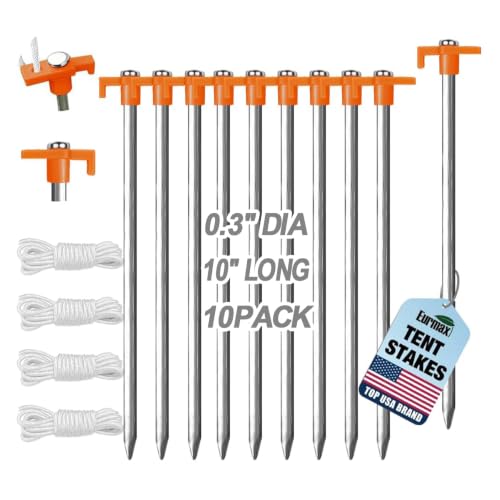
The Eurmax 10-Pack Secure Protection Galvanized Tent Stakes set is a specialized anchoring accessory designed for campers, canopy owners, and outdoor event setups. Built for securing camping tents, pop-up shelters, and gazebos, this kit targets campers who need more durable ground pegs than the thin wire stakes typically bundled with entry-level tents. With heavy-duty galvanized steel construction, it caters to car campers, backyard gazebo owners, and recreational shelter users seeking reliable tie-down support.
Each stake measures 10 inches in length, 2 inches in width, and 0.1 inches in thickness, providing a deep profile intended to anchor shelters against shifting winds. The listing highlights steel canopy anchors geared toward high winds, offering greater structural rigidity than lightweight aluminum or plastic pegs. Because of their length, these anchors penetrate deep into turf and packed dirt, helping prevent guyline slippage when guyed out properly.
Setup is straightforward thanks to the pre-cut lines and ready-to-drive design. The package provides ten commercial-grade ground pegs alongside four 10-foot ropes, eliminating the need to measure and cut auxiliary guylines at the campsite. Eurmax also includes a single high-visibility orange stopper designed to help campers spot stake placement and minimize foot-traffic tripping hazards around the perimeter of the shelter.
At 10 inches long, these steel stakes fit easily into standard gear totes, duffels, or car-camping bins. While the product listing mentions hiking along with camping and beach use, steel stakes are generally heavier than ultralight alternatives, making them most practical for drive-up campsites and vehicle transport. Routine care involves cleaning off damp soil after use and wiping the stakes dry before storage, maintaining the integrity of the galvanized rust-proof coating over multiple seasons.
Buyers should evaluate a few practical limitations and missing details. The manufacturer does not state the individual or total pack weight, which leaves backpackers uncertain about pack suitability. Additionally, while the listing includes an orange stopper for enhanced visibility, it provides only one stopper for ten stakes, meaning most anchor points will not have the bright marker. Soil compatibility is also not detailed, so shoppers pitching on rocky riverbeds or very loose beach sand may need specialized stakes suited for those surfaces.
For car campers, popup canopy owners, and family campers wanting to reinforce their shelter setup, this Eurmax 10-pack delivers practical durability and helpful accessories at an accessible price point. When evaluating ground anchors, campers should consider whether they have enough tie-down ropes for their shelter configuration and verify that 10-inch steel pegs match the soil conditions of their planned campsite.
The Eurmax anchoring set includes ten 10-inch galvanized steel stakes paired with four pre-cut 10-foot ropes. These steel pegs are engineered with a 2-inch wide hook design and 0.1-inch thickness to firmly hold guy lines under tension. The package also features an orange visibility stopper designed to reduce tripping hazards near tent corners and canopy legs.
Campers should note that securing a tent or gazebo depends heavily on proper stake angle and soil conditions. While these stakes offer rigid steel construction suitable for dirt and grass campgrounds, hardpacked gravel or loose beach sand may require specialized driving tools or sand-specific anchors.
These ground anchors are constructed from solid steel treated with a galvanized finish. This galvanized coating helps prevent rust and corrosion resulting from wet soil, morning dew, and rainfall, extending the service life of the hardware across varying weather conditions.
The rigid steel design resists bending and breaking under pressure when driven into standard campsite turf. To maintain the protective finish, users should clean away dirt and allow the stakes to dry before packing them into gear bags.
The package contains ten galvanized steel stakes, four 10-foot ropes, and one high-visibility orange stopper. The pre-cut ropes provide immediate tie-down capability for four canopy or tent guyout points without requiring additional cordage.
Because the set includes only one orange stopper across ten stakes, campers needing full-perimeter visibility markers may need to supply additional reflective tape or stoppers. A driving mallet and dedicated stake carry bag are not listed as included items.


Pros
- Heavy-duty S45C forged steel build resists bending in compacted or rocky campground soil
- 10-inch length delivers deep ground penetration for large tents, awnings, and wind-exposed tarps
- Thick 600D Oxford cloth organizer bag prevents sharp tips from damaging other gear during transport
- Fluorescent rings add low-light visibility to help prevent tripping over stake heads near tent guylines
- Large flat head and pull-out hole simplify both driving and extraction with standard camping tools
Cons
- Total weight of roughly 3.5 pounds makes the set impractical for weight-conscious backpacking trips
- Requires a solid camp mallet or steel hammer to drive effectively into compacted dirt or rocky ground
- Narrow peg profile may provide limited holding power in loose powder snow or dry sand compared to specialized snow and sand anchors
The Tialero 10-inch forged steel tent stakes are heavy-duty anchoring accessories designed to replace standard wire pegs that frequently bend under tension or in hard soil. Supplied in a pack of 12 with a dedicated carry bag, these stakes cater to car campers, family campers, and outdoor groups pitching shelters on rocky, compacted, or uneven ground. Campers using larger family tents, cabin shelters, tarps, or dining canopies will find this set geared toward stability in variable outdoor conditions.
In terms of dimensions, each stake measures 10 inches in length and weighs approximately 4.7 ounces, bringing the complete pack to roughly 3.53 pounds according to product specifications. While the 10-inch length provides generous depth for securing tent corners and guyline tension points, the overall package weight is a substantial consideration. Campers organizing their vehicle for weekend campground trips will easily accommodate the set, whereas backpackers will likely find the weight prohibitive for long-distance trail use.
The stakes are manufactured from S45C forged steel, a rigid metal selected to resist bending or snapping when driven against rocks and hardpan dirt. Each peg features a broad, flat striking surface at the top to distribute hammer blows evenly, along with a pointed tip to assist with initial ground penetration. For practical handling, each stake includes a hook and extraction hole near the head, allowing campers to loop guylines securely and pull the pegs out using a camp hammer or another stake during strike-down.
Included with the stakes are fluorescent rubber rings fitted near the head to enhance visibility around the campsite when dusk falls. The package also features a storage pouch constructed from 600D thickened Oxford cloth, which helps prevent the sharp tips from puncturing nearby gear inside a vehicle trunk or duffel bag. Maintenance involves wiping away clinging mud and drying the steel stakes thoroughly before packing them into the organizer bag to prevent premature surface corrosion.
A realistic consideration is the type of terrain and equipment needed to manage these stakes. While the manufacturer lists suitability for rocky ground, deserts, snowfields, and grasslands, anchoring in extremely soft sand or deep snow typically requires wide-flange snow or sand anchors rather than narrow steel pegs. Additionally, driving 10-inch forged steel into compacted earth requires a solid steel or brass camping mallet, as lightweight rubber or plastic mallets may not transfer sufficient force.
For campers frustrated with flimsy stock tent pegs that deform on rocky ground, this 12-piece forged steel set offers an anchored foundation for car-camping setups, basecamps, and shelter awnings. Shoppers should assess whether their shelter requires 10-inch penetration and whether their trip allows for carrying a 3.5-pound accessory set before purchasing.
These Tialero tent stakes measure 10 inches long and utilize an S45C forged steel build designed to provide reliable ground grip for tent guy lines, corner webbing, and rainfly loops. The top of each stake features a wide, flat striking head that accommodates camp mallets, paired with an integrated hook and hole designed to catch tension ropes and facilitate pulling the stake during take-down.
To assist with campsite safety, the stakes come equipped with fluorescent rubber rings placed below the head. These rings reflect ambient camp light and provide visibility after sunset, helping campers identify guyline attachment points in low-light environments.
The stakes are constructed from S45C forged steel, a high-strength carbon steel chosen for its resistance to breaking, bending, or deforming when impacted against hidden rocks, roots, or dense soil layers. This rigid structural profile makes them substantially sturdier than standard lightweight aluminum or wire tent pins.
The accompanying storage pouch is fabricated from 600D thickened Oxford cloth. This heavy fabric construction is designed to withstand abrasion and prevent the sharp tips of the forged steel stakes from wearing through the container or damaging other camping gear during transit.
Each individual stake weighs approximately 4.7 ounces, and the entire set of 12 stakes alongside the storage pouch weighs about 3.53 pounds. The stakes measure 10 inches in length, creating a compact yet dense bundle once packed into the organizer pouch.
Because of this weight profile, the set is best suited for car camping, overland travel, and established basecamps where gear weight is secondary to holding power. Backpackers or hikers aiming to minimize pack weight should note that this kit will add noticeable heft compared to ultralight aluminum or titanium alternatives.
The package contains 12 individual 10-inch S45C forged steel tent stakes, providing enough anchoring points to secure standard 4-person to 8-person family camping tents and their corresponding guylines.
Also included in the kit are individual fluorescent rubber rings pre-mounted on each stake and a reinforced 600D Oxford cloth carrying bag for organized transport and clean campsite storage.

Pros
- S45C forged steel construction provides rigidity when driven into hard or rocky campsite surfaces
- Multi-function carbon steel hammer includes both a driving face and an extraction hook for removing stakes
- Fluorescent rubber rings assist with visual identification at night around campsite tie-downs
- Durable 480D Oxford cloth organizer bag prevents heavy steel stakes from damaging other packed gear
- Substantial 10-inch stake length provides deep ground anchoring in windy outdoor conditions
Cons
- Individual stake weight of 4.7 ounces makes the complete 12-pack and hammer set too heavy for backpacking
- Manufacturer specifications do not state the overall packed dimensions or total weight of the kit in the carry pouch
- Straight cylindrical stake profile is less effective in loose, powdery sand or deep snow compared to specialized deadman anchors
The Tialero Tent Stake and Hammer Kit is a dedicated anchoring accessory set designed to replace standard wire pegs with heavy-duty ground hardware. Built around twelve 10-inch forged steel stakes, a carbon steel camping hammer, and a reinforced storage pouch, this kit is intended for campers, festival-goers, and outdoor travelers who regularly pitch tents, canopies, or tarps on hard, compacted, or rocky ground.
Each stake in this package measures 10 inches in length and weighs 4.7 ounces, manufactured from S45C forged steel to resist bending when driven into stubborn ground. Because 12 stakes alone account for over 3.5 pounds, the complete hardware set carries notable heft. This weight makes the kit an excellent fit for car camping, trunk storage, and vehicle-supported basecamps, while clearly ruling it out for weight-conscious backpacking or long-distance hiking.
The kit includes a multi-purpose 10-inch camping hammer equipped with a durable carbon steel head and an integrated extraction hook. Campers can drive stakes firmly into dense ground surfaces and use the rear hook to lever them out during campsite strike. The hammer also features a fixed wrist strap to prevent slipping during strikes, while each steel stake comes fitted with a fluorescent rubber ring to improve visibility around guylines in dark conditions.
Transport and campsite organization are handled by an included storage pouch constructed from 480D thickened Oxford cloth. This heavy fabric protects other camping gear in your vehicle from the sharp tips and weight of the steel stakes. For routine maintenance, steel stakes driven into wet or muddy soil should be wiped clean of dirt and allowed to dry thoroughly before long-term storage in the pouch to prevent surface oxidation.
A practical limitation of this kit is its bulk and specific ground profile. While the manufacturer lists suitability across environments from forests to sand and snow, narrow steel stakes typically do not hold well in loose sand or deep powdery snow without specialized snow stakes or deadman anchors. Additionally, the manufacturer does not provide exact total packed dimensions or formal warranty coverage in the product specifications.
For car campers and owners of large family tents or shade canopies who struggle with bent wire stakes on gravel-heavy campsite pads, the Tialero set offers a practical, heavy-duty upgrade. Shoppers should assess their expected ground conditions and verify their vehicle storage capacity, keeping in mind that these rigid forged stakes excel in hard soil where standard aluminum pegs fail.
The Tialero tent stakes are constructed from S45C forged steel, a carbon steel alloy chosen for structural rigidity and impact resistance when driven into dense or rocky soil. Each stake weighs 4.7 ounces, providing substantial mass to resist deforming or snapping under heavy hammer strikes.
The included 10-inch hammer features a cast or forged carbon steel head matched to the hardness of the stakes, accompanied by a rear extraction hook and a tethered safety wrist strap. The stakes are fitted with removable fluorescent rubber rings for low-light identification, and the entire set packs into an organizer bag crafted from abrasion-resistant 480D Oxford fabric.
This kit includes 12 pieces of 10-inch S45C forged steel tent stakes, each equipped with a high-visibility fluorescent rubber ring. These rings slip over the stake shaft near the head to help prevent tripping accidents after dusk.
The package also provides one 10-inch multi-function camping hammer with a carbon steel head, stake puller hook, and safety wrist lanyard. To keep the metal hardware contained, a dedicated 480D thickened Oxford fabric storage pouch is supplied.
This hardware kit is suited for vehicle camping at established campgrounds where campsite pads frequently feature compacted gravel, hard dirt, or hidden rocks that bend lightweight tent pegs. The heavy carbon steel hammer and rigid stake design allow campers to drive stakes securely through challenging topsoil.
When packing up camp, the reverse hook on the hammer head inserts into the stake eyelet or under the head flange to lever stakes straight out of firm ground without requiring separate extraction tools. For loose beach sand or deep snow, campers should consider wide snow and sand anchors instead of narrow cylindrical stakes.

Pros
- Galvanized steel construction resists bending and breaking during ground insertion
- Hot-dip galvanized coating protects against rust and outdoor moisture exposure
- High-visibility orange tops improve perimeter safety and help prevent campsite tripping
- Sharp pointed tip allows driving by hand, foot, or camping mallet into grass and dirt
- Convenient 10-pack quantity provides enough anchors for standard tents and tarps
Cons
- Listing does not provide product weight specifications, leaving total pack weight unclear for weight-sensitive packing
- Manufacturer notes they are not optimized for rocky ground without pre-softening the soil
- Seven-inch length may offer limited holding security in loose sand or deep snow compared to specialized anchors
The FEED GARDEN Heavy Duty Tent Stakes are a dedicated camping accessory pack designed to anchor outdoor shelters, tarps, and canopies. Sold in a 10-pack, these 7-inch ground pegs serve as a practical upgrade or replacement for the thin wire stakes often bundled with entry-level camping tents. They are well-suited for car campers, weekend campground visitors, and backyard canopy setups where reliable ground holding power is necessary to secure guy lines and tent corners against normal breezes.
Constructed from thick galvanized steel, these stakes feature a hot-dip galvanized finish engineered to resist rust and corrosion across wet ground and humid weather conditions. Each stake measures 7 inches long by 1.6 inches wide, with a 0.1-inch profile that tapers into a sharp pointed tip. This design allows campers to drive the pegs into grass, dirt, and packed earth using a standard camping hammer, the heel of a boot, or direct hand pressure when ground conditions allow.
A prominent functional element of these stakes is the molded, high-visibility orange head. In busy campsites, guy lines and ground anchors often create tripping hazards, particularly during dawn, dusk, or nighttime walks around the shelter. The bright orange tops make each peg easier to spot in turf or soil. The head design also creates an effective hook and anchor point for securing tent guy ropes, while offering sufficient surface area to grip and pull the stakes when striking camp.
While versatile for general camping, these stakes have specific terrain considerations noted by the manufacturer. They are designed primarily for turf, standard soil, and packed earth. If you encounter rocky or dense campsite surfaces, the manufacturer advises pre-softening the ground or choosing specialized longer or heavy-duty rock stakes to prevent damage. Furthermore, the listing does not state the exact weight per stake or the total bundle weight, so backpackers tracking base pack weight will need to weigh that missing specification against the durability of solid steel.
For car campers, festival attendees, and backyard organizers needing an affordable set of dependable replacement anchors, this 10-pack delivers practical utility. Ten stakes are typically enough to secure the four base corners and essential guy lines of a standard two- to four-person dome tent. If you pitch large family cabin tents, extensive tarps, or screen houses requiring extensive anchoring, verifying your total stake count before departure will ensure you have enough pegs for a secure pitch.
The FEED GARDEN tent stakes are manufactured from solid galvanized steel to resist bending under moderate mallet impact and lateral guy line tension. The steel core provides structural rigidity compared to lightweight aluminum wire stakes.
To protect against the elements, each stake features a hot-dip galvanized coating that shields the metal from rust and moisture damage during damp ground contact or prolonged rain exposure. The top of each stake is fitted with a durable, high-visibility orange cap designed for rope retention and pulling leverage.
These 7-inch stakes are engineered primarily for common campsite ground surfaces including manicured lawn grass, natural dirt, and moderately packed earth. The sharp point eases ground penetration whether driven by foot or a camping mallet.
Campers pitching in rocky or gravel-heavy pitches should take note of manufacturer guidance to soften the ground beforehand or switch to specialized stakes. The bright orange heads serve a dual role at camp by providing an obvious visual marker to reduce tripping accidents near tent perimeter lines.

Pros
- Noticeably lighter than standard iron stakes at approximately 0.07 pounds each
- High-visibility orange color makes stakes easy to spot in tall grass, dirt, and dim lighting
- Included storage bag keeps dirty or pointed stakes safely contained away from tent fabric
- Crafted from rust-resistant metal for extended outdoor service in damp conditions
- Generous 12-pack quantity provides enough anchors for a complete family tent or multiple tarps
Cons
- The product listing does not state the exact metal alloy or grade used in construction
- At 7.1 inches with a straight profile, these pegs may offer limited hold in loose sand or deep snow compared to specialized anchors
The AVOFOREST 12-pack of 7.1-inch metal tent stakes serves as an anchoring accessory for outdoor camping shelters. It is suited for campers, hikers, festival attendees, and canopy owners looking to replace lost or flimsy stock wire pegs with more visible and durable metal alternatives. Because these are standalone ground stakes, they function as a universal accessory rather than a complete shelter system.
In terms of practical dimensions and weight, each stake measures approximately 7.09 inches in length by roughly 0.39 inches square and weighs 0.07 pounds. The manufacturer emphasizes this low weight compared to heavier iron utility stakes, which often weigh around 0.3 pounds each. This compact profile allows a camper to carry all twelve stakes in a backpack or duffel without adding unnecessary bulk to their gear kit.
Constructed from rust-resistant metal, these pegs are designed to resist bending in typical outdoor ground conditions better than thin plastic or low-grade wire stakes. A key design element is the bright orange coating, which provides strong visual contrast against grass, dirt, and sand. This visibility helps campers avoid tripping over guyout points around camp and makes finding stakes during morning pack-down much easier.
Using these stakes involves driving the 7.1-inch shaft into the ground at an angle to anchor tent base loops, guyline cordage, or tarp corners. The set includes a dedicated storage bag, which keeps pointed tips and residual campsite dirt from puncturing tent fabrics or dirtying other gear in transit. For routine care, wiping away excess dirt and allowing the stakes to dry before packing them into the storage bag is good practice.
While the manufacturer highlights high-strength and anti-rust metal properties, the specific metal alloy (such as an aluminum or steel variant) is not detailed in the product data. Additionally, straight 7.1-inch stakes are best suited for medium-density campground soils. Campers pitching shelters in loose beach sand, powdery snow, or rocky riverbeds will likely require specialized wide snow/sand anchors or heavy-duty steel rock pins instead.
For campers, backpackers, and outdoor enthusiasts seeking an affordable, lightweight backup or upgrade set of high-visibility stakes, this 12-pack provides straightforward utility. Shoppers should assess the typical soil conditions of their planned destinations to verify whether standard 7.1-inch straight metal pegs will provide sufficient anchoring hold for their setup.
The AVOFOREST stake set includes twelve 7.1-inch metal pegs designed to anchor tent corners, vestibule pull-outs, rainfly guylines, tarps, and shade canopies.
With a profile measuring approximately 0.39 by 0.39 inches across and 7.09 inches in length, these stakes are built for standard penetration in common lawn, forest floor, and packed dirt campsite soils. The vibrant orange exterior coating provides clear contrast against soil and turf to aid in campsite safety.
Each package contains twelve individual 7.1-inch orange metal tent pegs.
The set also comes with a dedicated storage bag designed to keep the stakes organized in one place, preventing metal edges from rubbing against delicate shelter fabrics during transport.

Pros
- Ample 18-piece bundle provides full tent pitching plus spare anchors for guylines and tarps
- Hot-dip galvanized coating helps prevent rust from wet soil, morning dew, and rainy weather
- Hooked top retains cords cleanly and aids in quick pull-out during campsite take-down
- Versatile design installs via hand, foot, or camping mallet depending on campsite ground conditions
Cons
- Slender 4mm wire profile can bend if hammered forcefully into rocky ground or hidden roots
- Total weight of roughly 0.88 pounds is better suited for car camping than ultralight backpacking
- Listing does not indicate an included carry pouch or storage bag for keeping the stakes together
The FEED GARDEN 18-pack of 7-inch steel stakes is a dedicated tent accessory engineered to anchor camping tents, tarps, sunshades, and outdoor canopies. Campers frequently misplace factory tent pegs or bend lightweight aluminum wire during setup, making a complete replacement pack a helpful addition to any camping kit. While these metal hooks are also marketed for garden netting and holiday inflatables, their physical profile directly serves car campers seeking straightforward, reliable replacement stakes for standard campground pitches.
Regarding dimensions and physical specifications, each stake measures 7.1 inches in length with a 4mm wire diameter. The documented total weight for the 18-piece set is approximately 0.88 pounds. For car campers, festival attendees, and casual outdoor enthusiasts, carrying this bundle in a gear tote or vehicle trunk is simple and space-efficient. However, backpackers aiming for minimal base weight should note that 18 steel stakes carry more mass than specialized ultralight titanium or aluminum stakes. The 7.1-inch length strikes a practical balance, penetrating deep enough to hold firm in typical loam and turf without becoming cumbersome to transport.
Construction centers on all-steel durability treated with a protective hot-dip galvanized coating. This finish is specifically designed to resist rust and corrosion when exposed to wet soil, rain, and outdoor moisture. At the top of each peg, a curved hook design serves two practical functions: it prevents guyline loops and tent corner grommets from slipping off, and it offers an accessible point of leverage when pulling the stake from the ground. According to the manufacturer, campers can push the stakes in by hand, press them down with a sturdy boot, or tap them with a hammer depending on how firm the ground is.
At the campsite, having 18 stakes on hand ensures you have enough anchors to secure a dome tent, guy out rainfly vents, and pitch an extra utility tarp over a picnic table. Securing your tent perimeter properly assists with structural stability during windy spells and keeps the rainfly separated from the inner tent fabric. When breaking camp, the hooked ends allow you to slide another stake or puller underneath to extract each peg smoothly. Wiping off clinging dirt before stowing the stakes helps preserve the galvanized surface across multiple seasons.
Buyers should remain aware of clear limitations associated with slender wire stakes. With a 4mm steel shaft, these stakes perform well in typical grass, forest loam, and soft campground dirt, but they can bend if driven hard against rocks, gravel, or thick tree roots. Campers pitching shelters in rocky terrain or frozen earth may require heavier forged-steel spikes. Additionally, the product listing does not document an included carry bag, so campers will want to supply a small pouch or band to keep the metal pegs organized inside their tent bag.
Overall, the FEED GARDEN 18-pack delivers dependable, budget-conscious utility for campers who need extra or replacement anchors for standard campgrounds. While ultralight hikers will look elsewhere for weight savings, car campers and outdoor shelter owners will appreciate having a generous supply of rust-resistant steel stakes ready for their next weekend getaway.
The FEED GARDEN stakes measure 7.1 inches long, offering solid ground hold for standard camping tents, tarp ridgelines, and canopy corners. Their curved hook top provides an effective catch for guylines, shock cords, and webbing loops, preventing slippage while the shelter is under tension.
With 18 stakes in the package, users have enough hardware to secure a 4-person or 6-person family tent along with multiple perimeter guyout points. The hook also serves as a convenient handle during take-down, allowing campers to pull the peg using another stake, a cord loop, or a tent mallet puller.
Each stake is built from solid steel wire with a 4mm thickness, offering structural firmness for standard campsite soils. The all-steel core provides greater resistance to bending than basic budget wire pegs, provided they are not forced into solid rock.
To withstand outdoor moisture, the stakes undergo hot-dip galvanization. This surface treatment provides documented rust and corrosion resistance, helping them hold up across wet campsite grass, rainy weekends, and damp ground conditions season after season.
Essential Strategies for Anchoring a Tent on Solid Rock
Pitching a tent over solid bedrock or packed stone eliminates the standard option of pushing pegs cleanly into topsoil. When the earth offers zero penetration, tent stability relies entirely on structural tension, natural surface friction, and ballast weight. Campers can successfully anchor shelters on exposed rock by utilizing natural rock features or driving specialized forged metal stakes into hairline fissures. Mastering these techniques ensures that your shelter remains taut and wind-resistant without relying on soft soil.
Understanding the Mechanics of Pitching on Hard Surfaces
Freestanding tents provide an initial advantage on rock because their pole geometry holds the shelter upright without immediate staking. However, an unanchored tent acts like a sail when exposed to sudden mountain breezes or shifting valley winds. The lack of ground purchase means you must replace soil shear resistance with deadweight ballast or mechanical wedging. Without proper anchoring, wind forces can shift the entire shelter, bend pole sections, or tear lightweight floor fabric against sharp stone.
Surface friction alone cannot prevent a tent from sliding across smooth granite or slate slabs during moderate gusts. Anchor points must counteract lateral shear forces from wind and vertical uplift forces from gusts catching under the rainfly. Distributing wind loads across multiple reinforced webbing loops and perimeter guyouts prevents excessive stress on any single tent seam. Understanding this mechanical balance allows you to select the most reliable anchoring method for the specific rock formation beneath your campsite.
Ground hardness also influences how you position your shelter relative to the prevailing wind direction. Pitching the lowest profile or narrowest end of the tent into the wind minimizes surface drag and reduces the total holding power required from your anchors. Inspecting the surface for natural depressions, cracks, and surrounding boulders gives you immediate anchor opportunities before unrolling your tent body. A deliberate site evaluation saves time and preserves both your gear and your energy when setting up in rugged terrain.
The Big-Rock Little-Rock Anchoring Method
The big-rock little-rock method is one of the most reliable primitive techniques for pitching a tent on sheer stone. This approach uses two stones at each corner or guyline point to create a secure friction clamp without driving metal into the ground. You start by selecting a small, smooth stone roughly the size of a fist and wrapping your tent loop or guyline securely around its center. Once wrapped, you place this smaller stone on the ground and position a substantially heavier rock directly on top of the cordage.
The top boulder acts as deadweight ballast, while the small wrapped rock prevents the cord from slipping out under tension. For optimal holding power, select a top boulder that weighs at least twenty to thirty pounds, ensuring it cannot easily roll or shift in heavy winds. If large boulders are scarce, you can stack several flat, medium-sized rocks over the anchor line to achieve equivalent weight. Always test the anchor by firmly pulling the line toward the tent before attaching it to your rainfly.
Smooth, rounded river rocks or weathered field stones work best because they lack sharp edges that could fray or sever your guyline cordage. When you must use jagged rocks, wrap a piece of cloth, spare webbing, or duct tape around the cord where it contacts the stone edge. Taking the extra step to pad sharp contact points protects your shelter rigging throughout windy nights. This simple friction anchor turns surrounding geology into an immovable foundation for any camping shelter.
Driving Heavy-Duty Forged Steel Stakes into Fissures
When rock slabs contain visible fractures, seams, or weathered cracks, heavy-duty metal stakes provide exceptional holding power. Lightweight aluminum wire pegs or extruded stakes will bend instantly when struck against hard rock surfaces. High-strength S45C forged steel pegs, by contrast, possess the structural density needed to penetrate narrow rock fissures without warping. Driving a durable steel peg into a natural crack creates a mechanical wedge that resists hundreds of pounds of outward pull.
To execute this technique, carefully scout the perimeter of your tent footprint to locate natural fracture lines in the bedrock. Position the pointed tip of the forged steel stake into the crack at a roughly forty-five degree angle leaning away from the tent body. Strike the flat head of the stake deliberately with a camp hammer or a flat, dense hand stone until the shaft binds tightly in the fissure. Avoid overdriving the stake to the point where it becomes permanently wedged, as this can damage both the peg and the surrounding rock.
If a crack is wider than the stake shaft, you can jam a small wooden wedge or smaller stone alongside the stake to create a tighter fit. This wedging action expands within the fissure as tension is applied from the guyline, increasing holding power under load. Forged steel stakes measuring ten to twelve inches in length provide ample reach to lock deep into layered slate or granite fissures. Their high tensile strength makes them indispensable tools when camping on rocky plateaus and mountain summits.
Guyline Rigging and Counterweight Ballast Systems
Securing a tent on stone surfaces often requires extending your guylines well beyond their standard perimeter. Longer guylines allow you to reach immovable natural features such as large embedded boulders, scrub tree roots, or deep rock shelves. Carrying extra lengths of reflective paracord or high-tensile utility cord ensures you can bridge the distance to sturdy external anchors. Tying off to distant natural features maintains the low pulling angle necessary to keep rainfly panels taut and silent in gusty conditions.
When anchoring larger shelters, such as spacious outdoor tents for group trips, the increased wind profile demands robust counterweight systems on every high guyout. You can loop a long guyline completely around a large boulder, securing it with a taut-line hitch or an adjustable cord tensioner. For rounded boulders that might allow the cord to slip upward, place a heavy stabilizing stone over the loop to pin it against the ground. This basket-wrap technique prevents cord displacement even as wind directions shift throughout the night.
Another effective strategy involves building an external deadman ballast using heavy gear bags or specialized fabric anchor bags filled with gravel. Placing these filled bags on the leeward and windward sides of your shelter provides immediate, movable weight that requires no drilling or pegging. Connecting these weighted sacks to your tent corners via carabiners creates a flexible tension system that absorbs strong wind gusts. Inspecting cord tension before turning in for the night guarantees your counterweights remain properly positioned.
Hardware Selection: Forged Steel Versus Standard Ground Pegs
Standard tent stakes supplied with most camping shelters are designed primarily for manicured grass and loamy woodland soil. Thin aluminum hook stakes, plastic pegs, and ultralight titanium needles will quickly deform when forced into compacted gravel or stone cracks. Heavy-duty ground anchors made from S45C forged steel or thick galvanized steel provide the structural rigidity required for rocky environments. Their substantial shaft diameter, often around 0.35 inches, prevents bending under direct hammer impacts.
Forged steel pegs also feature large flat striking heads that distribute hammer force evenly down the shaft. This broad striking area prevents mushrooming and allows you to drive the anchor deep into stubborn ground without chipping the metal. Many heavy-duty models include integrated pulling holes or welded side hooks that make extraction straightforward when packing up camp. High-visibility fluorescent rubber rings or bright orange coated heads enhance safety by marking stake locations around the perimeter in low light.
Galvanized steel coatings provide essential protection against rust and corrosion when stakes are exposed to moisture, morning dew, or wet gravel. While heavy forged steel pegs add weight to your pack compared to wire stakes, their reliability on hard ground is unmatched. Car campers and basecamp operators benefit significantly from keeping a dedicated set of ten-inch or twelve-inch forged stakes in their vehicle kit. Having the right hardware on hand eliminates frustration and ensures immediate shelter stability on unforgiving ground.
Protecting Tent Fabrics and Floors Against Abrasive Stone
Hard stone surfaces pose a serious threat to thin polyurethane floor coatings and lightweight tent fabrics. Sharp rock spurs, jagged quartz chips, and rough granite textures can easily abrade or puncture shelter floors under the weight of campers. Even modern tents designed for easy setup require careful ground preparation when pitched over unyielding bedrock. A heavy-duty footprint or thick tarp beneath your tent body creates a sacrificial barrier that shields expensive waterproof coatings from abrasion.
Before spreading your footprint, take five minutes to sweep away loose gravel shards, pointed stones, and abrasive debris from your chosen pitching area. If you must sleep on uneven rock, placing foam sleeping pads or spare camp blankets between the rock and your footprint adds valuable cushioning. Inspect the perimeter to ensure that sharp rock outcroppings do not rub against taut rainfly fabric or vestibule walls. Continuous wind vibration against a rough rock edge can wear a hole through silicone-treated nylon in a matter of hours.
Corner stake loops and webbing straps also need protection from ground friction when held down by heavy rocks. Placing a flat piece of bark, folded cardboard, or spare cloth under tensioned webbing prevents rocks from grinding into the fabric straps. If you use rocks directly inside the tent corners to weigh down the floor, wrap each stone in a towel or dry bag first. This simple precaution keeps rough mineral surfaces from puncturing the waterproof bathtub floor during the night.
Managing Severe Wind and Storm Conditions on Exposed Rock
Camping on exposed rock ledges often exposes your shelter to severe, unobstructed wind gusts. Because you cannot drive stakes deeply into solid stone, your overall rigging strategy must incorporate multiple redundant anchor points. If one rock anchor shifts under high wind pressure, secondary guylines must instantly prevent the shelter from collapsing or blowing away. Connecting corner loops and mid-panel guyouts to separate, independent rock clusters creates a balanced load distribution across the frame.
Wind flowing over solid bedrock can also generate low-pressure uplift beneath your rainfly, attempting to lift the entire tent off the stone. To counter uplift, position your ballast rocks directly over corner webbing attachments rather than relying solely on extended outward lines. Lowering your tent profile by shortening pole sleeves or pitching the rainfly close to the stone surface reduces wind penetration under the vestibule. Ensuring the rainfly remains tightly cinched prevents flapping fabric from loosening your knot work.
Rain runoff on solid rock behaves very differently than it does on absorbent forest soil. Water flows rapidly across solid stone slabs in wide sheets, meaning pooling or stream formation can occur directly beneath your tent floor. Always choose elevated rock contours or gently sloping slabs that direct running water away from your shelter footprint. Inspecting drainage channels around your perimeter before building your rock anchors keeps your sleeping area completely dry throughout heavy downpours.
Striking Camp and Preserving Rock Anchoring Gear
Dismantling a tent pitched on rock requires patience to avoid damaging your hardware and the natural campsite environment. When using the big-rock little-rock method, carefully lift the top boulders away rather than violently yanking the guylines free. Dragging cordage beneath heavy stones can strip protective sheathing from kernmantle ropes and weaken your tension lines for future trips. Return all ballast stones to their natural locations around the site to uphold Leave No Trace principles.
Extracting forged steel stakes driven into tight rock fissures requires the right mechanical leverage. Never bend the stake shaft back and forth with excessive lateral force, as this can snap the peg or damage the rock seam. Instead, use a camp hammer hook or another sturdy stake passed through the pulling hole to twist the anchor along its vertical axis. Twisting the stake breaks the friction seal within the crack, allowing you to lift the peg smoothly out of the stone.
Once extracted, inspect your metal stakes for soil residue, moisture, or surface abrasion before packing them into storage pouches. Wiping steel pegs clean and allowing them to dry prevents rust formation on non-galvanized striking faces and hook points. Examine your guyline cords for frayed spots, cuts, or worn friction wraps caused by contact with rough rock edges. Replacing damaged cordage promptly ensures your anchoring kit remains dependable and ready for your next rugged outdoor excursion.
Securing a tent on solid rock transforms challenging terrain into an accessible and rewarding camping destination. By pairing durable forged steel stakes for rock fissures with dependable deadman ballast methods, you can pitch a taut, weather-resistant shelter anywhere stone dominates the landscape. Always assess the local rock features, safeguard your tent fabrics from surface abrasion, and maintain balanced guyline tension across all anchor points. With these practical skills and heavy-duty hardware in your pack, you can sleep soundly knowing your shelter is thoroughly anchored against the elements.


Write Your Review
No reviews yet. Be the first to share your experience!