

Pitching a campsite shelter on sun-baked clay, gravel, or rocky earth often presents a frustrating obstacle for campers. Standard aluminum wire pegs bend almost instantly under pressure, leaving your shelter vulnerable to unexpected gusts of wind. Learning how to stake tent in hard ground is an essential outdoor skill that ensures your shelter remains anchored, taut, and properly balanced throughout your trip. When you pair proper ground anchors with reliable heavy-duty water-resistant camping tents, your camp setup gains the structural stability needed for varying conditions.
Hard ground demands specific tools and adjusted pitching methods rather than brute force with a standard mallet. By switching to threaded drill-in anchors or forged steel spikes, campers can penetrate tough terrain without damaging their equipment. Proper staking angles, careful site evaluation, and steady tensioning also protect tent guylines and grommets from unnecessary wear. Taking a deliberate approach to difficult soil conditions keeps your sleeping quarters upright, secure, and ready for whatever weather rolls in during your stay.
Pros
- Drill-in threaded design speeds up pitching shelters compared to driving pegs with a mallet.
- Galvanized carbon steel build resists bending in compacted dirt and resists moisture rust.
- Luminous heads aid campsite safety by marking anchor points after dark.
- Comes equipped with 12 stakes, a hex drive bit, and a dedicated zippered storage bag.
Cons
- Total kit packed weight is not specified, making weight evaluation difficult for carried loads.
- Requires bringing an external cordless drill or driver to utilize the hex drive functionality.
- No manual turning handle or crossbar is documented for times when power tools are unavailable.
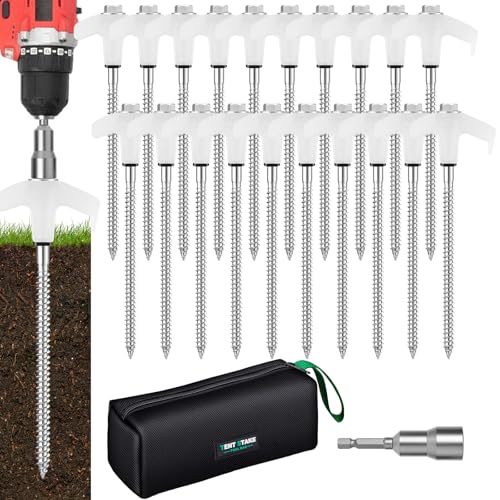
The CHANGX3KB 12-Pack 8-Inch Screw-In Tent Stakes is a specialized shelter anchoring accessory engineered to replace standard smooth tent pegs for camping tents, rainfly guy lines, sun canopies, and gazebos. Packaged with a matching hex head driver bit and a zippered carry pouch, this kit is primarily aimed at car campers, festival attendees, and backyard shelter users looking for dependable ground holding power without the physical strain of hammering stakes into stubborn ground.
Each anchor measures 8 inches in length with a 0.31-inch diameter, using deep threads along the lower shaft to grip grass, compacted soil, and gravel. The 12-stake quantity is practical for anchoring a standard family dome tent with multiple guy lines or a four-corner canopy with auxiliary perimeter lines. Because the manufacturer does not document the overall kit weight, backpackers should consider that heavy-duty carbon steel anchors generally add noticeable pack weight compared to lightweight aluminum stakes, making this kit best suited for vehicle-supported trips.
Setup involves inserting the included hex socket bit into a personal cordless drill or impact driver and driving each stake directly into the ground at the desired angle. This screw-in method allows quick installation into hard-packed campground soil where smooth wire pegs might bend. The top of each stake features a luminous, glow-in-the-dark head designed to remain visible in dim light, helping campers identify guy-out lines and anchor points after sundown to avoid tripping around the campsite.
For transport and long-term care, the included storage bag isolates the threaded metal shafts from the rest of your camping gear, preventing sharp threads from abrading tent fabrics or vehicle upholstery. Routine maintenance requires wiping away excess soil and drying the stakes before packing them away. The galvanized finish provides rust resistance against ground moisture, but keeping the metal clean and dry helps preserve the coating over extended outdoor use.
A practical limitation of this set is its reliance on a power tool for optimal use. The listing documents no manual hand handle or T-wrench, meaning you must provide your own cordless drill or driver to achieve the promised fast setup. If tool batteries deplete at an unpowered campsite, manually turning the hex heads could prove difficult without an appropriate hand socket wrench. In addition, the exact glow duration of the luminous tops is not specified in the manufacturer details.
For car campers, canopy owners, and outdoor event planners who pitch shelters on compacted dirt, rocky turf, or standard campground pads, the CHANGX3KB screw-in stake kit is a useful upgrade over basic wire stakes. Campers who already pack cordless tools in their vehicle will appreciate the combination of threaded holding stability, night visibility, and organized storage.
Installation is designed around a cordless drill or impact driver using the included hex head socket bit. Instead of pounding stakes into hard earth with a mallet, the threaded shafts rotate into turf, packed dirt, or gravel in seconds, establishing solid hold with minimal physical effort.
Take-down is equally straightforward by switching the drill into reverse to back the stakes out of the ground. Because the screw-in action pulls the stakes cleanly out of compacted soil, it reduces the risk of bending shafts or damaging guy-line loops during campsite breakdown.
Manufactured from carbon steel with a galvanized surface treatment, these 8-inch stakes feature a 0.31-inch diameter designed to resist bending under line tension. The threaded profile grips the ground along the shaft, helping to hold tent guy lines securely against moderate wind loads.
The top of each anchor includes a luminous fitting designed to glow in low-light conditions. This provides campers with a clear visual marker around tent corners and guy lines, reducing accidental trips and line snags during nighttime movement around camp.
The package includes 12 threaded 8-inch carbon steel stakes, 1 hex socket driver bit that fits standard drill chucks, and a durable fabric storage bag to keep all pieces organized in your vehicle or gear bin.
A cordless drill, impact driver, guy ropes, and manual turning handles are not included in the kit and must be supplied separately by the user.

Pros
- Galvanized carbon steel build resists bending under driving pressure and holds up against moisture
- Threaded spiral design delivers a firm grip in hard soil and gravel where smooth pegs often slip
- Drill-compatible installation significantly cuts down setup effort compared to manual mallet pounding
- Includes a hex head driver bit to easily chuck into standard cordless drills and impact drivers
- High-visibility orange accents make stake heads easier to see in low-light campsite conditions
Cons
- Total weight of roughly 2.03 pounds makes this set impractical for weight-sensitive backpacking trips
- Requires packing a charged cordless drill or impact driver to take advantage of the rapid installation feature
- Listing data shows conflicting overall package dimensions (20 x 0.3 x 0.1 inches) despite the 8-inch individual stake length
The YYGCL 12-Pack Screw-In Tent Stakes set is a specialized camping accessory engineered to replace standard smooth wire or plastic tent pegs. Made specifically for securing camping tents, rain shelters, gazebos, and vehicle awnings, this ground anchor kit targets car campers, RV travelers, and festival attendees who frequently pitch on tough ground. By utilizing an aggressive threaded body, these stakes provide a firm mechanical bite into surfaces where traditional hammered stakes often bend or loosen.
In terms of practical dimensions and build, each stake measures 8 inches long with a substantial 0.31-inch shaft diameter. The set of 12 stakes has a documented total weight of approximately 2.03 pounds. While this weight is easily managed in a vehicle trunk or camping gear bin, it is noticeably heavier than aluminum backpacking stakes and is clearly meant for drive-in campsites rather than long trail outings.
Setup is where this accessory stands out. The stakes feature an integrated hex head and come supplied with a matching hex head driver bit. Instead of pounding pegs into stubborn ground with a heavy mallet, campers can attach the bit to a portable cordless drill or impact driver and screw each anchor directly into grass, packed dirt, or gravel in seconds. Take-down is equally fast by reversing the drill direction to back the stakes out without straining guylines or damaging loops.
For routine campsite maintenance, the carbon steel shafts feature a galvanized finish designed to guard against moisture and rust during wet camping trips. The bright orange top fixtures enhance campsite safety by improving visibility around low-lying guylines, helping prevent accidental trips at dusk. After a rainy trip, wiping off residual mud and ensuring the metal stays dry before long-term storage will help maintain the protective coating.
There are a few practical limitations and uncertainties to note. The primary consideration is that mechanical installation relies on having a charged cordless drill on hand at the campsite, along with the correct driver bit. The product listing does not document an alternative manual hand-crank handle. Additionally, while the stakes themselves are specified at 8 inches long, the listing specifications include a confusing package dimension entry of 20 by 0.3 by 0.1 inches, which does not reflect the real-world footprint of a 12-pack bundle.
For car campers, canopy owners, and outdoor enthusiasts who dread hammering stakes into rocky or sun-baked ground, this YYGCL screw-in kit is a practical, labor-saving addition to a gear bin. It offers robust hold and quick deployment, provided you have room in your camp kit for a battery-powered drill.
Pitching a tent or canopy on hard-packed soil often leads to bent stakes and sore hands. The YYGCL ground anchors bypass manual pounding by integrating with everyday power tools. By locking the included hex head driver into a cordless drill or 1/4-inch impact driver, campers can spin the 8-inch threaded carbon-steel shaft directly into the ground with minimal physical effort.
Removal is just as straightforward. Switching your power drill to reverse allows each stake to back out smoothly without bending or tearing up the campsite turf. Campers should ensure their drill batteries are fully charged before leaving home and consider storing the hex driver bit in a dedicated pouch so it is never misplaced during transport.
These ground anchors are constructed from rigid carbon steel designed to withstand the torque of power drivers without twisting or snapping. The 0.31-inch diameter provides dependable lateral strength against gusty winds pulling on tent guylines and awning corners.
To protect the steel from damp campsite ground and rain, the surface is treated with a galvanized coating. The top of each anchor features a molded, high-visibility orange finish that serves as both a tie-off point for tent cords and a visual marker to help campers avoid tripping over perimeter lines.

Pros
- Galvanized carbon-steel construction resists bending under driving pressure and offers moisture resistance.
- Threaded shaft provides mechanical grip in challenging substrates like hard soil, gravel, and packed dirt.
- Includes a dedicated hex driver socket and organized storage case in the package.
- High-visibility orange accents make the stake heads easier to locate and avoid around the campsite.
Cons
- Requires carrying a separate cordless power tool or manual socket tool to drive the hex head efficiently.
- The 8-inch length and heavy carbon-steel build add noticeable weight compared to lightweight backpacking stakes, making them best suited for vehicle-supported camping.
- The listing specifications present an inconsistent thickness measurement, leaving the exact shaft diameter uncertain.
The x-vesolje 8-Inch Heavy Duty Screw-in Tent Stakes set is a specialized anchoring accessory designed to replace or upgrade standard ground pegs for camping tents, canopies, awnings, and rain tarps. Because these metal stakes feature a threaded shaft meant to be driven with a cordless drill or impact driver, they primarily suit car campers, RV travelers, and event setups where packing power tools is convenient. Campers dealing with hard-packed campground soil, gravelly tent pads, or frozen ground often struggle with standard hammer-in stakes bending, making drill-assisted hardware an appealing alternative.
Each stake measures 8 inches long, providing substantial depth for guylines on family cabin tents, dome tents, and pop-up shade shelters. The manufacturer highlights effectiveness across a wide range of surfaces, including grass, dirt, hard soil, gravel, sand, and snow. For large shelters exposed to wind, threaded metal spikes provide strong mechanical grip compared to smooth wire pegs. However, shoppers should keep in mind that while the stakes can grip loose or loose-packed terrain like sand or snow, conditions vary widely and proper guyline tension remains critical for shelter stability.
Pitching a tent with these stakes relies on mechanical leverage rather than swinging a camp mallet. The kit includes a matching hexagonal head socket that chucks directly into a standard power drill or impact driver. Threading the stakes into the earth reduces physical effort and minimizes the shock damage that often deforms conventional pegs when hammering into rocky substrate. The orange molded tops provide connection points for tent guylines and staking loops while increasing ground-level visibility to help campers avoid tripping.
Transporting 12 steel stakes is simplified by the included dedicated storage case, which prevents the threaded metal shafts from scratching other gear inside a vehicle trunk or camp tote. While the portable carrying case keeps all pieces organized alongside the hex driver bit, the carbon-steel construction means this kit carries substantial weight. This makes it an excellent choice for vehicle-based camping, car camping, and festival setups, but impractical for weight-conscious human-powered transport such as backpacking or bikepacking.
A practical limitation is the dependency on auxiliary equipment: campers must remember to pack a charged cordless drill or compatible manual driver to install and extract them easily. In addition, the manufacturer specifications contain a confusing thickness measurement of 0.039 inches alongside a 0.3-inch width figure, creating uncertainty about the exact shaft diameter. While the galvanized coating provides corrosion resistance against moisture and rain, prolonged damp storage should still be avoided to maintain hardware integrity over time.
For campers who regularly pitch large cabin tents, screen rooms, or awnings in tough ground conditions, the x-vesolje screw-in stake kit offers a reliable upgrade over basic bundled wire pegs. Buyers evaluating alternatives should consider whether their camping style allows carrying a cordless drill and whether an 8-inch threaded carbon-steel anchor matches their shelter size. For vehicle-supported campers seeking straightforward anchoring without bent stakes, this 12-pack provides a functional, organized kit.
The package contains 12 heavy-duty carbon-steel screw-in tent stakes designed with threaded shafts for mechanical anchoring.
A dedicated hexagonal head socket is included to allow compatibility with standard cordless drills or impact drivers.
The set also includes a compact storage case designed to keep the stakes and drive bit neatly contained during transport.
These ground anchors are constructed from heavy-duty carbon steel to withstand torsional stress and ground resistance without bending or breaking during installation.
The exterior features a galvanized surface coating engineered to resist rust and corrosion when exposed to outdoor moisture, wet soil, and rain.
Integrated high-visibility orange heads offer attachment points for shelter guylines while helping to minimize tripping hazards around the perimeter of your campsite.

Pros
- Galvanized steel construction resists bending and breaking during ground insertion
- Hot-dip galvanized coating protects against rust and outdoor moisture exposure
- High-visibility orange tops improve perimeter safety and help prevent campsite tripping
- Sharp pointed tip allows driving by hand, foot, or camping mallet into grass and dirt
- Convenient 10-pack quantity provides enough anchors for standard tents and tarps
Cons
- Listing does not provide product weight specifications, leaving total pack weight unclear for weight-sensitive packing
- Manufacturer notes they are not optimized for rocky ground without pre-softening the soil
- Seven-inch length may offer limited holding security in loose sand or deep snow compared to specialized anchors
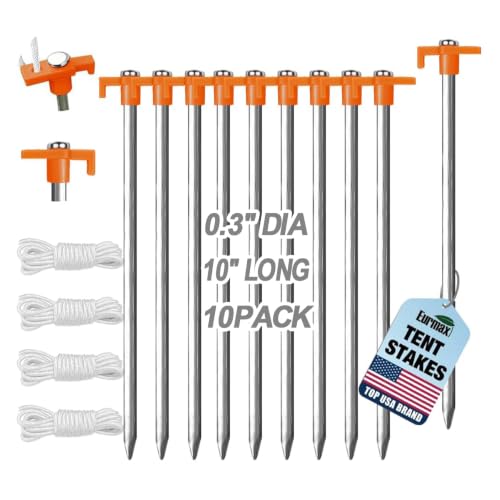
The FEED GARDEN Heavy Duty Tent Stakes are a dedicated camping accessory pack designed to anchor outdoor shelters, tarps, and canopies. Sold in a 10-pack, these 7-inch ground pegs serve as a practical upgrade or replacement for the thin wire stakes often bundled with entry-level camping tents. They are well-suited for car campers, weekend campground visitors, and backyard canopy setups where reliable ground holding power is necessary to secure guy lines and tent corners against normal breezes.
Constructed from thick galvanized steel, these stakes feature a hot-dip galvanized finish engineered to resist rust and corrosion across wet ground and humid weather conditions. Each stake measures 7 inches long by 1.6 inches wide, with a 0.1-inch profile that tapers into a sharp pointed tip. This design allows campers to drive the pegs into grass, dirt, and packed earth using a standard camping hammer, the heel of a boot, or direct hand pressure when ground conditions allow.
A prominent functional element of these stakes is the molded, high-visibility orange head. In busy campsites, guy lines and ground anchors often create tripping hazards, particularly during dawn, dusk, or nighttime walks around the shelter. The bright orange tops make each peg easier to spot in turf or soil. The head design also creates an effective hook and anchor point for securing tent guy ropes, while offering sufficient surface area to grip and pull the stakes when striking camp.
While versatile for general camping, these stakes have specific terrain considerations noted by the manufacturer. They are designed primarily for turf, standard soil, and packed earth. If you encounter rocky or dense campsite surfaces, the manufacturer advises pre-softening the ground or choosing specialized longer or heavy-duty rock stakes to prevent damage. Furthermore, the listing does not state the exact weight per stake or the total bundle weight, so backpackers tracking base pack weight will need to weigh that missing specification against the durability of solid steel.
For car campers, festival attendees, and backyard organizers needing an affordable set of dependable replacement anchors, this 10-pack delivers practical utility. Ten stakes are typically enough to secure the four base corners and essential guy lines of a standard two- to four-person dome tent. If you pitch large family cabin tents, extensive tarps, or screen houses requiring extensive anchoring, verifying your total stake count before departure will ensure you have enough pegs for a secure pitch.
The FEED GARDEN tent stakes are manufactured from solid galvanized steel to resist bending under moderate mallet impact and lateral guy line tension. The steel core provides structural rigidity compared to lightweight aluminum wire stakes.
To protect against the elements, each stake features a hot-dip galvanized coating that shields the metal from rust and moisture damage during damp ground contact or prolonged rain exposure. The top of each stake is fitted with a durable, high-visibility orange cap designed for rope retention and pulling leverage.
These 7-inch stakes are engineered primarily for common campsite ground surfaces including manicured lawn grass, natural dirt, and moderately packed earth. The sharp point eases ground penetration whether driven by foot or a camping mallet.
Campers pitching in rocky or gravel-heavy pitches should take note of manufacturer guidance to soften the ground beforehand or switch to specialized stakes. The bright orange heads serve a dual role at camp by providing an obvious visual marker to reduce tripping accidents near tent perimeter lines.

Pros
- Noticeably lighter than standard iron stakes at approximately 0.07 pounds each
- High-visibility orange color makes stakes easy to spot in tall grass, dirt, and dim lighting
- Included storage bag keeps dirty or pointed stakes safely contained away from tent fabric
- Crafted from rust-resistant metal for extended outdoor service in damp conditions
- Generous 12-pack quantity provides enough anchors for a complete family tent or multiple tarps
Cons
- The product listing does not state the exact metal alloy or grade used in construction
- At 7.1 inches with a straight profile, these pegs may offer limited hold in loose sand or deep snow compared to specialized anchors
The AVOFOREST 12-pack of 7.1-inch metal tent stakes serves as an anchoring accessory for outdoor camping shelters. It is suited for campers, hikers, festival attendees, and canopy owners looking to replace lost or flimsy stock wire pegs with more visible and durable metal alternatives. Because these are standalone ground stakes, they function as a universal accessory rather than a complete shelter system.
In terms of practical dimensions and weight, each stake measures approximately 7.09 inches in length by roughly 0.39 inches square and weighs 0.07 pounds. The manufacturer emphasizes this low weight compared to heavier iron utility stakes, which often weigh around 0.3 pounds each. This compact profile allows a camper to carry all twelve stakes in a backpack or duffel without adding unnecessary bulk to their gear kit.
Constructed from rust-resistant metal, these pegs are designed to resist bending in typical outdoor ground conditions better than thin plastic or low-grade wire stakes. A key design element is the bright orange coating, which provides strong visual contrast against grass, dirt, and sand. This visibility helps campers avoid tripping over guyout points around camp and makes finding stakes during morning pack-down much easier.
Using these stakes involves driving the 7.1-inch shaft into the ground at an angle to anchor tent base loops, guyline cordage, or tarp corners. The set includes a dedicated storage bag, which keeps pointed tips and residual campsite dirt from puncturing tent fabrics or dirtying other gear in transit. For routine care, wiping away excess dirt and allowing the stakes to dry before packing them into the storage bag is good practice.
While the manufacturer highlights high-strength and anti-rust metal properties, the specific metal alloy (such as an aluminum or steel variant) is not detailed in the product data. Additionally, straight 7.1-inch stakes are best suited for medium-density campground soils. Campers pitching shelters in loose beach sand, powdery snow, or rocky riverbeds will likely require specialized wide snow/sand anchors or heavy-duty steel rock pins instead.
For campers, backpackers, and outdoor enthusiasts seeking an affordable, lightweight backup or upgrade set of high-visibility stakes, this 12-pack provides straightforward utility. Shoppers should assess the typical soil conditions of their planned destinations to verify whether standard 7.1-inch straight metal pegs will provide sufficient anchoring hold for their setup.
The AVOFOREST stake set includes twelve 7.1-inch metal pegs designed to anchor tent corners, vestibule pull-outs, rainfly guylines, tarps, and shade canopies.
With a profile measuring approximately 0.39 by 0.39 inches across and 7.09 inches in length, these stakes are built for standard penetration in common lawn, forest floor, and packed dirt campsite soils. The vibrant orange exterior coating provides clear contrast against soil and turf to aid in campsite safety.
Each package contains twelve individual 7.1-inch orange metal tent pegs.
The set also comes with a dedicated storage bag designed to keep the stakes organized in one place, preventing metal edges from rubbing against delicate shelter fabrics during transport.
A Complete Guide to Staking Tents in Hard Ground
Securing a tent on unforgiving ground requires understanding how different soil structures interact with metal fasteners. Standard wire pegs bundled with entry-level tents work reasonably well in loose forest loam, but they crumple when pushed against compacted gravel or baked earth. When an anchor fails to seat deeply, the entire tent loses aerodynamic integrity and risks collapsing during overnight winds. Approaching tough terrain with appropriate equipment and mechanical leverage transforms a frustrating chore into a quick, reliable pitching routine.
Anchoring success depends primarily on two factors: the physical construction of your hardware and the angle at which you drive it into the earth. Forcing a blunt stake straight down creates excessive resistance and invites bending along the shaft. By selecting reinforced materials and applying steady, controlled force, you establish solid anchor points that resist high lateral tension. Mastering these fundamentals protects your tent fabric, preserves your poles, and ensures a peaceful night in camp.
Assessing Ground Composition Before You Pitch
Every campsite presents a unique geological mix that dictates your anchoring approach. Heavy clay soils dry into concrete-like slabs under direct sunlight, resisting surface penetration while gripping threaded anchors tightly once breached. Gravel-packed tent pads at established campgrounds often consist of crushed aggregate layered over compressed base rock. Identifying whether you are dealing with uniform clay, loose stones, or shallow bedrock helps you select the right staking tactic before driving metal into the ground.
Shallow topsoil over ledge rock poses a distinct challenge that brute force cannot solve. Driving any stake directly into solid bedrock will blunt the point or snap the head regardless of its build quality. A quick exploratory tap with a single peg or a camp mallet can reveal how deep the dirt layer extends across your chosen pitching footprint. If the soil is too shallow across the entire pitch, shifting your layout by just a few feet may uncover softer pockets where stakes can seat properly.
Moisture levels within compacted dirt also dramatically influence holding capacity. Sun-baked ground softens noticeably if exposed to light evening rain, which can cause shallow stakes to loosen if they were not driven deeply enough at the start. Conversely, driving pegs into bone-dry ground requires deliberate force, yet that same dry earth provides immense friction against withdrawal once the stake is embedded. Evaluating these soil conditions ahead of time prevents unexpected tent movement during shifting weather.
Selecting Purpose-Built Stakes for Tough Earth
Traditional hook stakes and lightweight aluminum shepherd hooks are ill-suited for difficult ground. When pitching on hard terrain, campers generally rely on two primary styles: heavy-duty straight steel spikes and threaded screw-in ground anchors. Straight steel spikes, such as seven-inch galvanized models with reinforced strike heads, feature thick shafts that resist bending under hammer blows. Their slender profile allows them to wedge between embedded pebbles where wider pegs would jam and deflect.
Threaded screw-in stakes provide an innovative alternative by utilizing mechanical rotation rather than impact force. Products measuring eight inches in length with carbon steel construction and galvanized coatings offer substantial holding power in stiff dirt, gravel, and packed earth. These drillable stakes feature integrated hex heads that fit cordless drills or impact drivers, allowing campers to drive them into dense soil in seconds. The wide threads bite into the compacted earth, generating strong resistance against upward tension without requiring heavy mallet swings.
Weight and portability represent critical trade-offs when selecting heavy-duty camping pegs. Thick carbon steel anchors deliver outstanding strength, but carrying a dozen heavy pegs can add noticeable weight to a backpack. Ultralight campers may opt for slim steel or titanium nails weighing under an ounce each, while vehicle campers can easily transport full sets of threaded anchors alongside a compact drill. Matching your stake selection to your travel style guarantees dependable anchoring without overburdening your gear bag.
Visibility features on heavy ground anchors should not be overlooked when selecting your kit. High-visibility orange coatings or glow-in-the-dark luminous heads make low-profile stakes easy to spot in dim twilight. Because hard ground often prevents stakes from sinking flush to the surface, protruding metal heads can become dangerous tripping hazards around tent vestibules. Bright accents help camp occupants avoid kicking rigid anchors in the dark and make morning inventory much simpler when packing up.
Step-by-Step Driving Techniques for Dense Earth
Driving stakes into dense dirt demands precision, proper angles, and measured impact. Begin by clearing away loose surface debris, leaves, and large loose stones to expose the firm substrate underneath. Position the stake at approximately a 45-to-60-degree angle angling away from the tent body, which directs the guyline pull perpendicular to the stake shaft. This deliberate orientation ensures that wind tension pulls against the broad face of the embedded metal rather than levering the stake straight out of the ground.
When using traditional straight stakes, strike the head with controlled, centered blows using a dedicated camp mallet or flat stone. Avoid erratic, heavy swings that strike the peg off-center, as uneven force easily bends even sturdy galvanized steel. If the stake encounters a stubborn underground rock after penetrating an inch or two, stop hammering immediately. Pull the peg out, shift the insertion point two inches in any direction, and drive it down again to bypass the subterranean obstacle.
For campers utilizing threaded screw-in anchors, mechanical drills streamline the installation process significantly. Attach the matching hex socket driver to a cordless drill or compact impact driver before placing the threaded tip against the target point. Apply firm downward pressure while maintaining low tool speed, allowing the metal threads to pull themselves progressively into the compacted soil. If the drill clutch slips on a subterranean rock, back the screw out slightly and adjust the entry angle rather than stripping the fastener head.
Hand installation of threaded anchors remains viable even without power tools in your kit. Many screw-in kits allow campers to use a manual T-handle driver or insert a secondary steel pin through the stake head to create rotational leverage. Turning the anchor clockwise with steady downward body weight drives the threads smoothly through clay and packed dirt. While manual driving requires more physical effort than a power drill, it provides excellent tactile feedback if the tip contacts an impassable boulder.
Guyline Geometry and Load Distribution
Proper stake placement only protects your shelter if the connecting guylines are rigged with balanced geometry. Cinching cordage too tightly puts excessive strain on tent seams and can lever partially driven stakes out of hard ground. Conversely, slack lines allow gusts to build momentum against the rainfly fabric, transferring sharp shock loads to the anchor points. Maintaining firm, uniform tension keeps the canopy smooth, which sheds wind efficiently and prevents stress concentrations at individual peg loops.
Anchor security becomes especially critical when managing large family shelters or tall cabin tents. Because these structures feature broad vertical walls, they catch significantly more wind than low-profile expedition models. Campers pitching spacious outdoor tent options must distribute tension across multiple perimeter points to stabilize the high peak height. Staking every primary guyline and corner webbing loop prevents wind loads from buckling the central frame during sudden squalls.
Looping your guyline around the base of an exposed stake dramatically improves holding power in dense terrain. When hard ground prevents a peg from sinking completely, placing the cord loop near the top creates a powerful lever arm that works the peg loose. Sliding the cord down so it rests flush against the ground surface reduces rotational leverage to near zero. You can also slip a half-hitch around the shaft to lock the cord securely against the dirt line.
Adjustable tensioners and friction hitches allow you to fine-tune line tightness without disturbing the ground anchor. As temperatures fluctuate overnight, nylon and polyester cordage can expand slightly, altering the tautness of your rainfly. Using plastic tension runners or tying an adjustable taut-line hitch lets you restore proper tension in seconds. Checking guyline firmness before heading to bed ensures your anchors remain stable through shifting overnight winds.
Alternative Anchoring Methods for Unyielding Ground
Sometimes a campsite sits directly on bedrock, asphalt-hard pads, or frozen ground where no stake can penetrate. In these extreme situations, creative anchoring techniques must replace conventional sub-surface driving. The classic rock-wrap method provides reliable holding power by utilizing heavy boulders found around the campsite perimeter. Simply tie your guyline securely around a substantial rock weighing twenty pounds or more, then place a second heavy stone on top to prevent sliding.
Campers utilizing free-standing shelters possess distinct advantages when ground penetration proves entirely impossible. Because the pole framework supports the basic shelter shape independently, you can weight the tent floor from inside with heavy duffel bags, water jugs, and gear packs. Travelers using easy setup shelter designs often rely on this internal ballast technique to keep their footprint positioned before securing external lines to natural features. Tying guylines to surrounding trees, sturdy root systems, or picnic table benches provides additional wind security without driving a single peg.
Deadman anchors offer another practical strategy in rocky or mixed-composition terrain. Instead of driving a stake vertically, you tie your guyline around the center of a sturdy peg, branch, or flat rock. You then lay this object horizontally into a shallow surface depression or trench and pile several heavy stones directly over it. This arrangement uses surface friction and gravitational weight to withstand lateral pull, functioning effectively even in soil that rejects vertical penetration.
Softening localized ground with a small amount of water represents a helpful emergency technique for rock-hard clay. Pouring a cup of non-potable water directly over your intended staking point and waiting two minutes allows the surface crust to hydrate. While this does not dissolve subsurface rocks, it lubricates the top layer enough to let a sharp metal tip find purchase. Avoid flooding the area, as saturated mud loses shear strength and can compromise your tent’s holding stability.
Safe Extraction, Cleaning, and Stake Maintenance
Pulling stakes out of compacted ground requires as much care as driving them in. Yanking directly on the tent’s webbing loops or pulling the guyline cord can tear stitches and fray line strands. Instead, use a dedicated stake puller, hook the claw of a hammer under the peg head, or loop a spare cord around the metal shaft. For threaded drillable anchors, simply reverse your cordless drill or manual wrench to back the fastener out smoothly without disturbing the surrounding dirt.
If a straight stake feels completely seized in hardened clay, avoid levering it sideways with aggressive force. Bending the shaft back and forth will fatigue the metal and cause permanent structural damage. Gently tap the stake head downward a fraction of an inch to break the soil’s friction seal, or twist the peg in place using pliers or a second stake as a lever. Once the rotational bond breaks, the peg should slide straight out of the ground with moderate upward tension.
Proper maintenance between camping trips extends the service life of heavy-duty ground hardware considerably. Wipe away caked mud, grit, and moisture before stowing stakes inside your storage pouch to prevent corrosion. While galvanized coatings and high-grade carbon steel resist moisture, storing damp metal in a sealed bag invites oxidation over time. Inspect your pegs regularly for dulled tips or bent shanks, and straighten minor bends gently at home so your gear remains dependable for future adventures.




Write Your Review
No reviews yet. Be the first to share your experience!