

Pitching a tent securely requires more than simply pushing metal pegs into the grass and hoping the breeze stays calm. Learning how to tie a tent stake creates a reliable anchor system that keeps your rainfly taut, prevents structural collapse in heavy gusts, and preserves interior living space. When unexpected weather rolls across a campsite, guy lines that are properly tied off absorb incoming loads and distribute tension evenly across the frame. Campers pairing their staking routine with heavy-duty water-resistant camping tents often find that proper line tensioning makes the difference between a dry shelter and pooled condensation.
A well-tied tent stake relies on friction, angle, and line adjustability rather than brute knot force. Using the right knots allows you to tighten or loosen guy lines in seconds as temperatures fluctuate or nylon cordage stretches in damp conditions. Galvanized steel pegs, ribbed ground anchors, and threaded canopy stakes all interact with guy ropes differently depending on their heads and eyelets. Mastering simple hitch techniques protects tent seams from excessive strain while keeping your shelter stable throughout the entire trip.
Pros
- Galvanized steel construction offers reliable rigidity and protection against rust in wet ground
- Substantial 10-inch length provides deeper ground penetration than standard wire pegs
- Includes four pre-measured 10-foot ropes ready for immediate guying out
- High-visibility orange stopper helps mark stake placement near high-traffic paths
Cons
- Individual and total pack weight are not specified, making pack-weight calculations difficult for backpackers
- Package includes only one visibility stopper for ten stakes, leaving the remaining nine unmarked
- Listing does not detail holding performance across specific soil conditions such as loose sand or solid rock
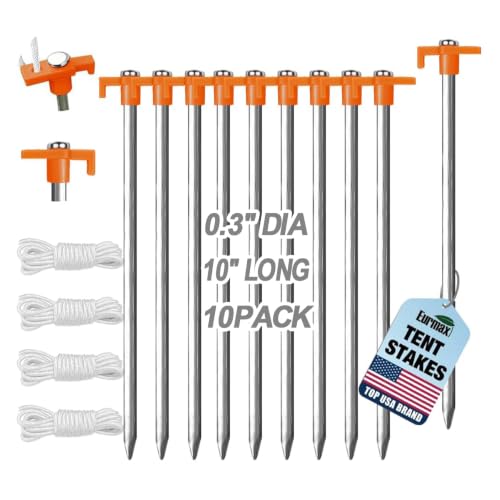
The Eurmax 10-Pack Secure Protection Galvanized Tent Stakes set is a specialized anchoring accessory designed for campers, canopy owners, and outdoor event setups. Built for securing camping tents, pop-up shelters, and gazebos, this kit targets campers who need more durable ground pegs than the thin wire stakes typically bundled with entry-level tents. With heavy-duty galvanized steel construction, it caters to car campers, backyard gazebo owners, and recreational shelter users seeking reliable tie-down support.
Each stake measures 10 inches in length, 2 inches in width, and 0.1 inches in thickness, providing a deep profile intended to anchor shelters against shifting winds. The listing highlights steel canopy anchors geared toward high winds, offering greater structural rigidity than lightweight aluminum or plastic pegs. Because of their length, these anchors penetrate deep into turf and packed dirt, helping prevent guyline slippage when guyed out properly.
Setup is straightforward thanks to the pre-cut lines and ready-to-drive design. The package provides ten commercial-grade ground pegs alongside four 10-foot ropes, eliminating the need to measure and cut auxiliary guylines at the campsite. Eurmax also includes a single high-visibility orange stopper designed to help campers spot stake placement and minimize foot-traffic tripping hazards around the perimeter of the shelter.
At 10 inches long, these steel stakes fit easily into standard gear totes, duffels, or car-camping bins. While the product listing mentions hiking along with camping and beach use, steel stakes are generally heavier than ultralight alternatives, making them most practical for drive-up campsites and vehicle transport. Routine care involves cleaning off damp soil after use and wiping the stakes dry before storage, maintaining the integrity of the galvanized rust-proof coating over multiple seasons.
Buyers should evaluate a few practical limitations and missing details. The manufacturer does not state the individual or total pack weight, which leaves backpackers uncertain about pack suitability. Additionally, while the listing includes an orange stopper for enhanced visibility, it provides only one stopper for ten stakes, meaning most anchor points will not have the bright marker. Soil compatibility is also not detailed, so shoppers pitching on rocky riverbeds or very loose beach sand may need specialized stakes suited for those surfaces.
For car campers, popup canopy owners, and family campers wanting to reinforce their shelter setup, this Eurmax 10-pack delivers practical durability and helpful accessories at an accessible price point. When evaluating ground anchors, campers should consider whether they have enough tie-down ropes for their shelter configuration and verify that 10-inch steel pegs match the soil conditions of their planned campsite.
The Eurmax anchoring set includes ten 10-inch galvanized steel stakes paired with four pre-cut 10-foot ropes. These steel pegs are engineered with a 2-inch wide hook design and 0.1-inch thickness to firmly hold guy lines under tension. The package also features an orange visibility stopper designed to reduce tripping hazards near tent corners and canopy legs.
Campers should note that securing a tent or gazebo depends heavily on proper stake angle and soil conditions. While these stakes offer rigid steel construction suitable for dirt and grass campgrounds, hardpacked gravel or loose beach sand may require specialized driving tools or sand-specific anchors.
These ground anchors are constructed from solid steel treated with a galvanized finish. This galvanized coating helps prevent rust and corrosion resulting from wet soil, morning dew, and rainfall, extending the service life of the hardware across varying weather conditions.
The rigid steel design resists bending and breaking under pressure when driven into standard campsite turf. To maintain the protective finish, users should clean away dirt and allow the stakes to dry before packing them into gear bags.
The package contains ten galvanized steel stakes, four 10-foot ropes, and one high-visibility orange stopper. The pre-cut ropes provide immediate tie-down capability for four canopy or tent guyout points without requiring additional cordage.
Because the set includes only one orange stopper across ten stakes, campers needing full-perimeter visibility markers may need to supply additional reflective tape or stoppers. A driving mallet and dedicated stake carry bag are not listed as included items.


Pros
- Heavy-duty 15-inch solid steel spiral design delivers deep anchoring for shelters in breezy conditions
- Includes both a drill adapter bit and a manual T-handle wrench for versatile setup options
- High-visibility orange powder-coated finish protects against steel corrosion and increases campsite visibility
- Supplied carry bag keeps the 5-pound hardware collection organized during vehicle transport
- Integrated top rings simplify tying off tent guylines, tensioners, or canopy tie-down straps
Cons
- Weighing roughly 5.03 pounds, the set is far too heavy for backpacking or foot travel
- Cordless drill is not included, requiring manual effort with the T-wrench if power tools are absent
- Effectiveness and driving ease in heavily rocky soil or deep loose sand are not documented
The Phopich Ground Anchor Screw-in 4-Pack is a heavy-duty anchoring accessory designed to secure camping tents, shade canopies, screen rooms, and outdoor shelters. Rather than functioning as a standalone tent, this set of four steel spiral stakes serves campers and shelter owners who require significantly more holding power than thin standard wire pegs can offer. It is particularly relevant for car campers, family groups, and festival campers setting up tall cabin tents, dining flys, or event gazebos in exposed, windy campground environments.
Each anchor measures 15 inches (38 cm) in overall length, featuring a spiral blade width of 1.6 inches (40 mm) and a blade thickness of 2.21 mm (0.087 inches). Built from powder-coated solid steel with a bright orange finish, the anchors are engineered to resist outdoor corrosion, chipping, and bending under high tension. The entire package weighs approximately 5.03 pounds and measures 15 x 4 x 2 inches. This weight profile confirms that the set is intended for vehicle transport rather than human-powered backpacking where lightweight gear is required.
The mechanical holding strength comes from the continuous spiral blade design, which bores into the earth as it turns rather than relying strictly on vertical friction. Installation can be performed in two ways depending on the equipment at your campsite. Campers can attach the included power nut driver bit to a cordless drill for rapid placement, or they can use the included manual T-handle hex wrench to screw the anchors in by hand. An integrated closed ring at the top head provides a secure tie-off point for tent guylines, cords, or tensioning straps.
Transport and campsite storage are straightforward thanks to the included zippered carry bag, which keeps the heavy metal stakes and installation tools consolidated in your trunk or gear tote. To preserve the powder-coated finish and extend the service life of the steel, campers should wipe off damp mud and allow the stakes to dry before long-term storage. Users should note that tie-down ropes and power drills are not included, so you will need your own guylines to connect your tent frame to the anchor rings.
Buyers should consider practical limitations regarding soil composition. While the spiral profile excels in typical campground turf, dirt, and loam, heavily compacted ground with buried rocks or thick tree roots can hinder manual installation and may require pre-drilling or alternate placement. The manufacturer does not provide specific pullout tension ratings or certifications for loose beach sand. Furthermore, the 5-pound total weight limits this accessory strictly to car camping and stationary shelter anchoring.
For campers setting up large family shelters, screen houses, or canopy awnings that must withstand gusty weather, the Phopich 15-inch anchor set offers a durable, reusable upgrade over standard stake kits. Shoppers should assess whether their upcoming campsites feature soil deep enough to accommodate a 15-inch anchor and ensure they bring a compatible drill or prepare for manual rotation using the supplied wrench.
Installation versatility is a notable feature of the Phopich ground anchor set. For fast setup at car campsites, campers can attach the included power nut driver bit directly into a standard cordless drill. The manufacturer states that this method allows driving an anchor into suitable soil in approximately 10 seconds per stake. When power tools are unavailable, the supplied T-handle hex wrench provides the necessary leverage to turn the full spiral blades into the ground manually.
Taking down the anchors involves reversing the rotation direction using the same power drill bit or T-handle wrench. The top ring structure allows for straightforward extraction once the threads begin backing out of the soil. After removal, users can quickly wipe off excess dirt before returning the four anchors and tools to the dedicated carry bag for vehicle transport.
These anchors are constructed from solid steel protected by an orange powder coating. This exterior coating helps guard the underlying metal against moisture, rust, and surface abrasion during outdoor use. The high-visibility orange color also assists campers in spotting the anchor heads around tent corners and guyline perimeters to reduce tripping risks.
Structurally, each anchor measures 15 inches (38 cm) long with a 1.6-inch (40 mm) wide spiral blade and a 2.21 mm (0.087-inch) blade thickness. The continuous helical blade design is intended to grip surrounding soil firmly to resist vertical uplift under wind tension. A welded top ring provides a sturdy attachment point capable of holding carabiners, guylines, or ratchet straps.
The Phopich package contains four 15-inch spiral screw-in steel ground anchors, one power nut driver drill bit, one T-handle hex wrench, and one protective carry bag. The entire kit weighs approximately 5.03 pounds and packs down to dimensions of 15 x 4 x 2 inches.
Campers should keep in mind that the kit does not include a cordless drill, guyline ropes, carabiners, or tensioners. Buyers must supply their own tent tie-downs to connect the anchor rings to their camping tents, canopies, or shade shelters.
Essential Knots, Angles, and Methods for Securing Tent Stakes
Securing a camping shelter against variable weather begins with knowing how cordage and ground hardware interact under tension. Understanding how to tie a tent stake correctly ensures your shelter maintains its intended structure even when sudden wind gusts test every guy-out point. Whether you are rigging lightweight backpacking pegs or heavy-duty galvanized stakes, the right knot and anchor angle work together to distribute force safely into the earth.
Understanding Guyline Mechanics and Ground Peg Angles
Guy lines work as tension members that oppose tent pole flex and prevent the rainfly from resting against the canopy. When wind pushes against a broad fabric wall, kinetic force travels down the guyline directly to the anchor stake. If the connection slips, the tent wall collapses inward and exposes the frame to severe bending forces. Maintaining a balanced anchoring perimeter keeps the shelter stable and preserves essential ventilation channels.
The angle at which you drive a tent stake into the soil determines its holding capability under load. Best outdoor practice dictates driving the stake at approximately a forty-five-degree angle pointing away from the tent body. This orientation creates an opposing vector where the guyline pulls against the broad shaft rather than along its length. Driving a stake straight down or angling it toward the tent drastically reduces holding power.
The Most Reliable Knots for Tying and Tensioning Tent Stakes
The taut-line hitch remains the standard knot for tying guy lines to ground stakes because it creates an adjustable friction loop. This hitch grips firmly under tension yet slides smoothly by hand when adjusting line tension. To tie a taut-line hitch, wrap the running end around the stake and bring it back along the standing line. Make two turns inside the loop toward the stake, then finish with one half hitch outside the loop.
Two half-hitches offer a dependable solution when you need a fixed loop that will not slip under heavy stress. This knot functions well when securing a line around a stake notch where tension adjustments happen at the tent body via a runner. Tie two half-hitches by wrapping the cord around the stake neck, passing through the loop, and repeating the wrap in the same direction. The finished knot binds tightly and resists jamming during campsite takedown.
The trucker’s hitch provides mechanical advantage when securing large family tents, rain canopies, or vestibules in exposed campsites. By forming an inline slip loop on the standing line, you create an improvised pulley system through which the running end passes. Pulling the tag end through this loop doubles your mechanical pulling force, establishing firm line tension without straining your hands. Once the line reaches proper tension, finish with two half-hitches for rapid release when packing camp.
Step-by-Step Procedure for Securing Lines to Ground Pegs
Begin by inspecting the guy-out point on your rainfly to confirm the cord is securely anchored to the reinforced fabric tab. Uncoil the guyline outward in a straight line that aligns directly with the seam line of the tent panel. Position your stake approximately four to six feet from the tent base, leaving adequate length on the cord for friction knots. Driving the stake at this distance establishes a low pulling angle that maximizes holding strength.
Drive the stake firmly into the earth using a rubber mallet until only the top hook remains visible above the surface. Leaving several inches of stake exposed above ground creates a lever arm that increases torque, making it easier for wind to dislodge the peg. Loop the running end of your guyline around the neck of the stake, ensuring the rope sits underneath the downward-facing hook. If you use pre-cut cords with loops, slip the loop over the hook before adjusting line tension.
Slide your taut-line hitch or tensioning knot toward the tent to pull out all remaining slack from the cord. The rainfly should pull taut without creating sharp wrinkles along the stitching or distorting the pole geometry. Walk around the perimeter to verify that the guyline is not rubbing against sharp rocks that could fray the fibers. Giving the line a gentle downward pluck should produce a firm resonance that confirms sufficient anchoring tension.
Managing Guyline Tension Across Shifting Weather Conditions
Temperature fluctuations, humidity changes, and rainfall cause tent fabrics and guy ropes to expand and contract throughout the day. Standard nylon guylines naturally absorb moisture and can stretch during steady downpours, causing once-taut lines to sag against the canopy. When setting up easy-setup outdoor shelters, monitoring your guyline tension after rain ensures your rainfly maintains proper clearance from the inner mesh. Sagging fly fabric allows condensation to transfer inside and diminishes wind resistance.
Periodic adjustments throughout a multiday trip keep your staking system functioning at peak efficiency. Inspect your guy lines before turning in for the night and give adjustable hitches a quick slide to restore firm tension across the perimeter. If strong winds pick up during the night, avoid over-tightening lines beyond reasonable limits, as excessive tension can tear webbing loops. Balanced tension should feel firm and supportive, distributing the environmental load across multiple ground points.
Dry sunny conditions present the opposite dynamic as sun exposure warms synthetic fibers and causes cords to tighten naturally. Releasing slight tension on hot afternoons prevents continuous stress on tent seams and guy-out reinforcements. Keeping an eye on soil conditions is equally critical, since baked clay can crack and loosen its grip on smooth stakes after rapid drying. Taking a moment to inspect your pegs and hitches each morning ensures your tent remains structurally sound.
Connecting Cords to Different Peg and Anchor Designs
Standard galvanized steel stakes with curved shepherd hooks, such as the Eurmax USA 10-Pack Secure Protection Galvanized pegs, require precise knot placement under the hook. Always loop the guyline around the main shaft so the pull pulls directly into the interior bend of the hook rather than sliding off the tip. If the soil forces you to drive the stake slightly shallow, wrap the line twice around the shaft near ground level. This clove hitch wrap transfers pulling force to the base, reducing leverage against the upper hook.
Heavy-duty drill-in or hex-head awning stakes, exemplified by the HORUSDY 20 Pack 20CM / 8-Inch Heavy Duty Tent set, feature thick seven-millimeter shafts and welded collars designed for tough ground. When tying off to these substantial pegs, running your guyline beneath the welded stop collar prevents the cord from slipping up the shaft in gusty winds. The included ropes in such kits pair smoothly with taut-line hitches, providing ample length for wide anchoring triangles on gravel. Using a hex driver to seat these stakes flush creates an anchor point that holds tension reliably.
Spiral screw ground anchors, including the Phopich Ground Anchor Screw design, utilize full spiral blades and top welded rings that require a dedicated tie-off method. Because these anchors seat deep into dirt and terminate in a closed loop, you can pass your guyline directly through the top ring to create a secure running loop. Tying a bowline or two half-hitches directly onto the anchor ring ensures the rope cannot jump off the hardware during wind shifts. Spiral designs excel in loose sandy soils where traditional smooth stakes fail to gain sufficient friction.
Staking in Rocky, Sandy, and Difficult Campsite Soils
Setting up camp on rocky riverbeds or hard mountain soil often prevents driving stakes to their full depth. When a metal peg hits bedrock halfway down, never force it with a heavy sledge, as bending the steel weakens the anchor point. Instead, tie your guyline directly to the base of the partially driven stake using a clove hitch at the soil line, and place a heavy boulder over the peg. This deadman anchoring principle anchors the stake horizontally and prevents lateral movement without relying solely on ground penetration.
Camping on coastal sand or loose snow presents the opposite challenge where smooth metal stakes easily pull out under minimal line tension. In loose substrate, you can tie your guyline securely around the center of a stake and bury it horizontally ten to twelve inches deep. Pack the sand or snow firmly on top of the buried object to create a broad surface area that resists upward pull. For spacious outdoor tents with tall profiles and broad rainfly surfaces, this buried deadman method provides vastly superior stability compared to vertical staking.
When anchoring in loose gravel or fractured shale where individual stakes feel unstable, consider using a double-stake rigging system. Drive two stakes side by side approximately six inches apart, both angled at forty-five degrees away from the tent. Run your guyline around both stakes before tying your adjustable hitch, effectively dividing the pulling load across two separate ground points. This redundant anchoring approach keeps guylines securely anchored even in soft meadow turf after hours of saturating rain.
Avoiding Frequent Pitching Errors and Line Damage
One of the most widespread errors campers make is tying friction knots too close to the ground stake, leaving zero room along the standing line for adjustment. Always position your taut-line hitch or friction slider roughly midway between the tent guy-out tab and the stake. Leaving two to three feet of exposed standing line allows you to slide the knot upward as the cord stretches or downward to relieve tension. If the knot is jammed against the peg head, adjusting line tension requires untying and completely re-rigging the cordage.
Another frequent pitfall is tying guylines at awkward angles that work against the tent’s built-in frame architecture. Guylines should extend directly in line with the roof seams or pole arcs they are meant to support, pulling the fabric outward rather than twisting it sideways. Angling a guyline sharply to the left or right pulls the tent poles off-center, creating uneven stress points that can warp ferrules and distort door zippers. Stepping back to check that each line projects outward symmetrically preserves the structural harmony intended by the tent designer.
Using overly complex or permanent knots like square knots or multiple overhand tangles makes campsite takedown frustrating and damages cord fibers over time. When knots bind tightly under tension and absorb rainwater, untying them with cold fingers often leads campers to use sharp tools, ruining their lines. Sticking to proven hitches like the taut-line, trucker’s hitch, or two half-hitches guarantees that the line can be released quickly without damaging the nylon sheath. Inspecting your cords for frayed spots before departure avoids sudden snaps when high winds arrive.
Perimeter Safety, Line Visibility, and Hardware Care
Low-hanging guylines stretched across a campsite present a major tripping hazard, especially around door vestibules and high-traffic pathways after dark. Using bright orange cord stoppers, reflective tracer lines, or high-visibility flag tape tied to the cords prevents stumbling campers from pulling stakes out of the ground. The bright stoppers included with multi-piece canopy stake kits provide an effective visual marker that catches flashlight beams and keeps walkways safe for everyone. Placing a glow stick or reflective ribbon near perimeter guy-outs protects both your fellow campers and your tent frame from accidental collisions.
Proper care and cleaning of your stakes and guy ropes extends their usable lifespan across many seasons of rugged outdoor travel. When pulling stakes from muddy ground, use a dedicated T-pull hook or another stake rather than yanking hard on the guyline cord itself, which can slice through the rope sheath. Wipe wet soil, clay, and pine sap from steel and aluminum stakes before storing them in your gear sack to prevent corrosion. Keeping ropes coiled neatly in loose figure-eight bundles prevents frustrating knots and tangled messes when you arrive at your next campsite.
Performing a quick perimeter walk before turning in and after waking up ensures your shelter stays safe, stable, and ready for whatever weather brings. Checking each stake angle, confirming friction hitches are snug, and clearing debris from your lines takes only a minute and delivers dependable peace of mind. When your guy lines are tied off with precision, your tent maintains optimal airflow, resists heavy wind, and provides the secure sanctuary every camper counts on.


Write Your Review
No reviews yet. Be the first to share your experience!