

Securing a shelter against sudden wind gusts requires more than simply pushing metal pins into the soil. Campers often struggle with loose cords, shifting corners, and bent hardware when stormy weather tests their campsite layout. Learning how to tie down tent stakes creates an anchored foundation that preserves structural stability and keeps rain protection intact throughout the night. A properly tensioned shelter shields gear effectively and prevents pole damage during unexpected afternoon squalls.
Different soil conditions demand specific anchor angles and knot techniques to maintain holding power. Matching your cordage and pegs to the terrain allows you to adapt whether you camp on rocky dirt, soft forest loam, or hard-packed clay. Setting up a durable weather-resistant camping tent relies heavily on balanced perimeter anchoring to stop moisture pooling on outer fabrics. Mastering these basic outdoor rigging skills gives you confidence regardless of changing wilderness conditions.
Pros
- Galvanized steel construction offers reliable rigidity and protection against rust in wet ground
- Substantial 10-inch length provides deeper ground penetration than standard wire pegs
- Includes four pre-measured 10-foot ropes ready for immediate guying out
- High-visibility orange stopper helps mark stake placement near high-traffic paths
Cons
- Individual and total pack weight are not specified, making pack-weight calculations difficult for backpackers
- Package includes only one visibility stopper for ten stakes, leaving the remaining nine unmarked
- Listing does not detail holding performance across specific soil conditions such as loose sand or solid rock
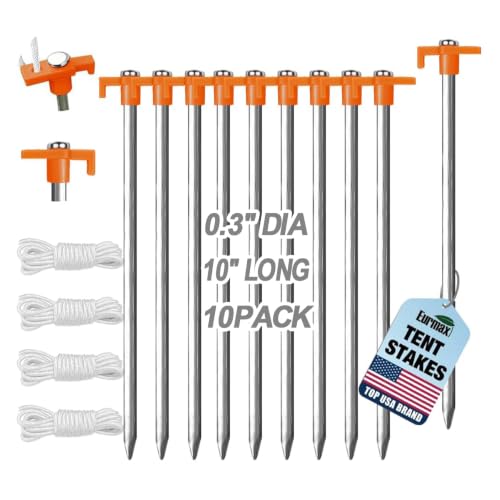
The Eurmax 10-Pack Secure Protection Galvanized Tent Stakes set is a specialized anchoring accessory designed for campers, canopy owners, and outdoor event setups. Built for securing camping tents, pop-up shelters, and gazebos, this kit targets campers who need more durable ground pegs than the thin wire stakes typically bundled with entry-level tents. With heavy-duty galvanized steel construction, it caters to car campers, backyard gazebo owners, and recreational shelter users seeking reliable tie-down support.
Each stake measures 10 inches in length, 2 inches in width, and 0.1 inches in thickness, providing a deep profile intended to anchor shelters against shifting winds. The listing highlights steel canopy anchors geared toward high winds, offering greater structural rigidity than lightweight aluminum or plastic pegs. Because of their length, these anchors penetrate deep into turf and packed dirt, helping prevent guyline slippage when guyed out properly.
Setup is straightforward thanks to the pre-cut lines and ready-to-drive design. The package provides ten commercial-grade ground pegs alongside four 10-foot ropes, eliminating the need to measure and cut auxiliary guylines at the campsite. Eurmax also includes a single high-visibility orange stopper designed to help campers spot stake placement and minimize foot-traffic tripping hazards around the perimeter of the shelter.
At 10 inches long, these steel stakes fit easily into standard gear totes, duffels, or car-camping bins. While the product listing mentions hiking along with camping and beach use, steel stakes are generally heavier than ultralight alternatives, making them most practical for drive-up campsites and vehicle transport. Routine care involves cleaning off damp soil after use and wiping the stakes dry before storage, maintaining the integrity of the galvanized rust-proof coating over multiple seasons.
Buyers should evaluate a few practical limitations and missing details. The manufacturer does not state the individual or total pack weight, which leaves backpackers uncertain about pack suitability. Additionally, while the listing includes an orange stopper for enhanced visibility, it provides only one stopper for ten stakes, meaning most anchor points will not have the bright marker. Soil compatibility is also not detailed, so shoppers pitching on rocky riverbeds or very loose beach sand may need specialized stakes suited for those surfaces.
For car campers, popup canopy owners, and family campers wanting to reinforce their shelter setup, this Eurmax 10-pack delivers practical durability and helpful accessories at an accessible price point. When evaluating ground anchors, campers should consider whether they have enough tie-down ropes for their shelter configuration and verify that 10-inch steel pegs match the soil conditions of their planned campsite.
The Eurmax anchoring set includes ten 10-inch galvanized steel stakes paired with four pre-cut 10-foot ropes. These steel pegs are engineered with a 2-inch wide hook design and 0.1-inch thickness to firmly hold guy lines under tension. The package also features an orange visibility stopper designed to reduce tripping hazards near tent corners and canopy legs.
Campers should note that securing a tent or gazebo depends heavily on proper stake angle and soil conditions. While these stakes offer rigid steel construction suitable for dirt and grass campgrounds, hardpacked gravel or loose beach sand may require specialized driving tools or sand-specific anchors.
These ground anchors are constructed from solid steel treated with a galvanized finish. This galvanized coating helps prevent rust and corrosion resulting from wet soil, morning dew, and rainfall, extending the service life of the hardware across varying weather conditions.
The rigid steel design resists bending and breaking under pressure when driven into standard campsite turf. To maintain the protective finish, users should clean away dirt and allow the stakes to dry before packing them into gear bags.
The package contains ten galvanized steel stakes, four 10-foot ropes, and one high-visibility orange stopper. The pre-cut ropes provide immediate tie-down capability for four canopy or tent guyout points without requiring additional cordage.
Because the set includes only one orange stopper across ten stakes, campers needing full-perimeter visibility markers may need to supply additional reflective tape or stoppers. A driving mallet and dedicated stake carry bag are not listed as included items.

Pros
- Galvanized carbon-steel construction resists bending under driving pressure and offers moisture resistance.
- Threaded shaft provides mechanical grip in challenging substrates like hard soil, gravel, and packed dirt.
- Includes a dedicated hex driver socket and organized storage case in the package.
- High-visibility orange accents make the stake heads easier to locate and avoid around the campsite.
Cons
- Requires carrying a separate cordless power tool or manual socket tool to drive the hex head efficiently.
- The 8-inch length and heavy carbon-steel build add noticeable weight compared to lightweight backpacking stakes, making them best suited for vehicle-supported camping.
- The listing specifications present an inconsistent thickness measurement, leaving the exact shaft diameter uncertain.
The x-vesolje 8-Inch Heavy Duty Screw-in Tent Stakes set is a specialized anchoring accessory designed to replace or upgrade standard ground pegs for camping tents, canopies, awnings, and rain tarps. Because these metal stakes feature a threaded shaft meant to be driven with a cordless drill or impact driver, they primarily suit car campers, RV travelers, and event setups where packing power tools is convenient. Campers dealing with hard-packed campground soil, gravelly tent pads, or frozen ground often struggle with standard hammer-in stakes bending, making drill-assisted hardware an appealing alternative.
Each stake measures 8 inches long, providing substantial depth for guylines on family cabin tents, dome tents, and pop-up shade shelters. The manufacturer highlights effectiveness across a wide range of surfaces, including grass, dirt, hard soil, gravel, sand, and snow. For large shelters exposed to wind, threaded metal spikes provide strong mechanical grip compared to smooth wire pegs. However, shoppers should keep in mind that while the stakes can grip loose or loose-packed terrain like sand or snow, conditions vary widely and proper guyline tension remains critical for shelter stability.
Pitching a tent with these stakes relies on mechanical leverage rather than swinging a camp mallet. The kit includes a matching hexagonal head socket that chucks directly into a standard power drill or impact driver. Threading the stakes into the earth reduces physical effort and minimizes the shock damage that often deforms conventional pegs when hammering into rocky substrate. The orange molded tops provide connection points for tent guylines and staking loops while increasing ground-level visibility to help campers avoid tripping.
Transporting 12 steel stakes is simplified by the included dedicated storage case, which prevents the threaded metal shafts from scratching other gear inside a vehicle trunk or camp tote. While the portable carrying case keeps all pieces organized alongside the hex driver bit, the carbon-steel construction means this kit carries substantial weight. This makes it an excellent choice for vehicle-based camping, car camping, and festival setups, but impractical for weight-conscious human-powered transport such as backpacking or bikepacking.
A practical limitation is the dependency on auxiliary equipment: campers must remember to pack a charged cordless drill or compatible manual driver to install and extract them easily. In addition, the manufacturer specifications contain a confusing thickness measurement of 0.039 inches alongside a 0.3-inch width figure, creating uncertainty about the exact shaft diameter. While the galvanized coating provides corrosion resistance against moisture and rain, prolonged damp storage should still be avoided to maintain hardware integrity over time.
For campers who regularly pitch large cabin tents, screen rooms, or awnings in tough ground conditions, the x-vesolje screw-in stake kit offers a reliable upgrade over basic bundled wire pegs. Buyers evaluating alternatives should consider whether their camping style allows carrying a cordless drill and whether an 8-inch threaded carbon-steel anchor matches their shelter size. For vehicle-supported campers seeking straightforward anchoring without bent stakes, this 12-pack provides a functional, organized kit.
The package contains 12 heavy-duty carbon-steel screw-in tent stakes designed with threaded shafts for mechanical anchoring.
A dedicated hexagonal head socket is included to allow compatibility with standard cordless drills or impact drivers.
The set also includes a compact storage case designed to keep the stakes and drive bit neatly contained during transport.
These ground anchors are constructed from heavy-duty carbon steel to withstand torsional stress and ground resistance without bending or breaking during installation.
The exterior features a galvanized surface coating engineered to resist rust and corrosion when exposed to outdoor moisture, wet soil, and rain.
Integrated high-visibility orange heads offer attachment points for shelter guylines while helping to minimize tripping hazards around the perimeter of your campsite.
Mastering Guyline Tension and Tent Stake Anchoring
A reliable tent pitch depends on balanced tension between the flexible poles, the fabric body, and the ground beneath. Driving metal pins directly straight down into the dirt creates a weak anchor point that pulls free under light cord tension. Campers must align the angle of each peg against the pull direction of the cordage to maximize subterranean friction. This fundamental mechanical balance prevents sudden shelter collapses and keeps the shelter taut during stormy nights.
Understanding Ground Resistance and Peg Angles
The holding strength of any ground peg relies directly on soil friction and structural resistance. Driving a pin at an angle of roughly forty-five degrees sloping away from the tent provides the strongest resistance against upward guyline force. A perpendicular stake creates a sharp fulcrum where cord pull quickly loosens the surrounding soil bed. Angling the peg backward forces the guyline tension to pull directly against a broader volume of compact earth.
Soil consistency dictates how deep you must drive hardware to establish a solid hold. Loose topsoil often requires deeper penetration to reach the denser, undisturbed dirt beneath forest litter. In contrast, hard-packed earth or gravel pads offer high resistance near the surface but risk bending softer metals during placement. Checking the depth and resistance as you drive each peg ensures you do not deform the hardware before tying off the lines.
Leaving several inches of metal exposed above the ground creates unnecessary leverage that increases failure risks. Long lever arms allow gusting winds to rock the anchor back and forth until the hole widens. You should sink the peg until only the attachment head or notch rests just above ground level. This low positioning minimizes tripping hazards and ensures the guyline pulls flush against the strongest section of the shaft.
Core Rigging Knots for Guylines and Stakes
Adjustable tension knots form the foundation of dependable outdoor rigging without relying on plastic hardware. The taut-line hitch remains one of the most practical friction hitches for outdoor cordage because it slides smoothly to adjust line tension yet grips under strain. To tie it, wrap the working end inside the loop twice toward the anchor, then finish with a single half hitch outside the loop toward the shelter. This knot allows campers to tighten sagging guylines after nighttime temperature drops without pulling the peg out of the ground.
The trucker hitch provides mechanical advantage when securing large canopies or broad rainfly panels against stiff breezes. This knot incorporates an in-line slip loop that acts as a simple pulley for doubling your pulling leverage. Passing the working end around the ground pin and through the loop allows you to tighten lines firmly before locking them off with two half hitches. Anchoring large rainflies requires consistent tension, especially when pitching a spacious outdoor tent that presents a broad surface area to incoming gusts.
A fixed loop such as the bowline provides an unyielding connection point when securing cord directly to corner webbing loops. Unlike slip knots, a properly tied bowline retains its structural shape and will not jam under heavy wind loading. Campers frequently use the bowline at the upper shelter attachment point while reserving adjustable friction hitches for the ground anchor end. Knowing both fixed and adjustable knots ensures you can build a stable rigging system even if pre-attached tensioning sliders crack or fail.
The clove hitch serves as a fast method for locking a continuous cord around the middle of an anchor or timber pole. It holds well when sustained tension pulls equally from both directions, though it can slip on smooth metal surfaces if tension slacks completely. For added reliability on steel stakes, finishing the clove hitch with an extra half hitch locks the working end securely. Practicing these cordage patterns at home ensures fast and frustration-free pitching when arriving at camp in fading daylight.
Step-by-Step Procedure for Securing Pegs and Lines
Begin by staking the four corners of the shelter floor before assembling or raising the central pole structure. Pull the floor fabric taut in an alternating diagonal pattern to ensure a square and wrinkle-free floor plan. Insert the corner stakes through the grommets or webbing loops at the recommended backward angle, tapping them firmly into the substrate. Establishing a tight, square base prevents the tent body from twisting or sliding while you raise the canopy poles.
Once the main tent frame stands upright, attach the waterproof rainfly and extend all perimeter guylines outward along the seam lines. Guylines should extend in a straight path from the reinforced stitching points to maintain balanced structural support across the frame. Walk the line out approximately four to six feet from the tent perimeter to establish an optimal pulling trajectory. Driving the ground anchor at this extended distance prevents the line from lifting upward on the frame during crosswinds.
Loop your cordage around the stake head below the retention hook or notched stopper before taking up slack. Slide your adjustable hitch or tension slider toward the shelter until the cord feels springy and firm under light finger pressure. Avoid overtightening single lines, because excessive force can distort the pole curvature and pull seams out of alignment. Balance tension evenly across opposite sides of the structure to maintain symmetrical pole architecture in changing weather.
Hardware Styles and Ground Compatibility
Different stake profiles offer distinct mechanical advantages depending on soil structure and campsite conditions. Straight galvanized steel pegs, such as the Eurmax USA 10-Pack Secure Protection Galvanized model, feature rust-resistant steel construction designed to resist bending in firm soil. The inclusion of high-visibility components, such as bright orange stoppers, helps prevent painful campsite trips while marking peg positions clearly. Having pre-cut ten-foot ropes included with straight peg sets simplifies establishing extended guyline perimeters without searching for extra cord.
Rocky dirt, compacted gravel pads, and dry clay often resist manual mallet strikes, causing smooth pins to bounce or deflect. Threaded screw ground anchors, exemplified by the 8″ Heavy Duty Screw in Tent Stakes 12 Pack Drill set, use carbon steel threads that bite into dense substrates. Using a cordless drill with a dedicated hexagonal head socket drives these screw anchors quickly into hard earth with minimal physical exertion. The threaded design increases surface contact area within hard ground, offering substantial holding power for large shelters and tarps.
Carrying a combination of straight galvanized pins and threaded screw anchors prepares campers for diverse regional campsite surfaces. Soft grassy parks allow traditional straight pins to sink quickly and grip soil through clean lateral friction. Hard-packed backcountry sites or developed gravel recreation pads reward drillable threaded hardware that penetrates rocky layers without bending shafts. Evaluating your expected campsite terrain helps you pack an anchor kit that balances weight, installation speed, and holding strength.
Adapting Tie-Downs for Sand, Snow, and Rocky Soil
Sand and deep powdery snow offer minimal resistance for conventional narrow wire or straight steel pegs. Standard pins slice easily through loose grains whenever moderate wind tension pulls against the upper guyline loop. In loose sand, campers can bury specialized wide sand stakes or create deadman anchors using wrapped sticks, rocks, or stuff sacks. Sinking an anchor horizontally twelve to eighteen inches below the surface distributes tension across a massive column of sand or snow.
Extremely rocky ground presents the opposite problem by blocking deep vertical or angled stake penetration entirely. When metal anchors hit solid subterranean ledge rock after only an inch or two, you must rely on campsite ballast techniques. Drive the peg as deeply as safely possible, then secure the exposed shaft by piling heavy boulders across the base. Positioning a heavy rock directly over the peg prevents upward leverage from dislodging the tip under heavy shelter movement.
Waterlogged soil following prolonged torrential downpours loses structural coherence and can cause ground anchors to slide loose unexpectedly. When soil turns soupy, doubling up your stakes provides an effective field solution to restore holding capacity. Drive a primary stake at forty-five degrees, then sink a second backup stake directly behind it in the line of pull. Tying the heads of the two stakes together with a short cord loops their holding strength and resists soil slippage.
Managing Line Tension and Wind Buffeting
Wind forces exert variable, pulsing dynamic loads on shelter fabric rather than static, predictable pressure. A taut rainfly sheds incoming wind gusts smoothly, deflecting airflow over the aerodynamic curve of the pole frame. If guylines slacken, fluttering fabric catches wind like a sail, multiplying strain on seam stitching and pole joints. Inspecting your line tension shortly before sleeping ensures your shelter maintains the rigidity required to endure nighttime squalls.
Cordage materials behave differently when exposed to nocturnal temperature drops and elevated ambient humidity. Nylon lines possess natural elasticity that cushions shock loads, but they absorb water and stretch noticeably when damp. Polyester cordage stretches far less under load and holds tension consistently through heavy rain and cold nights. Checking and tightening your friction hitches as evening dew settles maintains proper canopy spacing and prevents fly fabric from touching inner tent walls.
Proper tension also plays a vital role in moisture management and active tent ventilation. A sagging rainfly clings to the breathable inner mesh canopy, transferring condensation directly onto sleeping bags and gear. Firmly tensioned guylines pull rainfly vestibules away from the main tent body, creating open airflow channels at the perimeter. This steady circulation allows warm, humid air to escape while keeping external precipitation safely diverted away from interior living space.
Campsite Safety and Anchor Maintenance
Tensioned guylines and low-profile metal stakes pose significant tripping hazards around camp after the sun goes down. High-visibility accessories, such as reflective cord tracers or bright orange stake stoppers, make peg locations easy to identify with headlamps. Marking anchor lines with colorful trail flags or placing inverted cups over stake heads alerts campsite occupants to low-lying lines. Taking a few moments to illuminate anchor zones prevents painful nighttime stumbles and protects your shelter from accidental dislodgment.
Removing stakes requires deliberate technique to preserve the structural integrity of your hardware. Pulling a peg outward by yanking on the attached guyline can fray cordage fibers or snap tension sliders under sudden force. Use a stake puller, the claw of a camp mallet, or another spare stake hooked beneath the notch to lift anchors straight along their entry angle. Pulling along the angle of insertion minimizes resistance and stops thin metal shafts from bending against stubborn rocks.
Routine maintenance extends the usable life of both standard steel pegs and carbon steel threaded anchors. Wipe dirt, mud, and moisture off all metal surfaces before packing hardware away into protective storage cases. Galvanized coatings help resist rust, but storing damp stakes in sealed bags can promote oxidation over long seasonal storage breaks. Inspect your ropes and hitch loops regularly for frayed sheaths, replacing worn cords promptly so your tie-down system remains dependable on every outdoor trip.
Practicing proper anchoring mechanics transforms a vulnerable shelter into a secure outdoor living space capable of handling unsettled mountain weather. Aligning stakes at correct backward angles, mastering versatile friction hitches, and choosing hardware suitable for the ground surface ensures lasting reliability. Regularly inspecting your guyline tension and maintaining clean gear prevents unexpected failures during rough camping trips. Investing care into each anchor point gives you complete peace of mind so you can focus entirely on enjoying your wilderness journey.


Write Your Review
No reviews yet. Be the first to share your experience!